“Midnight in Paris” is the latest production written and directed by Woody Allen. A young couple, portrayed by Owen Wilson and Rachel McAdams, travels to Paris on the eve of their wedding. As Owen’s character falls in love with the city, the movie takes an unexpected turn, exploring a nostalgic – and at times over-idealized – fantasy that a life different from ours would be much better. The opening sequence of the movie, with the camera lingering lazily on stunning Parisian vistas, sets the visual tone for the entire movie, with fantastic performances from a star-studded cast.
Anne Seibel is responsible for the flawlessly executed production design of the movie. Over the last couple of decades she has worked on numerous productions, from “Marie Antoinette” to “Munich”, from “Swordfish” to “The Happening”. I am quite delighted that Anne has agreed to answer a few questions I had about her work on the movie and her craft in general.
 Kirill: Can you tell us a little bit about yourself and your background?
Anne: I studied in an architecture school, and I always liked doing art props for dance shows and family productions. My family was not in the movie business, but rather in science and medicine, and I went to study architecture. One day a friend of my parents offered to take me to a movie set, and I was very curious to see what happens during the shoot. There I realized there was an entire team of people doing what I was doing at home – making the sets – and it attracted me. I realized that with my background in architecture I can be part of such a team.
After finishing the school I had a chance encounter with someone working in the movie business, and when he asked me what I wanted to do, I told him that I wanted to do sets for movies. He offered me a job to draw a few sets for the fund-raising presentation. After working there and meeting a few people I have decided to call ten best designers in France to get an assistant position.
And then one day, I met a big designer named Serge Douy at the bar and he told me that he has a small job to mirror an english crew coming to Paris to film a movie, and he needs someone who speaks english. I asked which movie was that, and he said that it’s a James Bond movie – and I screamed inside my head.
Kirill: And that was “A View to a Kill” in 1985?
Anne: Exactly. That was my opportunity to start working on english-speaking american productions. I made friends with set decorator Jille Azis whom I was mirroring, and I went with her to her next movie, “The Living Daylights” which was shot in Morocco with a french speaking crew. From there I continued working first as an assistant art director, and later as an art director, on additional productions that came to France. I also did french movies as additional education with great designers, most of whom are now gone. And as time went, I learned my skill from great production designers that I worked with.
Kirill: What are your impressions working on american movies shot in Europe?
Anne: Sometimes I am hired as an art director to recreate the Paris parts of the movie outside France itself, in Budapest or Prague, for example. This happened on “G.I. Joe” with Ed Verreaux and “Munich” with Rick Carter. On other movies, such as “Rush Hour” or other scenes in “Munich” I work in France. Even “Marie Antoinette” is an american movie, even though it is about french history. I worked with K.K. Barrett as a supervising art director, and it goes very deep into the local history and culture, which might be difficult for an American to understand in detail – same as it would be difficult for me to research and recreate New York or London, more difficult because it’s not in my blood.
We were doing “Munich” with the production designer Rick Carter in Paris, and for financial reasons some parts were shot later in Budapest. At first I thought that I would not be doing those parts, but he called me and asked me to join him in Budapest to continue the work, and it was fantastic.
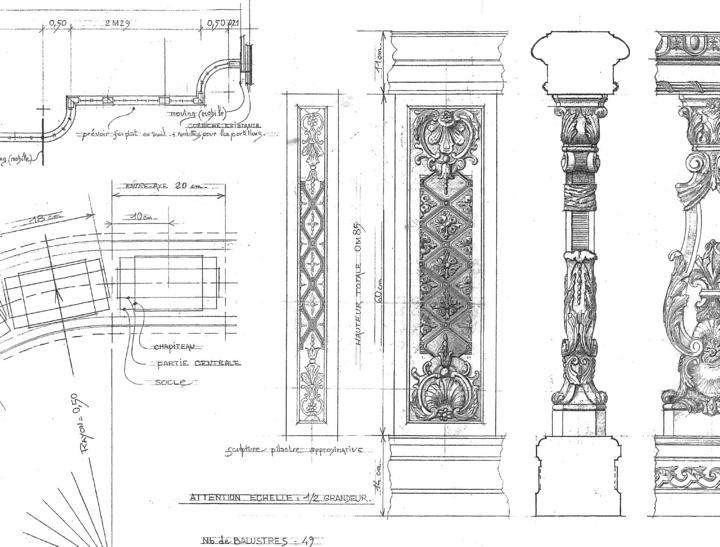
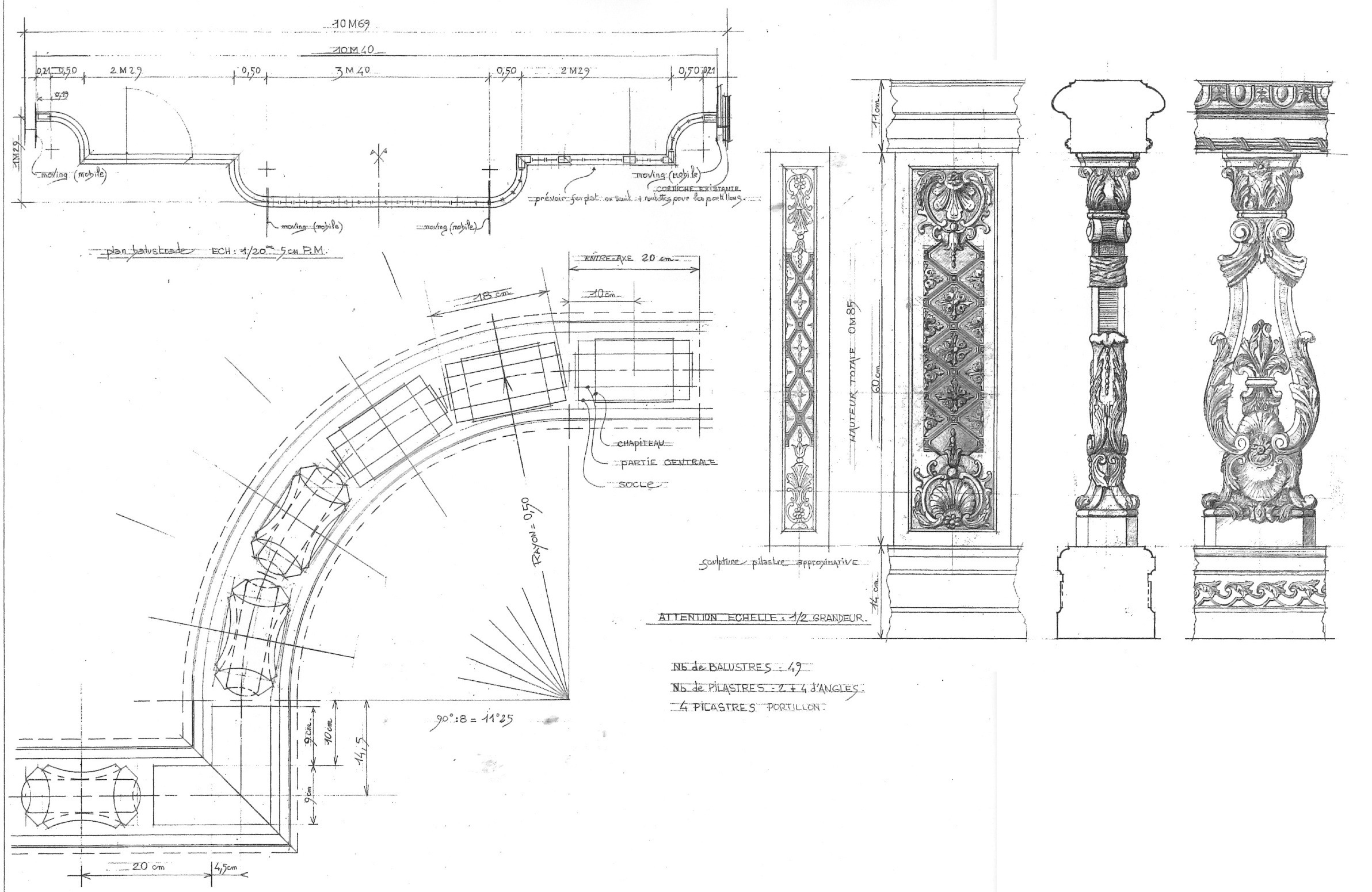
Marie Antoinette, detailed bedroom plan. Click to see fullsize image.
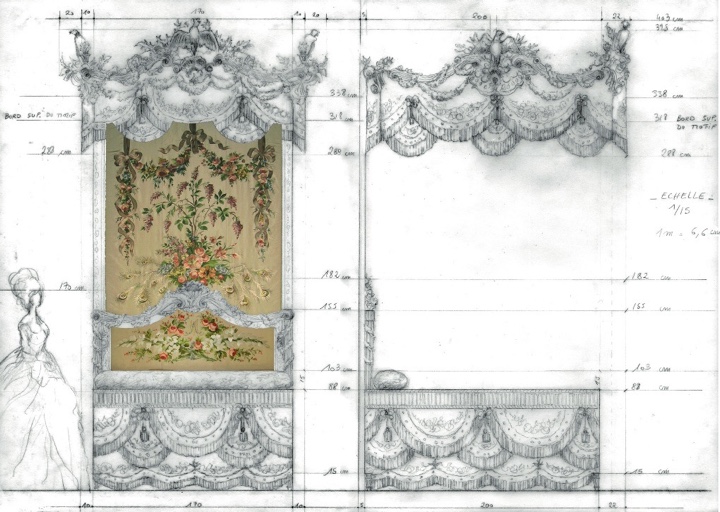
Marie Antoinette, detailed bedroom drawing.
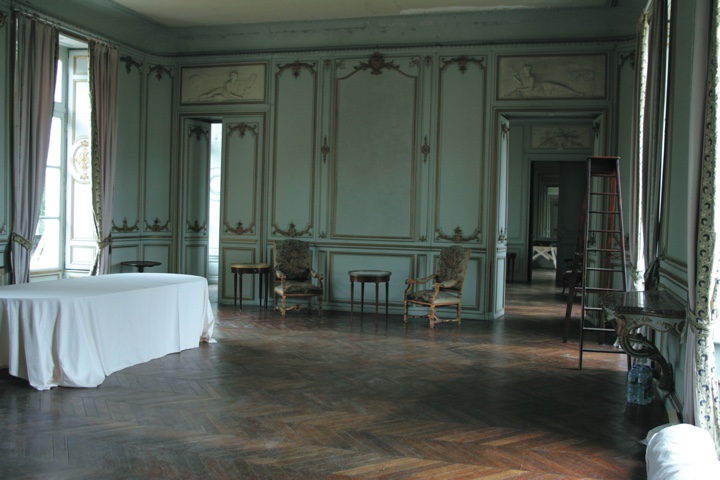
Marie Antoinette, bedroom location before decoration.
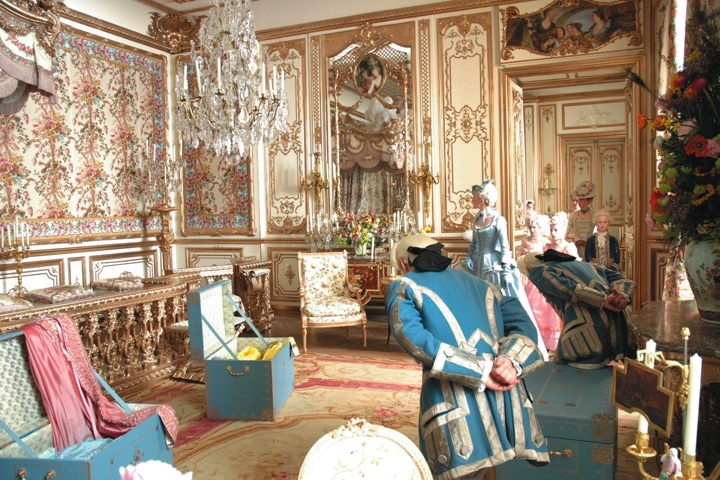
Marie Antoinette, bedroom location after decoration.
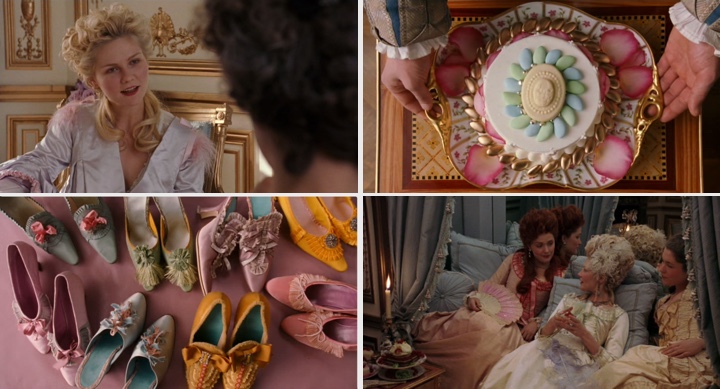
Marie Antoinette, final stills.
Kirill: I was just recently watching “Marie Antoinette” again, and it is so unbelievably rich in color, texture and incredibly lush set decorations. How did it go on your side?
Anne: It’s one of my best memories. It was such a nice and warm vibe working with Sofia Coppola. I did a lot of research, and had a real thrill doing all the construction. It was such a pleasure to go into the smallest details reproducing Versailles, to see how it was done – a really good way of learning history, better than at school. It was fantastic to go to Versailles, to meet the people who maintain the gardens and to talk with historians. I met this completely mad woman who is collecting everything about Marie Antoinette, and it was really incredible to see some of the pieces. It’s a really interesting part of our job to do the research, to put yourself in a different period.
We also spent a lot of time on small details. For example, we made extensive camera tests to find the right color of the gold. We didn’t want it to be too pink or too green, and you might not have noticed it, but it does not feel cold. We looked very carefully at colors and fabrics, and how they reproduced on the screen.
Kirill: This brings me to your latest movie, “Midnight In Paris”. It also has a very stylish look from the very first opening sequence. As the production designer of this movie, what was the initial exploration stage between you, the cinematographer and the director?
Anne: Woody Allen movies are different. The very first thing they told me during the interview – no construction, as Woody does not spend more the 10 million dollars per movie. With such a small budget for art department it was a challenge to do this movie in France. As soon as casting was over and I started working on it, I spent a lot of time researching the period. It was about two months before the shooting started, watching films, reading books and other materials.
I had very little discussion with Woody Allen. I saw him for an hour in New York, and about half an hour in Cannes after I’ve already looked at different locations that I could transform and adjust for the different periods of the movie. The contemporary period was the simplest, even when we tried to achieve a certain look with the cinematographer Darius Khondji. When I first met Darius, I gave him all my research to get on the same level. We worked closely, particularly on the colors and light of the period – brown, maroon and beige – and brighter colors for contemporary, to give a sense of passing from one period to another. And we had these great conversations about colors that I wanted to use, and how it fit into the look that he was targetting. We also talked a lot about the lighting and the practicals that we equiped in a certain way to affect the mood. I had another DoP (director of photography) calling me and asking how we managed to achieve this unity of lighting – and it’s because we worked together from the beginning on colors, texture of the shade, vibration of the bulbs and dim of the lights.
We had a task to find a modern location which we could use for 1920s within the budget restrictions, to find a solution that makes the viewer believe that it is a location from that period. “Moulin Rouge” was a particular challenge for me, my art director and my construction manager. The original building from the beginning of 20th century does not exist anymore, and there are very few concert halls or theaters that could be used to reproduce the original structure. We found one concert hall that hosts rock concerts, with a balcony running around it, and I took Darius there to show him the space that I will transform with false wooden floor, built ballustrades, drapes and period lights. I chose this place and studied a few visual elements that would attract the audience’s eye – light bulbs, peelers, table, railings – particular pieces that I found in the period references from my initial research. We managed to achieve the look we wanted with the mood and lighting by Darius, and if you look at the references, it’s the same feel.
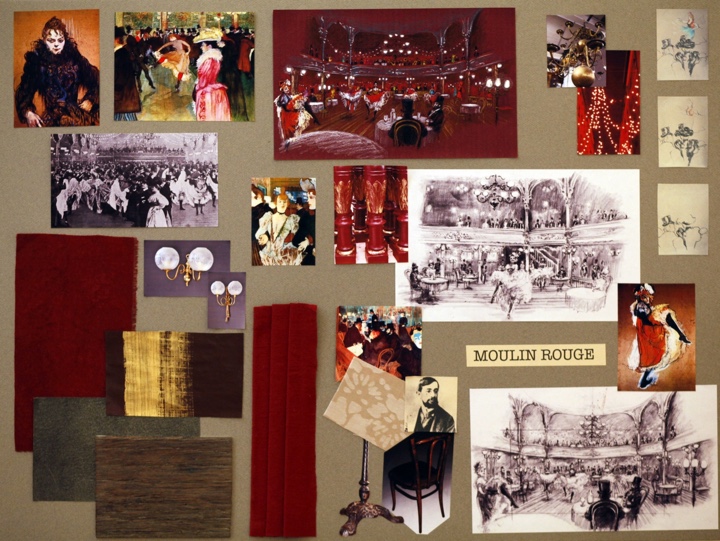
Mood board for the “Moulin Rouge” set by Anne Seibel.
When I went there with Woody, it was completely empty, and I thought that if he doesn’t like it, we don’t know what we’re going to do, because we only had one place. We used drawings and mood boards, and I sold the idea of shooting at that place, and everyone was waiting as Woody and I were standing alone in the middle of it, and he said “that could work”. Everyone was relieved, and that’s where we did it, a combination of finding little tricks and keeping within the budget.
Kirill: You mentioned that you wanted a distinct look for each period, but the first transition was almost unnoticeable. Owen Wilson gets into the car, goes into the nightclub, and it took me some time to realize what is happening. Was that intentional as you slowly introduced different costumes, lighting and colors?
Anne: As the car goes up the road, we started removing modern items, as the car itself, and the people and their costumes are telling that it’s different. It’s not telling it straight away as it can be people going to a dressing party, but as they’re stepping outside, they come into a place which has the real look of 1920s, the costumes, the furniture, the mood, and that slow transition was intentional to make people realize what is going on. We want to make a bit of mystery surrounding the midnight, and I like the way we did it.
Kirill: How much time overall did you spend on the movie?
Anne: The filming was seven weeks, the official preparation was also seven weeks, and I personally researched for two months before that. We shot it during the summer, as Woody calls them “Woody Allen summer projects”.
Kirill: What happened during the preparation?
Anne: When Woody came five weeks before the shooting began, I had visuals and mood boards to illustrate my vision. Most of the time it worked, and we only spent a lot of time on the Pigalle set. Woody wanted to go to that district which is very modern with a lot of neon lights, traffic and sex shops. We looked around a lot of little streets, and we ended up in Pigalle narrowing the space. If you go out of the frame, it’s all modern, but within the frame it was our magic – change the facade, change the lighting, change the coffee shop furniture, the posters, the cars in front – just the magic of dressing.
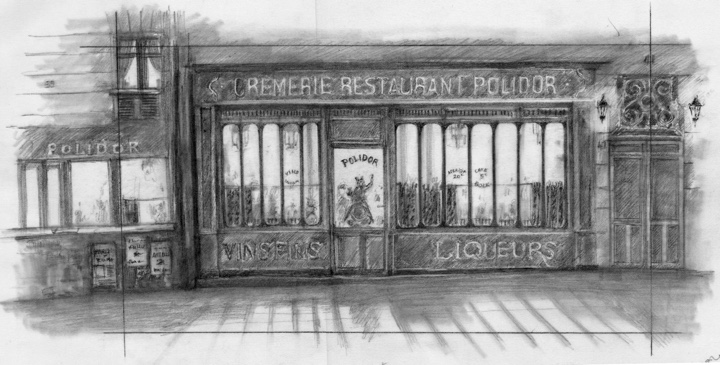
A sketch of a 1920’s restaurant exterior.
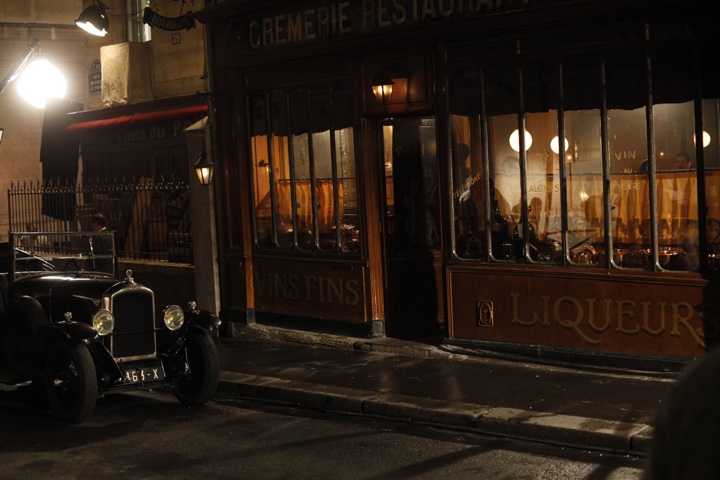
The decorated exterior of “Polidor” restaurant by Anne Seibel.
There was also a place that I found, and I really liked it, and it was completely unusual and not even part of the script. Some of the Zelda Fitzgerald’s cocktail parties were supposed to be in an apartment, and this place I found was a museum for fair pieces, with old merry-go-rounds and game machines, was so incredible, with such a strange dark ambience, that I had to take Woody there. When Woody went there, he was like a child and he changed the script to have the party inside this place. It was the look of the place that made him change the location.
Kirill: Did you spend a lot of time decorating the hotel room where Owen Wilson and Rachel McAdams stay in the modern period?
Anne: We shot it on location in “Bristol” hotel. We changed things according to the script – the lights, the curtains – just dressing it with props and flowers. We didn’t do anything major, but there are always some adjustments to do, especially with lighting because it’s very complicated to film in a small area. We did a lot of research on different hotels, and this was our favorite.
Kirill: Did you enjoy working within the tight limitations of the budget?
Anne: It’s a challenge, but at the same time the budget is never enough, even on big movies. You just never have enough money. I enjoyed this challenge, and I liked that the producer Raphaël Benoliel brought this movie here [Paris], and he made us feel as one big family on the set. It was a pleasure working with everybody, communicating, working for Woody Allen, making his movie the best we could.
Kirill: Do you have a favorite scene?
Anne: I really enjoyed “Moulin Rouge”, mostly because of the set, and all the scenes with Gertrude Stein [Kathy Bates]. I also liked the surrealistic wedding at the taxidermist “Deyrolle”, where we created special lamps with feathers, working around the wild animals. We managed to create a different look for different scenes, instead of going for a traditional look of apartments or restaurants, and I’m very pleased with this movie.
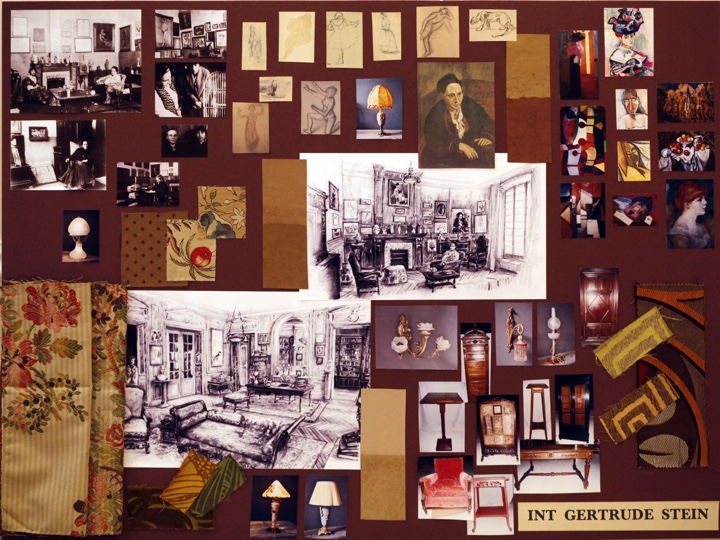
Mood board for the Gertrude Stein set by Anne Seibel.
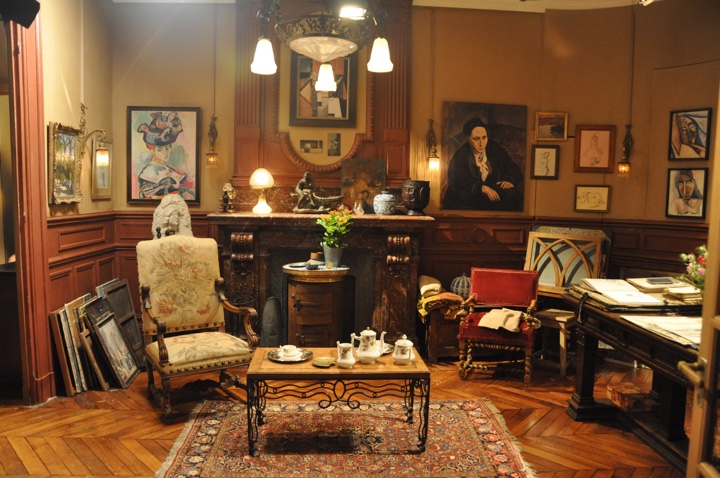
Final decorated set for Gertrude Stein location by Anne Seibel.
Kirill: You worked on different types of productions, periods and looks. Do you have a favorite one?
Anne: Contemporary movies set in usual locations interest me less. Woody’s next movie, “Nero Fiddled” is set in Rome, and although it’s a contemporary movie, I tried to find unusual locations to serve the script, giving various different look at the same time. I’d love to be able to work on a fantasy movie, where you can completely let go of your imagination and go crazy, like on Tim Burton productions.
Kirill: Can you recommend a few of your favorite productions?
Anne: It is hard to choose a few. “Midnight In Paris”, of course, is my first recommendation. The film I will watch again and again with a true pleasure. “E.T.: The Extra-Terrestrial”. I am a fan of Tim Burton and Terry Gillian. Recently I enjoy very much the Polanski film “The Ghost writer” and I liked “Avatar”, for the look of it, and because I’m a great fan of Rick Carter. I really loved what he has created in the Avatar world.
Kirill: Do you start analyzing the production aspect of movies when you go to the cinema?
Anne: Sometimes. I look at it, because it’s my job, and I like movies in general. When I saw “Midnight in Paris” for the first time in Cannes, I was drawn into it even though I worked on it. Woody did a really beautiful film with what we created for him. When you work on a movie, you don’t realize what will happen and what the director is going to do with it. It was very clever in the way he put things together, and I was totally drawn into it and I believed in it myself, even knowing how we set up the scenes.
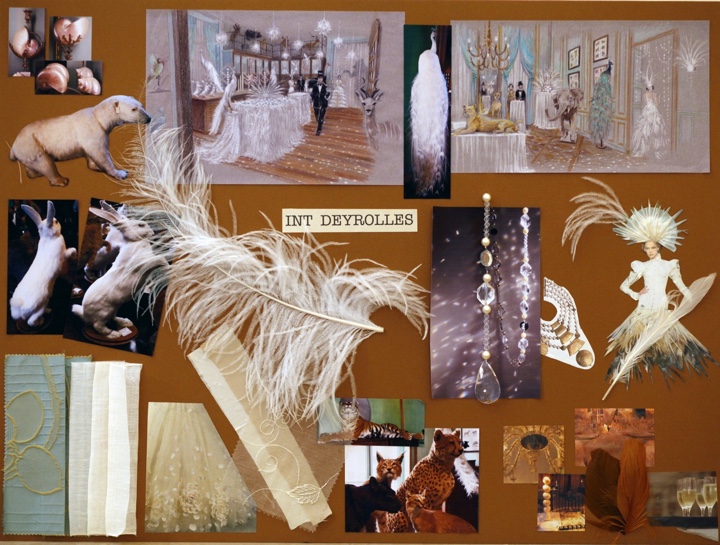
Mood board for the “Deyrolles” surrealistic wedding by Anne Seibel.
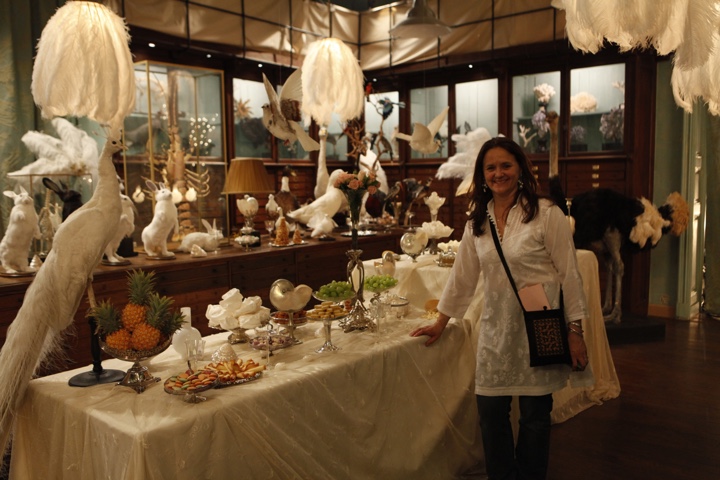
Anne Seibel on the constructed set of “Deyrolles”.
And here I’d like to thank Anne Seibel for the interview and the supporting materials, and Rebecca Fayyad of Sheldon Prosnit Agency for putting me in touch with Anne.
In this interview the cinematographer Jonathan Freeman ASC talks about what drew him into the craft, the slow transition from film to digital and the art of lighting. In between he walks me through the creative process behind his recent movie “The Edge Of Love“, from choosing the locations and defining the visual language, to capturing low-light scenes, post-production color matching and integrating visual effects.
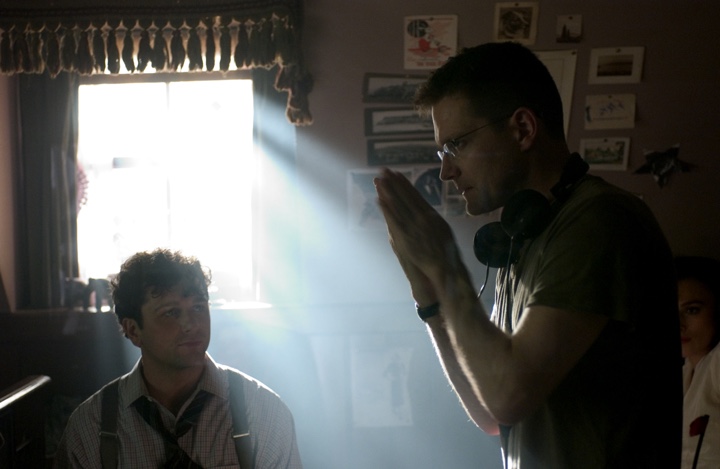
Jonathan Freeman on the set of “The Edge Of Love” with Matthew Rhys and Keira Knightley.
Kirill: Tell us about your background and why you decided to pursue a career in cinematography.
Jonathan: I was born in Canada. After studying in Concordia University in Montreal I began my career doing low-budget Quebecois dramas, even though I spoke very little French at the time. Then I moved to larger projects as I built my reputation, eventually leading to larger American projects. Around twelve years ago I moved to New York as I was receiving more offers from American productions. For the most part I shoot drama, whether it’s for features or for television, and also some commercial work.
Kirill: Were you always interested in making movies?
Jonathan: Going back many years, I was always drawn to movies. It was the first “Star Wars” film that pulled me in as a kid and, like a lot of people in my generation I was blown away by the spectacular special effects. The opening sequence, with the ship flying overhead, felt so real; and then the camera tilting down to show a planet that looked very much like Earth – as a ten-year old I wondered “how did they shoot that?”
As much as I was captured by the story, I was even more intrigued by the magic that was in front of me and I wanted to understand how that magic was created. And from that simple process of being inspired I went to see the movie again and again and then again. My mother was a painter and she taught me a lot about light and color, and my analysis on why it seemed so real was the magical element in how the camera was used to photograph the models. In addition, the way the models were lit seemed to be very realistic comparing to the space photographs of the period.
Throughout high school I was interested in great directors and cinematographers. Bertolucci and Storaro were particularly influential. My generation was fortunate enough to be at the advent of VHS home movies available for rent – as an essential tool to study movies at home. Sometimes when I was overwhelmed by certain movies during the first viewing I would go back and watch the specific sequences to see if I could figure out how they achieved their beautiful work.
Kirill: You mentioned the word “magic” when you described your first impression with “Star Wars”. Were you disappointed as you started dissecting the actual techniques, unravelling the illusion and masterful deceit?
Jonathan: It was actually the opposite. I marveled that someone was able to create this illusion. I particularly was impressed with the work of the team led by John Dykstra ASC who supervised the special photographic effects on the original movie. It was good to see that there was this group of people who were able to achieve this, and it was inspirational in a way that I wanted to do what they were doing.
Kirill: Looking back at those years in high school where you would rent these precious VHS tapes and rewind the specific sequences to study and analyze them, how would you compare it to the abundant access to an ever-expanding selection of high quality digital media in the present day? Does that affect the genesis of the next generation of cinematographers and movie creators on one hand, and the movie fans on the other?
Jonathan: I think more access means more information, and it’s always a selective choice. If I was born ten or fifteen years earlier, I would have been more restricted because the only way I could have reviewed movies back then was with 16mm prints or repertoire cinemas. Overanalyzing things doesn’t necessarily help either, but the ability to have access is a good thing.
There’s a bigger question when it comes to the current and the next generations, certainly for cinematographers, as the digital medium overtakes film. It’s much like the way the digital still camera has lost the magic of still photography. First of all people don’t even look through a view finder anymore, and even if they do look at the camera monitor, they’re already half-editing the shot before the moment it could be created. There is a great deal one can learn from trial and error. When you look at the work Robert Frank did with a still camera on the subway, he would often have it on the shoulder strap not even looking through the view finder, taking a shot of what he thought was interesting. He was able to capture these images confidently because he imagined what his camera was seeing without looking through it. That requires a lot of trial and error. He may not have known for certain whether he got an interesting image. Only later when he would look at the negatives and proof did he discover what would become very iconic images.
I think that kind of magic is being eliminated. The experience of not knowing for certain whether you have captured the moment is surely different from shooting in a digital production – there’s a bit of a loss in that respect. Does it mean that the work of the next generation is not going to be as good, or even better? I don’t know. There might be a gain in other areas. But I certainly love film.
Kirill: Is it a loss in the sense that instead of relying on your artistic instincts you’re guided by the immediacy of the visual feedback, not only for you, but for the rest of the production crew on the set?
Jonathan: I have to admit to sounding a bit like a dinosaur. There’s a certain value to understanding the photographic latitude that the film required you to learn. It would involve thinking about the stock, the lenses, the filters, setting the correct exposure value to cover what you’re looking at. The kind of experience that you eventually gain through shooting film is valuable in how you understand and appreciate the technical restrictions of the medium. Of course similar things happen when you shoot video, analyzing the exposure outside the windows and compensating, but for me it comes back to the magic of it.
It’s not something that derails the potential quality of cinematographer’s work, but I do think that emerging cinematographers would benefit from shooting film. Even still film is a good learning tool, as well as shooting in black-and-white. When you shoot in black-and-white, you get a much more appreciative idea of contrast, and the lack of color separation forces the photographer to find ways to create separation.
Kirill: So through restricting yourself to a different physical medium you’re becoming a better artist?
Jonathan: I wouldn’t qualify it as better, but definitely more versatile. I don’t consider myself a very technical cinematographer, and there are a lot of things I wouldn’t be able to tell you about a film camera and certainly about a digital camera and their basic components. I do understand the principles of exposure value, and as a cinematographer it’s critical for you to understand, not just for the immediate moment when you’re recording on film or digital, but for the final projected and broadcast result.
Kirill: What was your choice for “The Edge Of Love”, film or digital?
Jonathan: It was actually a mix. It was probably 40% film and 60% digital Panavision Genesis HD camera. This was by choice and not necessarily aesthetically. I was working with the brilliant director John Maybury, and it was actually our second collaboration in a period of less than a year. We worked together on an HBO series “Rome” which we shot on film, and at one point I was shooting digital stills to give him an idea of what the result might look like. We were talking about monitors which are either too bright or don’t represent what I’m exposing, and I realized that it would be helpful for both of us to see an image that is much closer to the end result. This way I could go even darker in the scene because he was OK going that dark, because he felt more confident that he was seeing an accurate image. Before I would be more conservative regarding exposure, and as a cinematographer you rather expose the negative as close to your intended result. I thought that HD was a good attempt at resolving this.
However, as we were shooting a portion of the film in Wales, it didn’t seem that Genesis was a system comfortable under different weather conditions. Never knowing what you would get in Wales, and for efficiency reasons (not being tethered to HD) I just felt it would be OK to shoot that portion on film. As it was meant to be stylistically separated in anyway, I shot the Wales part in film, a kind of a dreary Tarkovsky landscape – in contrast to a more vibrant night London.
And so we shot our first three weeks on film in Wales and then came back to London and switched over to HD. I think it worked out pretty well.
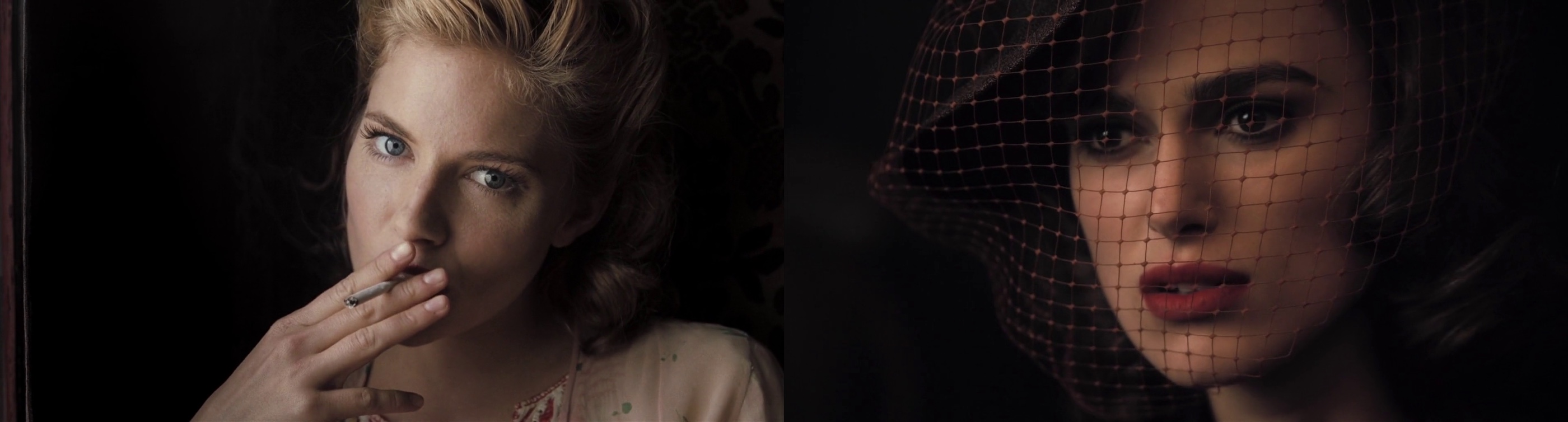
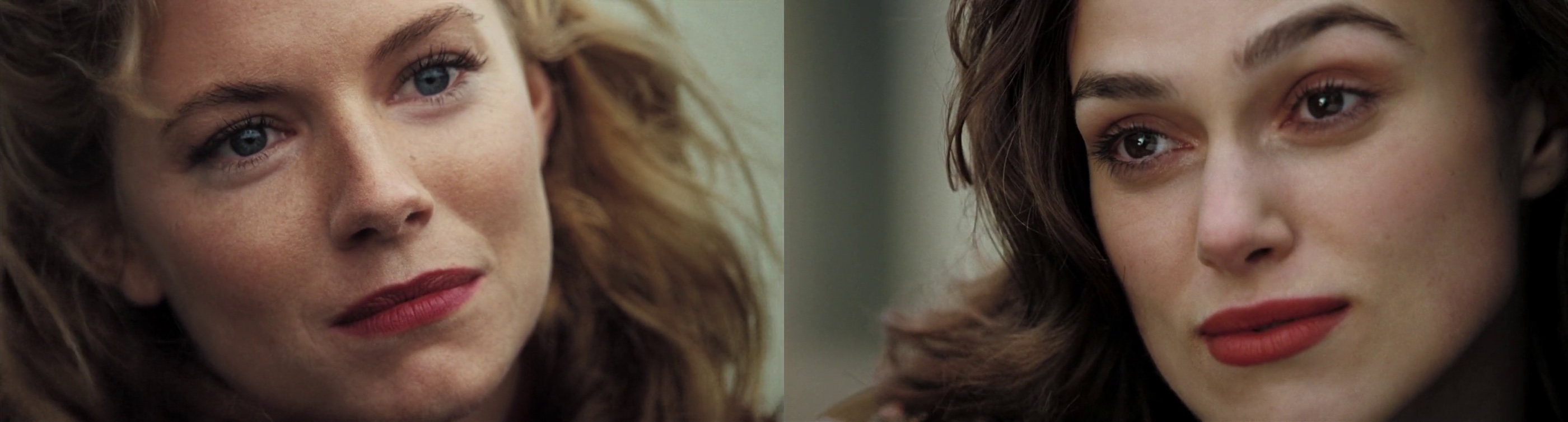
Left – close up of Sienna Miller – 35mm film. Right – close up of Keira Knightley – HD digital.
Kirill: Are you more limited by the bulkier HD cameras that often run thick tether cables back to the recording booth?
Jonathan: It was back in 2007. The current technology comes with its own version of recordable sources, so that you can record without being tethered to a cable, apart from some recommended dependent systems. Regardless, even on film we’re used to an attached video cable that provides video playback, and at the time it was the choice that we felt to be more efficient. Today, in the same exact scenario, I would probably assume to shoot in one format or the other.
Kirill: Given that your most recent work on the “Boardwalk empire” is on film, do you see yourself continuing this in the next five to ten years?
Jonathan: It’s becoming progressively less of a choice, being driven by production considerations as well. In some cases the production will be willing to consider doing film as long as there’s a financial give back on our end in some way. Shooting straight film is very costly, and the cost of DI [digital intermediate] stage has come down to a point where posting your film in anything other than digital intermediate is not even affordable. Digital has improved rapidly year to year, and it’s possible that in five years a system will come out and it is really superior to film.
When it comes to low light levels it’s hard to argue against HD even with the highest quality film. It’s at least comparable, if not more successful – depending on what you’re talking about. It’s certainly comparable in grain and resolution, and it’s harder to narrow down in regards to color range as different systems respond differently into the low end. But when it comes to highlights, HD is overall universally challenged and film is still superior, but that will change.
I said ten years ago that film will be dead. Maybe not in ten years [laughs], and hopefully there will still be opportunities to shoot it because it’s a beautiful format. But being conscientious of the environment, video is much better for the planet.
Kirill: Transitioning to your role in the overall production process, what does a cinematographer do?
Jonathan: The director usually hires the production designer first, and that was the case on “The Edge of Love”. John has worked with Alan MacDonald for many years; a cinematographer’s dream to work with. Alan worked on principal ideas before I came on board, and after I joined we started adding to and reshaping the script into what John was visualizing. They are both very collaborative, and together we developed various ideas for the scenes, going through the script.
It was over a period of weeks, where we would gather notes and sit down scene by scene, discussing different locations and how we would approach things. John would tell me how he visualized opening the movie, and we’d work together to figure out the shot elements. Alan would have ideas on specific imagery that he researched and found, and we’d apply those to certain scenes.
Kirill: Did you drive to locations across Great Britain, shooting stills and bringing them back to discussions?
Jonathan: Exactly. In some cases we studied generic photographs of locations, and at other times we would discuss very specific angles that one of us thought to be a strong support for the story. Sometimes the locations didn’t look exactly as I wanted them to be, so I photoshopped the pictures to give a stronger impression to John, or I would take his thoughts and apply that look.
Kirill: And the goal was to have a prototype of the intended visual style?
Jonathan: I’ll give you a few examples. Many years ago John had found this beautiful location in Wales, and he wanted to use it for the sequence of Cillian Murphy‘s character at war (that took place in Greece). Even if it doesn’t make logical sense as it doesn’t look like any specific location in Greece, the black slate quarry surrounding the hillside is very dramatic, and after going there, we tried to figure out the sequence. The script as it was originally written was very true to the story, but not very dramatic. Cillian’s character was originally tasked with digging up land mines, but as he was not blown up or exposed to direct violence, we needed to give him a little more heroic angle.
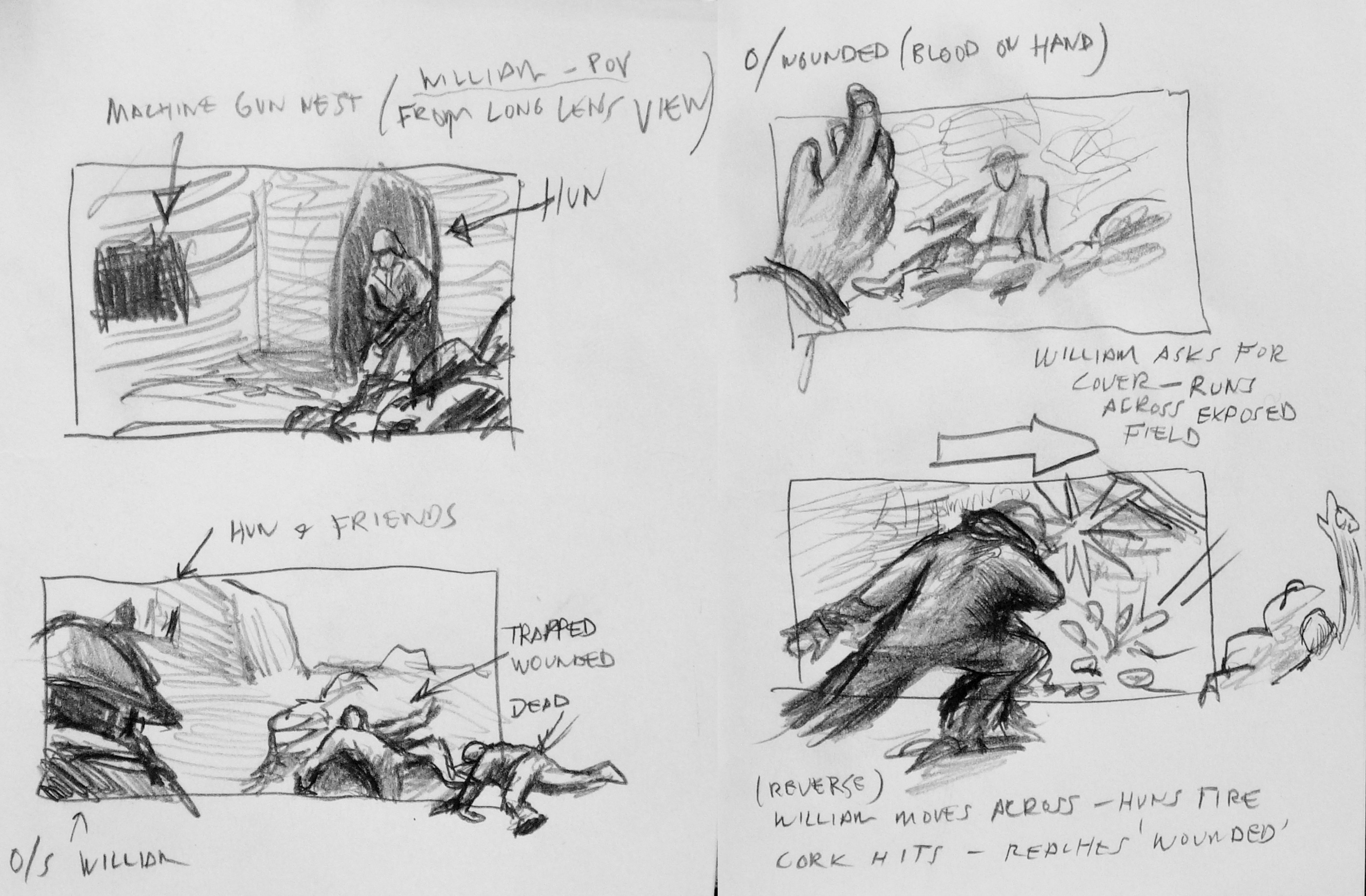
Hand drawn original boards by Jonathan Freeman.
So we had to reconceive the sequence – with very little money – to tell the story not only of his character, but also the potential psychological and traumatic experience at war. In addition to the field surgery scene, we needed another one of battle, and we only had seven hours to shoot it. It was done in a way that was as simplistic as we could do it, with great help from the brilliant “Double Negative“; the digital effects company behind “Children Of Men” among countless other projects. They delivered some of the missing elements in the scenes that we pre-planned and shot.
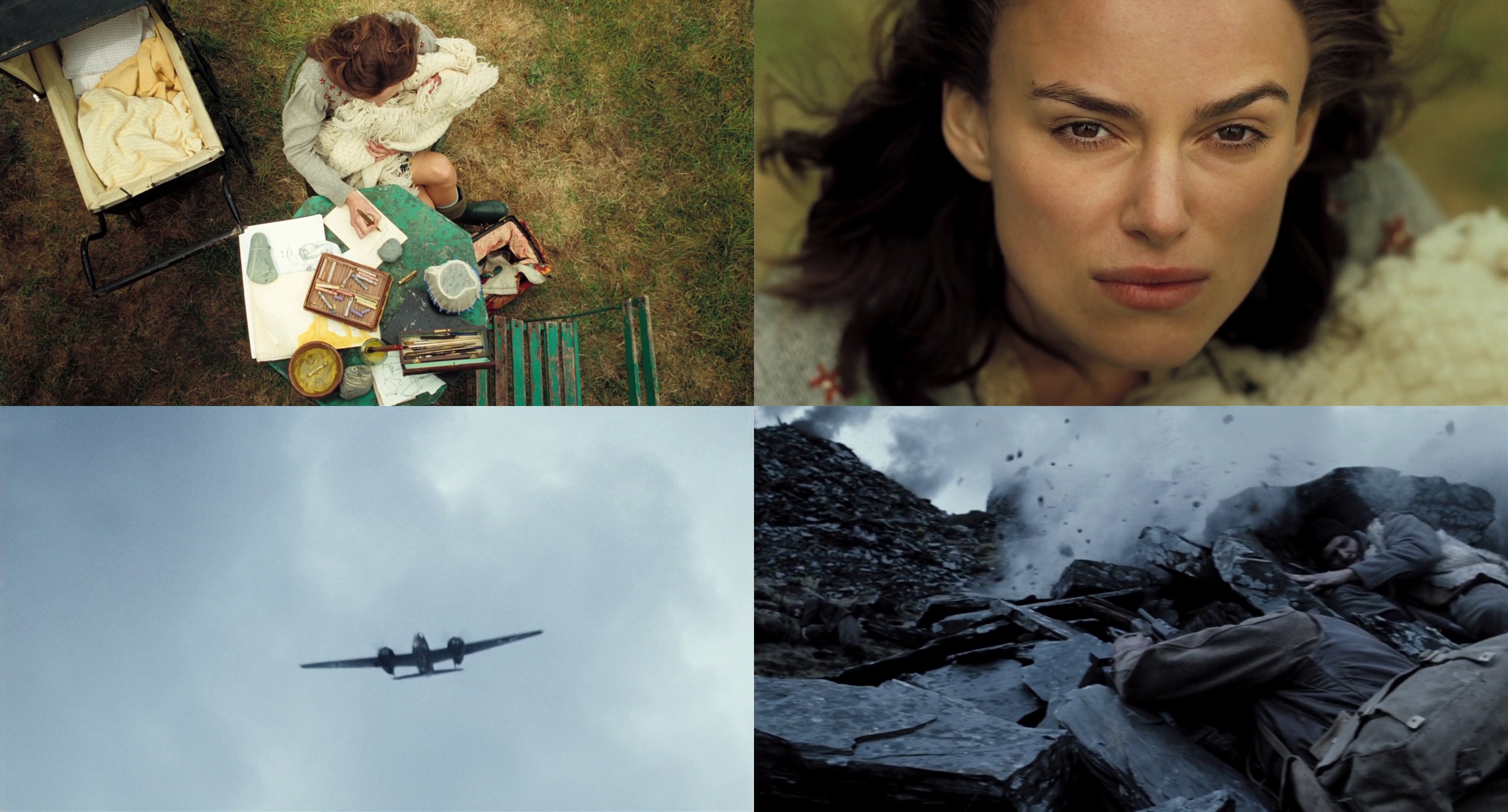
This specific sequence begins with Keira Knightley‘s character writing a letter, and then, when she hears a plane, we cut to the plane above and transition to the battle scene. Originally I suggested that the plane is going away and we tilt down with its movement, but in the end we flipped it to an advancing plane and tilting from there, as the visual effects company thought it would be easier for them to do. And all the elements including the CGI planes were cut together to create a sequence which I boarded as a reference, and in the end it came pretty close to what we’ve planned.
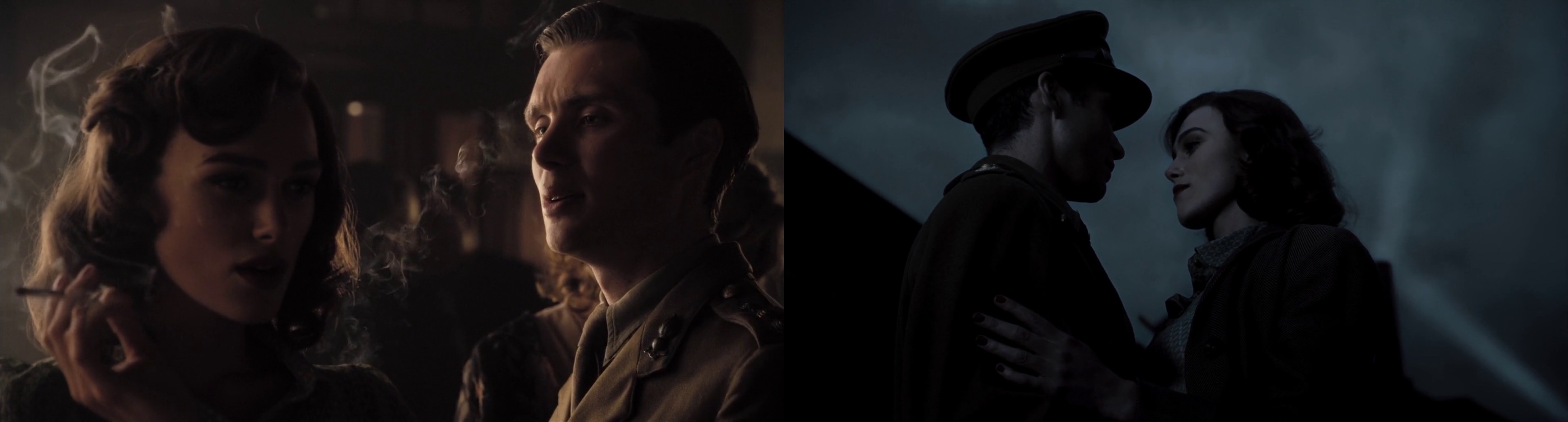
Another concept of a sequence was with Cillian and Keira huddled together outside the bombed night club, just before he was shipped to war. Alan had this image of a firefighter during the blitz, as a silhouette hosing down the fire.
Kirill: This was a nice transition from a glamorous dance hall interior to the grim reality of a wartime London.
Jonathan: This was John creating an experience of the time, where you live on the edge, risking your life on the daily basis – and a lot of characters are right on that edge. You risk a lot, but you feel that you live the best that you can under the circumstances.
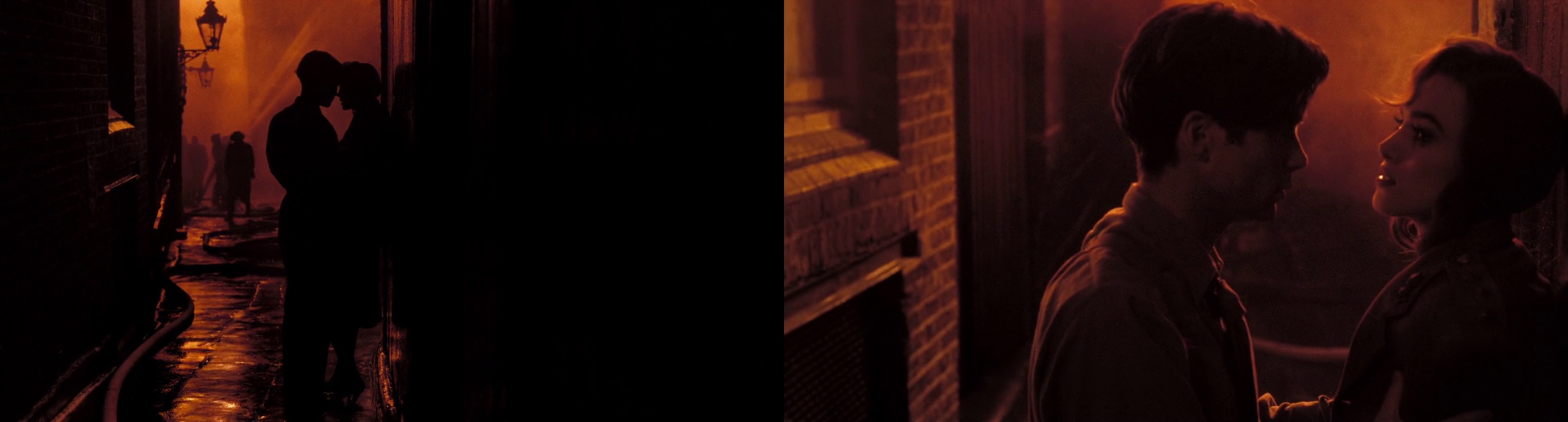
And the sequence that we could afford, without a big spectacular CGI fire scene, was based on this photograph. We looked around London to find a place where we could recreate this practically, without it becoming a huge thing. I don’t remember the exact location, but it was close to the theater district, sort of a narrow alleyway, where we were able to frame their silhouettes against what ended up being a cluster of lights on a tower, with a lot of smoke and some guys hosing a building offscreen. This is sort of a typical illusion that ends up feeling more expressionistic – which is what we wanted to achieve in much of the London portion.
A lot of John’s movies and approaches are expressionistic and suggestive. That image didn’t have real fire, but you know it’s fire because of the color and the logic behind it. You never see the collapse of the interior of the night club, but you get a sense of it when the chandelier is down and everything goes black, and it’s just search lights panning over the victims while our heroes escape. And this is John’s visual way of interpreting simply something more spectacular, in a somehow more gratifying way.
Kirill: You talked about your collaboration with “Double Negative”. How does it work during the post-production as their digital output is merged back to the live action sequences?
Jonathan: The color correction was done at Framestore. Brian Krijgsman is a true artist, and he was very integral in delivering another layer of the look through his expertise and patience. He would show us things that he could do with the system, and it’s unfortunate they’re no longer doing DI [digital intermediate], as their system was the best DI experience I’ve ever had.
Digital intermediate is essentially color grading or color timing which happens at the final stages before you do the film print. It used to be done chemically, but now it’s a much simpler process. You also have other things which you couldn’t do in standard film timing, like power windows where you can darken or lighten part of the frame, more versatile range of color and exposure adjustment.
Kirill: Did you participate in the post-production stage?
Jonathan: The visual effects company was certainly involved during the integration of their sequences. But overall it was again myself, John [Maybury, director] and Alan [MacDonald, production designer]. Although it doesn’t always happen, I wanted Alan to be there as well. It was important for me to see him getting value on the images that we collaborated on. If he felt that the initial exposure missed out on a certain set detail, I’d be very happy with him going in, taking that detail and bringing up the exposure. John also was able to highlight other aspects of the frame whether it was costume or an actor’s face.
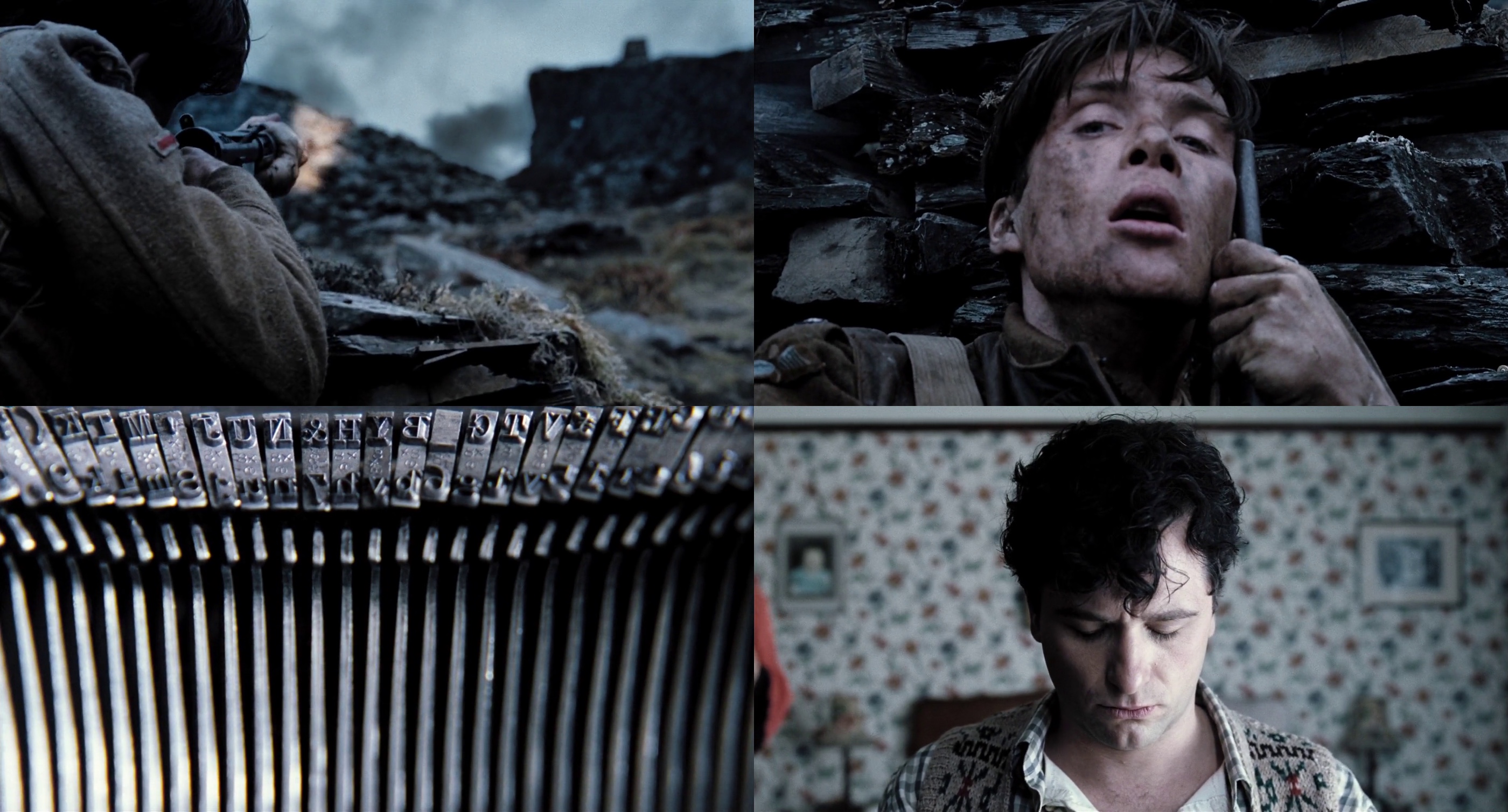
The staccato of bullets morphs into the staccato of typewriter, aiding the visual transition from war back to peace.
Kirill: How much time did you spend during the post-production phase?
Jonathan: Once the shooting was complete, the editing took a few weeks. It was fairly quick edit, and we did the color timing within six-eight weeks or so, and we spent two weeks at Framestore which has been an excellent experience for us.
Kirill: What was the daily routine of looking at the output of that specific day?
Jonathan: We did what most people do – watch DVD dailies. It was a standard analysis, and it was more critical in Wales as we were shooting film. It became less critical when you’re shooting HD as the dailies that you get are essentially the same as you see on the set – which was another advantage of HD, as you’re able to see the immediate output collectively.
Kirill: The London scenes were done in very low light, immersing the viewer in the environment that required the citizens to close all the windows and use as little light as possible. Was it more challenging to shoot London scenes from the lighting perspective?
Jonathan: In some ways that was my biggest challenge. I remember John joking about how was I going to figure this out. Technically speaking, we took some liberties in terms of what we got away with, but basically the exteriors of London at that time were pitch black during the night because of the mandatory blackout during the blitz. At night you can’t use any artificial light as your source. It’s essentially what they classically describe as moon light, and I personally loathe this idea. Moon light tends to look very artifical on film when it’s recreated, and you can’t shoot in the real moon light. There’s very few examples in cinema which I’d describe as great moon light.
There’s a choice, and I felt that a more subtle ambient sky light in a cloudy overnight cast – as opposed to a harder single-source direct moon light – will cause your eyes to eventually adjust and see something. And on top of that we’d have the search lights illuminating the clouds, so theoretically between that ambience and the natural ambience of the moon light filtered through the clouds you’d have your light source.
We could justify the artificial tungsten lights for the interior scenes, and the blocked windows provided a nice contrast between warmer interior and cooler exterior as the light did not enter from the outside. I had my biggest challenge in the scenes which were not supposed to have any light sources at all.
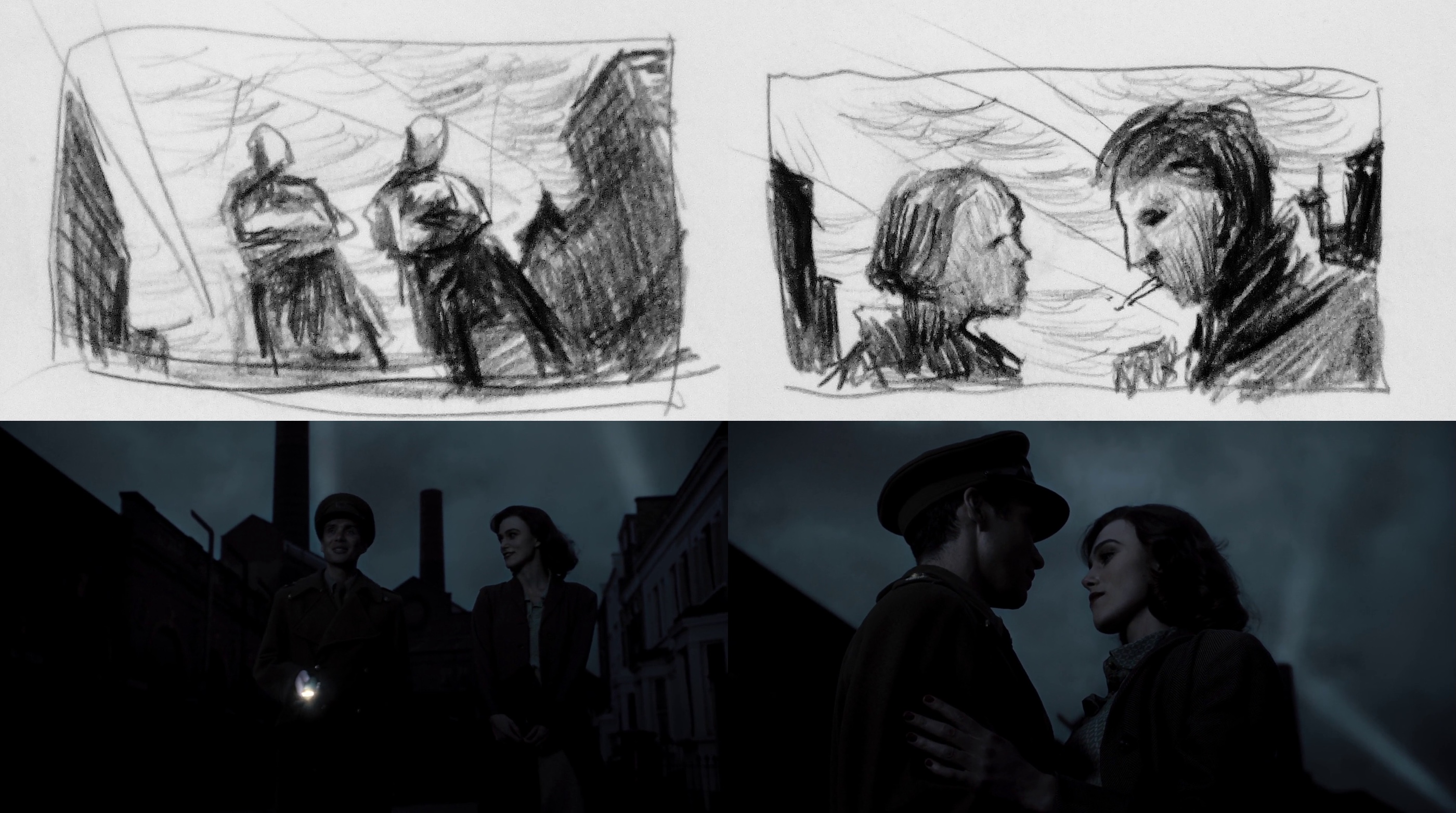
Top row – hand drawn original boards by Jonathan Freeman, bottom row – final stills.
The sequence where Cillian is walking Keira home, and there’s a street in Chelsea with this beautiful factory, and we asked ourselves how do we show the scale of the street without it looking false. You can get a big light way down the street, and that becomes your moonlight – but I felt that it was very artificial. And the alternative that I came up with was no less artifical, but more aesthetically interesting. We shot the sequence in one shot at magic hour, with the intention to take most of the street and the figures, bringing the exposure down so they’re almost silhouette walking against the sky that we eventually replaced with visual effects.
Part of the framing was to keep the characters silhouetted against the sky, because otherwise they would be buried against the dark architecture.
Kirill: And there you lowered the camera to show more sky and less cityscape
Jonathan: Exactly. This would silhouette them more distinctly, and would provide the opportunity to show the search lights that happened at London at the time. I drew some boards for this, and did some photoshop explorations.
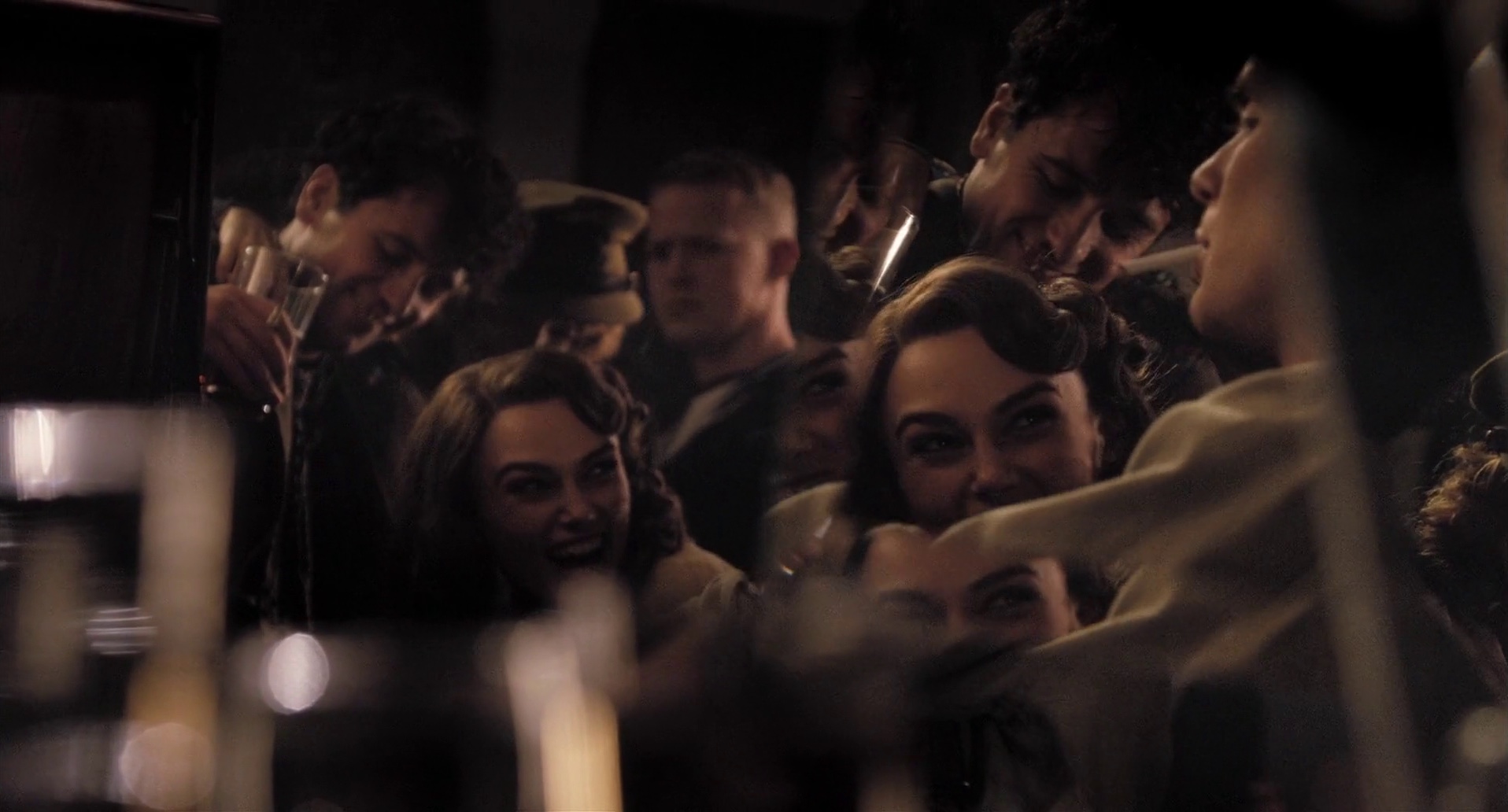
Kirill: There were two shots, one at the bar, and another where Cillian and Keira were making love for the first time, and it appeared that you shot them through some kind of a glass structure that resulted in a series of complex overlapping reflections. Can you share your secret?
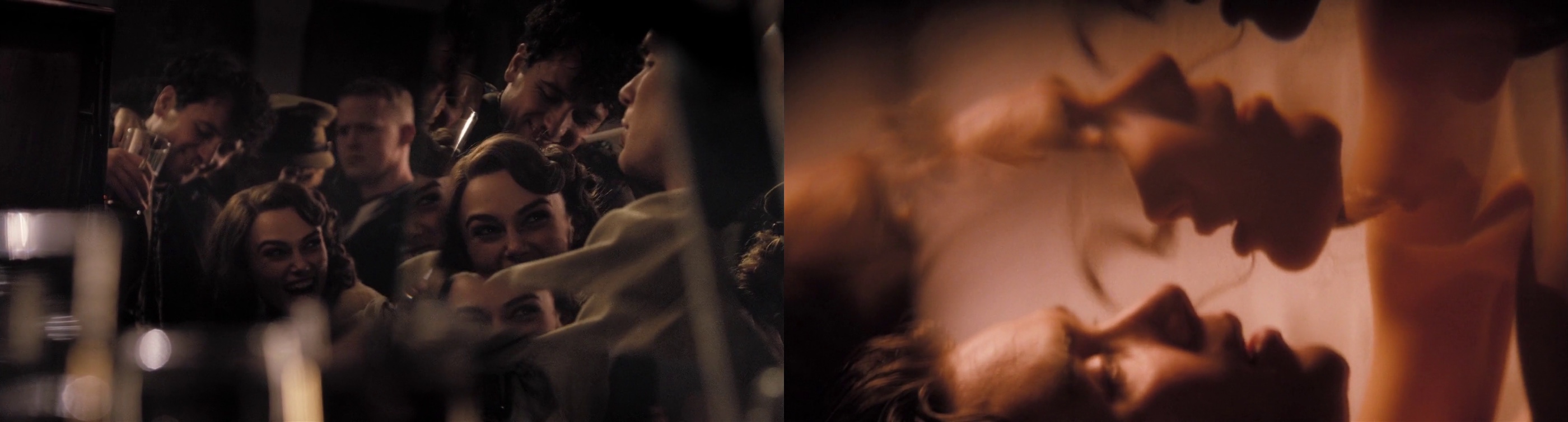
Jonathan: That’s the pure genius of John Maybury. We shattered a large mirror and selected a portion of the mirror break that seems to be the most photographically interesting, with fragments large enough so you can capture almost the full image.
There are two things that happen. Since the fragments are not flush to each other, they capture slightly different degrees of angles of the same image. We’ve asked the actors to start pretending to make love, and as that’s happening we shot them in profile through the mirror and panned while using a series of zooms to give the camera some movement. Then we created a dissolve effect which we did through a series of shots. Because of this, we had this magical moment in two or three shots, as they separate from kissing, there’s a silhouette that happens where their faces seem to merge together to become one. John knew we would get something interesting but this was one of those magical moments you can’t plan for. It was very lucky actually.
Kirill: Would you describe this as going with the flow, as it’s hard to plan for?
Jonathan: You can plan for it but it’s, again, the magical element. We did a lot of very precise planning, but things like that are organic and it’s fantastic when it does happen. You know you’re going to get something interesting, and John knew confidently that he’ll get something that he could use. Following his lead I knew that as well; but we didn’t know what we would get in moment. On camera it works photographically in a way which is very abstract and beautiful.
John is a brilliant artist and a great person to work for and work with. He inspires you in a lot of ways, and encourages you to contribute, which is the best collaboration you could possibly ask for.
Kirill: There were a couple of scenes with very strongly defined pyramid of light penetrating the windows. Was it your intent to have this in scenes where Cillian’s character is not present, highlighting the more feisty side of the other three characters?
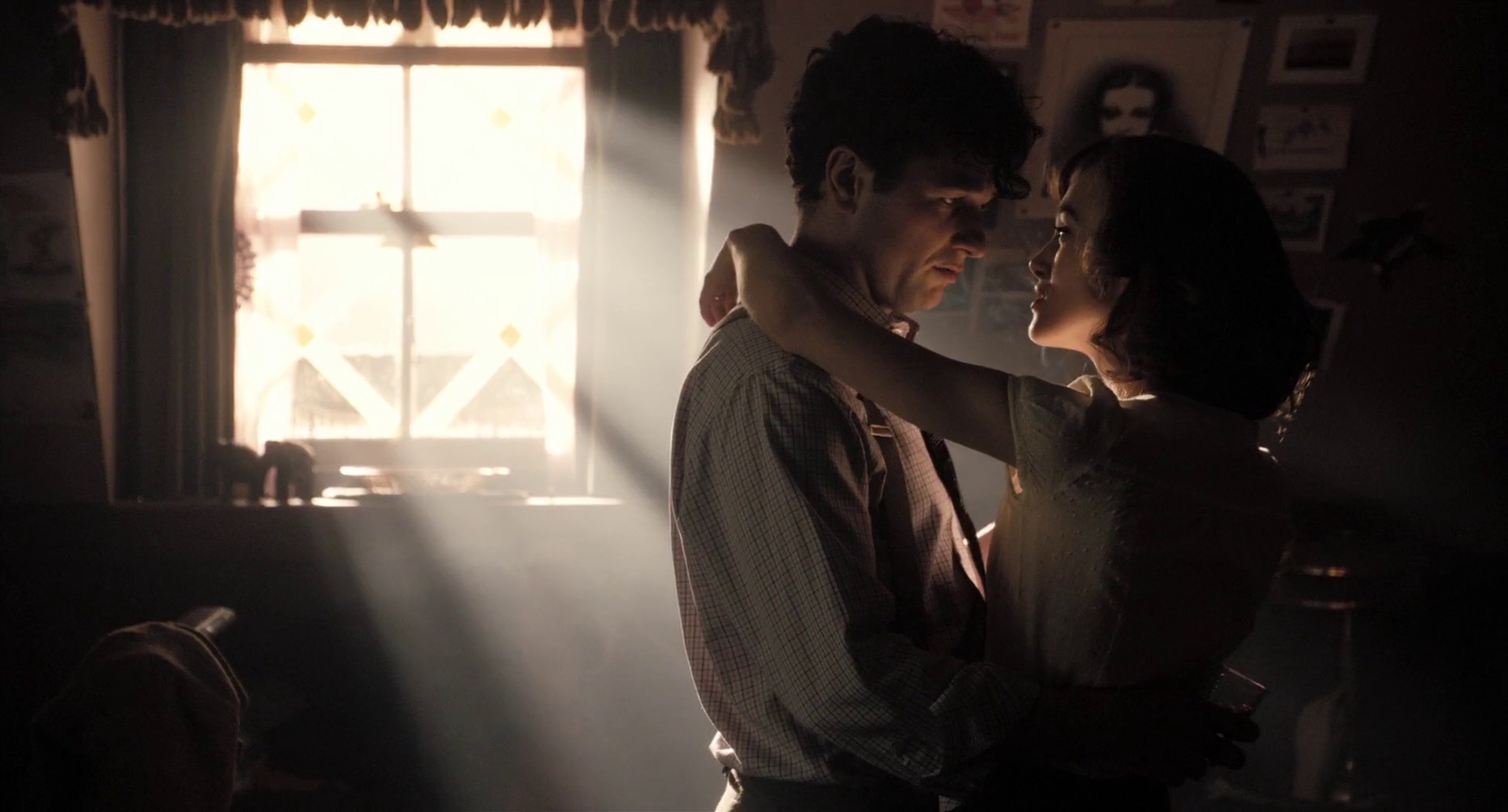
Jonathan: I like the analogy of pyramid of light. We definitely wanted to frame Cillian out of the shot, but I’m not sure if this type of light was the right call. You certainly don’t get a lot of sunlight in London, but that scene needed a contrast to highlight the potential jealousy from both Cillian and Sienna [Miller]. We needed something less gloomy to elevate an image of Dylan Thomas played by Matthew Rhys, as he and Keira are sort of enveloped by the light, digging the knife even further into Cillian’s character.
Kirill: As it wasn’t direct sunlight, how did you achieve these visuals?
Jonathan: It was a very simple standard technique used by a lot of cinematographers. We used a 10K tungsten Fresnel light which can be used for sunlight effects, placed outside the set. I wanted this shaft of light to be even narrower, but we didn’t have enough space in the studio. So I bounced the light into a mirror, and then it would be directed into the window. Since the reflection of the light has to travel twice the distance to the window, it effectively moved the light further back from the window. Otherwise if you put the light too close to the set, its quality becomes too wide and unnatural. The placement itself and the backlit quality makes it more impressionistic, but still has a natural quality to it.
Kirill: You said in the very beginning that you were immediately drawn to analyzing and understanding lighting as an integral part of the cinematographer’s craft.
Jonathan: I can’t imagine being a cinematographer not constantly thinking about the light. Obviously the composition and framing are incredibly important too, not only to be aware of, but to be an active participant as well. But to be fair there are a lot of directors that know where exactly they want the camera to be. Some others may not have an idea where they want the camera, preferring to work with the actors. When that happens occasionally, I then try to find different alternatives to cover the scene – so it can spark a discussion. But most of the time it’s somewhere in the middle as a collaborative process, building together a shot design based on the director’s ideas and my suggestions. And even if there are few directors that have specific ideas for the look of some scenes, the cinematographer’s principle essence is the light, or lack thereof. It begins and ends with light for me.

Capturing the magic hour. Top left – test mockup during construction (waistcoat and gun added in Photoshop). Top right – shot from the set, capturing the scale of the house against a fragile character. Bottom row – final stills.
Kirill: You mentioned that digital cameras are not good at capturing highlights or a wide contrast range. Does this contribute to some cinematographers’ opposition to this technology?
Jonathan: I think it would be wrong to say that we’re opposed to it. Five years ago there were a lot of cinematographers swore that film was it. The technology is still not there yet. It still needs to be further developed, it needs to surpass film in terms of full dynamic range and capacity, and once it does that, I think that everyone will understand that a new medium has effectively replaced the old one. But a lot of us are not comfortable with the idea that if a technology gets locked in too soon to be acceptable, then we’ve lost something. If a technology gets to replace another technology, it has to be because it’s better in all respects.
Kirill: That is not necessarily what happened when the music recording industry has transitioned from vinyl to CD. Even though the hardcore audiophiles still swear by the dynamic range and warmth of sound captured by vinyl, the general public does not seem to care as much.
Jonathan: That would be true for cinematography and photography in general. I think there’s another stage where in twenty years digital will be so far advanced in terms of dynamic range capturing that we’ll be requested to make it worse, if you will. There will be functions like today’s hipster apps that will give you a look of the specific film stock that we’re shooting with now, like Kodak 35mm 5219.
Kirill: And even now the visual effects artists are required to recreate the physical imperfections such as lens distortion or film grain, as their output is integrated into the live action.
Jonathan: Going back to magic, the first thing about visual effects is that they have to appear real. There are certain ways in which you can aid that, and taking away the perfection of a computer generated image is one of them. You can do this through lens distortion, light flaring, and film grain – which is still hard to simulate. I’m sure that somebody will come up with a program that will be able to satisfactorily simulate grain of different film stock.
The only way it’s going to happen is if dinosaurs like me, and more influential dinosaurs will keep saying that what we have now is not good enough. If we all say that it’s OK, there’s no reason for the companies that develop these technologies to move forward and to advance and improve their products. So the motivation must come from us to keep their feet to the fire and make sure that this transition into the new medium is done in a way that succesfully surpasses film.
It’s unlikely that twenty or thirty years from now we will look back at the films we shot and people would say “wow, that looks terrible, how would you even think that looked great”? It’s much like the black-and-white films that have their own essence and their own beauty that represent a certain time period of cinematic history. And the new technology that replaces film can have its own marker, but it needs to be at a place where we’re not struggling to achieve things that we can already do on film.
I’d like to thank Jonathan Freeman for kindly agreeing to this interview, and I hope you enjoyed it as much as I did. Special thanks to Kimberly Weston at ASC and Andrew Stadler for their help.
“The Edge of Love” is a small glimpse into the life of a charismatic poet, told through his passion and love of two women. Keira Knightley plays his teenage love that crosses his path ten years later in the wartime London, and Sienna Miller stars as his feisty Irish wife that finds the open-ended marriage as a convenient arrangement to satisfy her restless void.
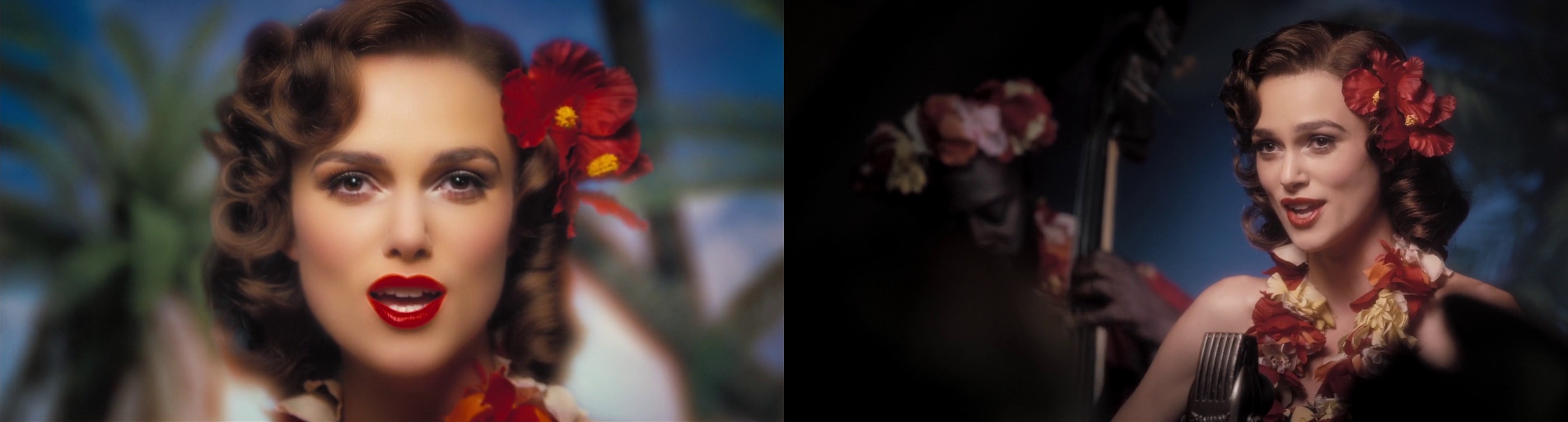
The dazzling glamour of Keira Knightley adorned with rich florals quickly gives way to a somber surrounding of the underground tunnels of wartime London where small groups of people would gather to forget the horrors of ceaseless bombings. The passing illusion is highlighted in one of the next scenes that shows the lighting technician using a hand-rotated color wheel placed in front of a small improvised stage light:
The visual mood is defined by a number of techniques applied consistently throughout the entire movie. As we are quickly introduced to the two female leads, the camera remains steady on their faces, cutting off the top part of the hair:
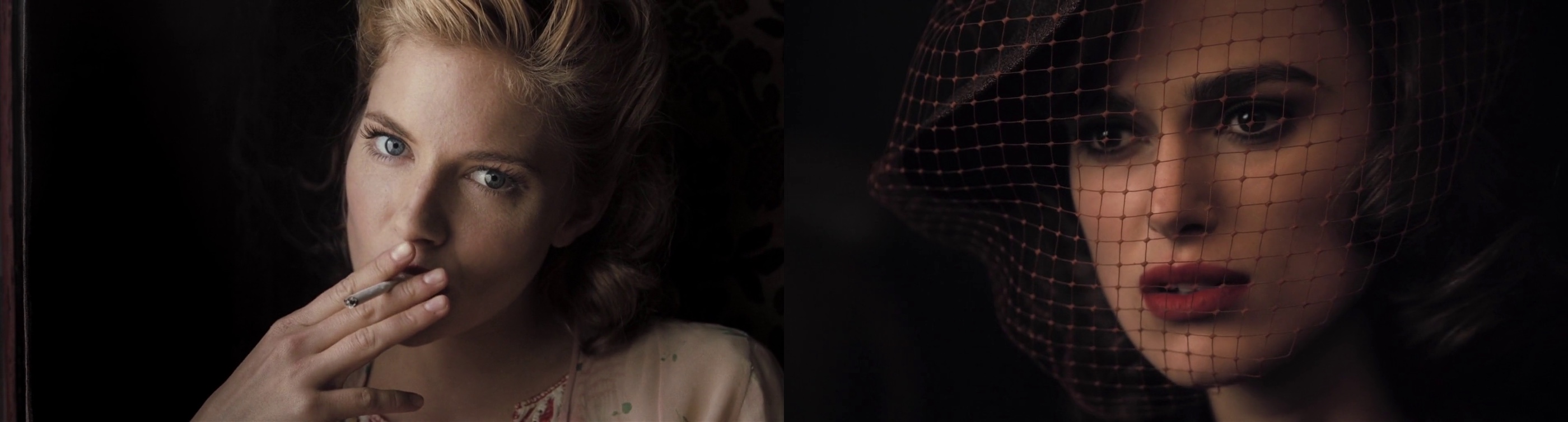
An intimate look into the strange bond that forms between the two women seems to return to the close-ups, not straying from the center even in the alternating dialog cuts that would usually places the faces on opposite edges. At times the camera lingers on small set pieces
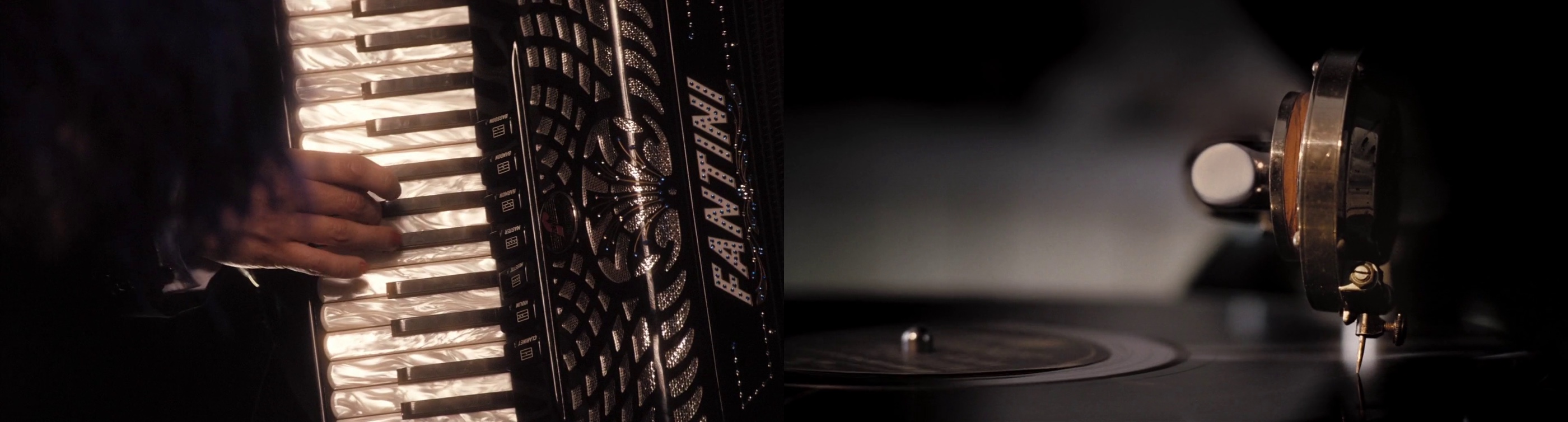
and at times we see the scene through an intricate arrangement of multiple refractive surfaces
The soft browns and yellows of inside scenes are in harsh contrast with heavy grays and blues of sequences shot outside on the backdrop of the sky illuminated by anti-aircraft search lights:
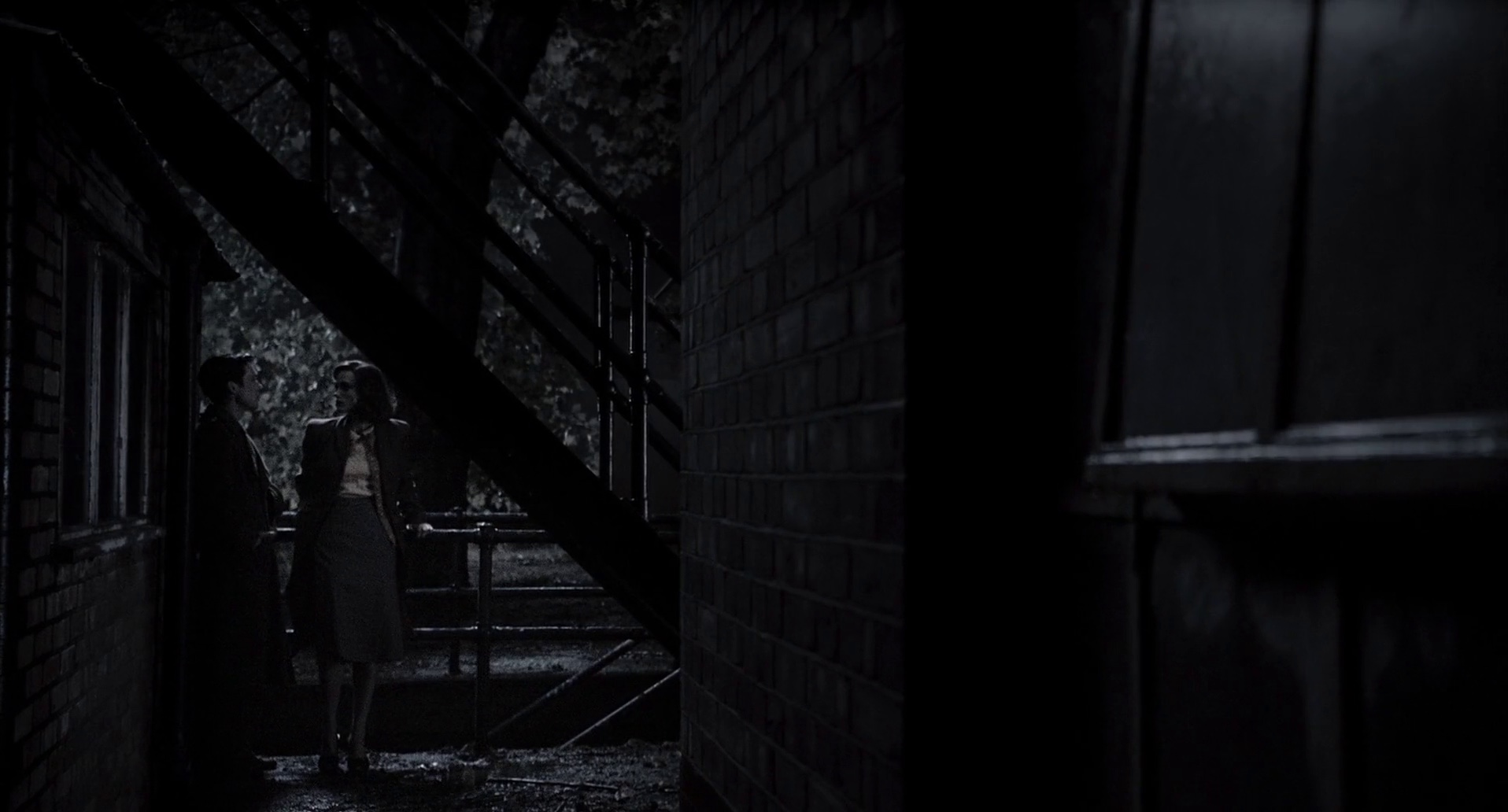
The oppressive abandonment of the streets is captured perfectly by the frame-within-frame in the next shot, as the budding relationship between Keira Knightley and Cillian Murphy (who plays a soldier waiting for his orders to be shipped to continental Europe) is overshadowed by the slanted lines of brick walls and staircases, almost leading the eye to believe that the human couple is about to disappear on the horizon:
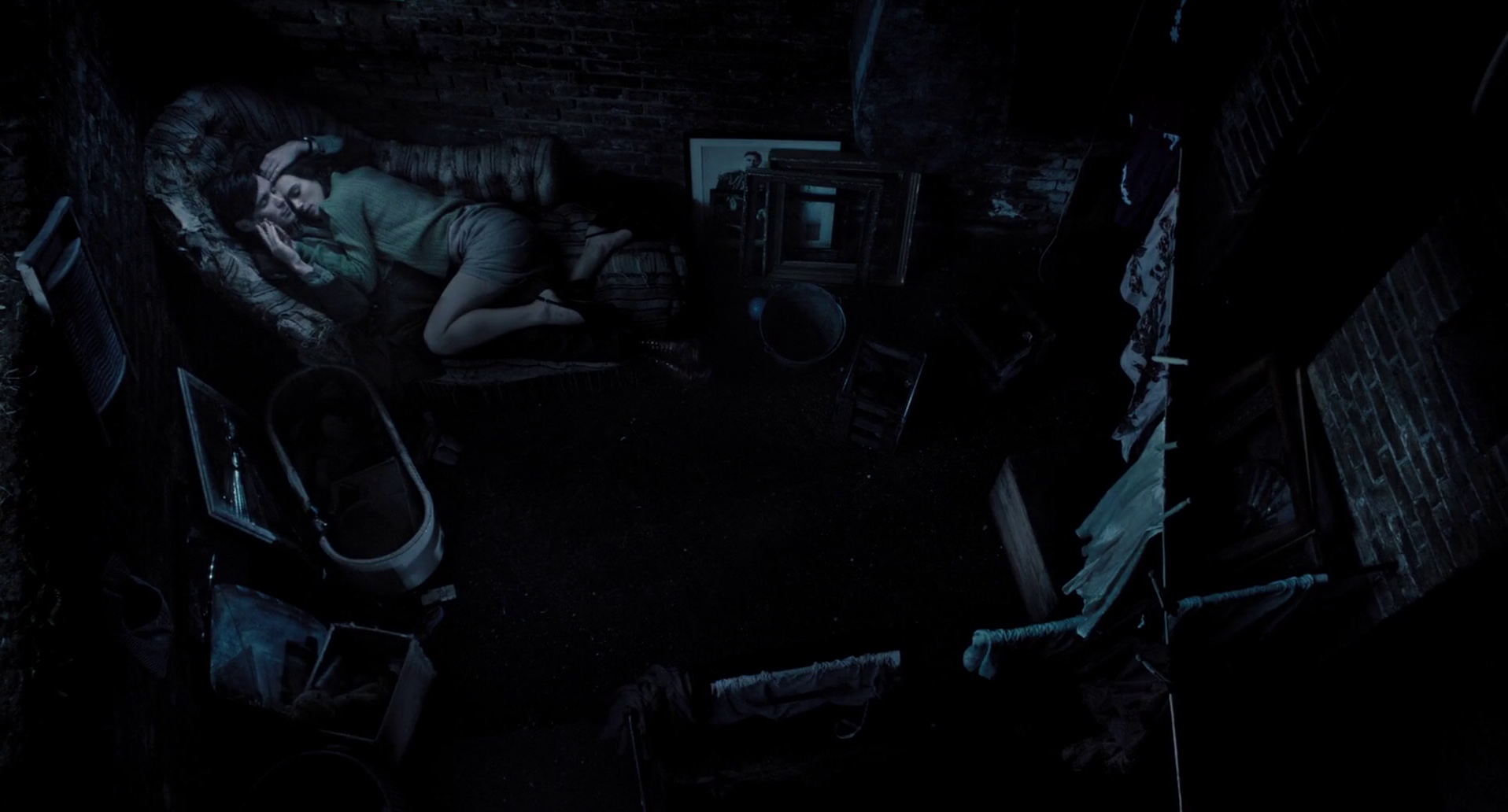
The same composition is applied when the couple is lying on the couch amidst the disarray of household items. The elevated positioning of the camera further adds to the ever-fleeting illusion of hope as he fights to steer her attention away from the rekindled passion for her teenage love:
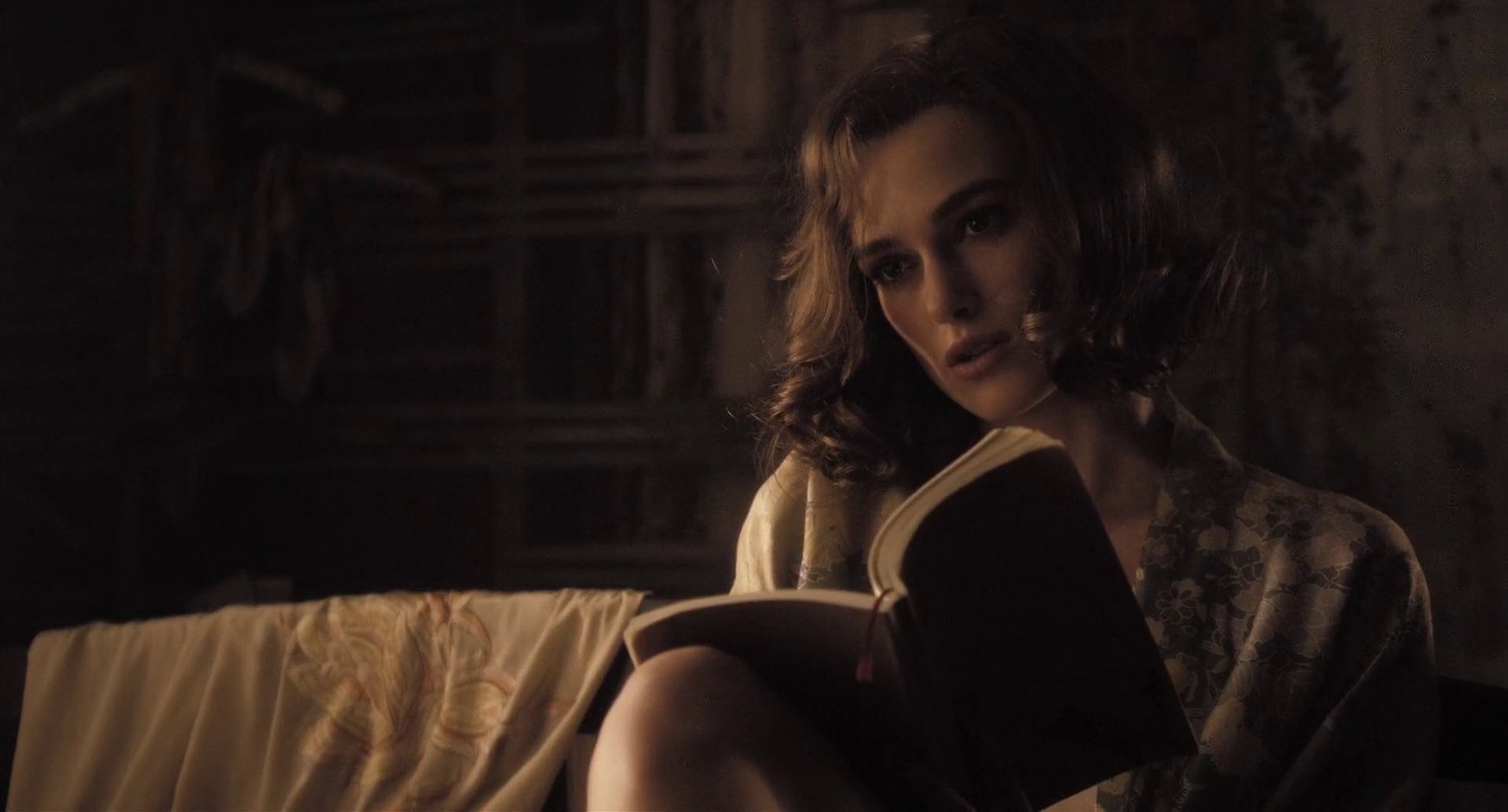
The wartime blackout mandated in the British capital is enforced by stripping almost all the colors from the interior scenes. But even the extremely limited palette of washed out ochre, olive and leather brown is enough to show the characters’ desire to surround themselves with beautiful objects – in this case intricately patterned textures of clothing, wallpapers and drapes:
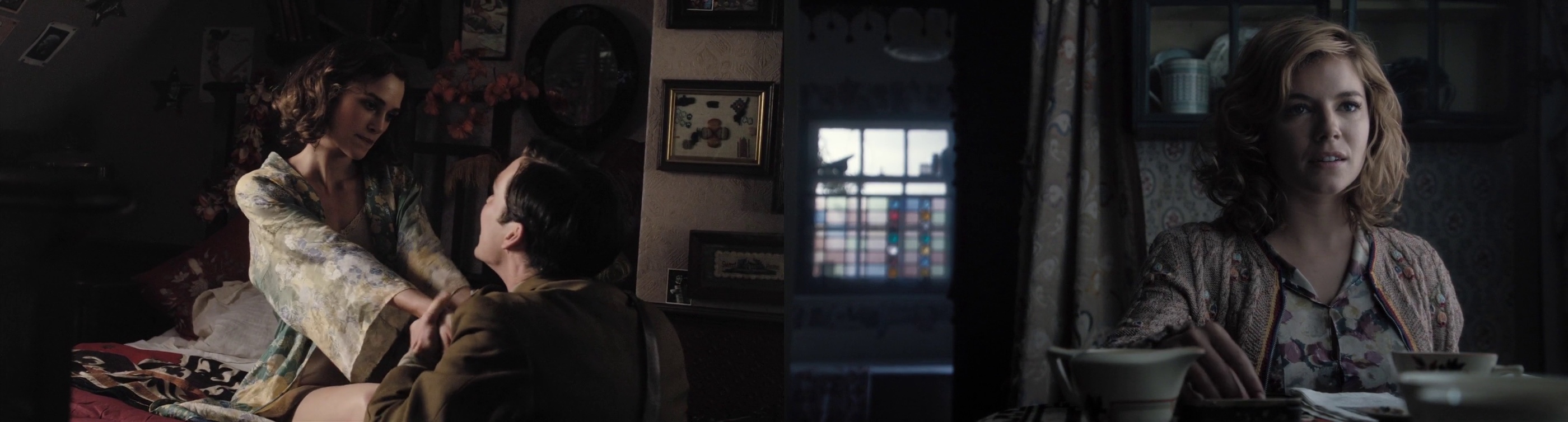
As the characters are confined to closed interior spaces, the camera spends a lot of time following the rare intrusions of external light. Here, the almost horizon-level sunlight penetrates through the window as a precise light pyramid:

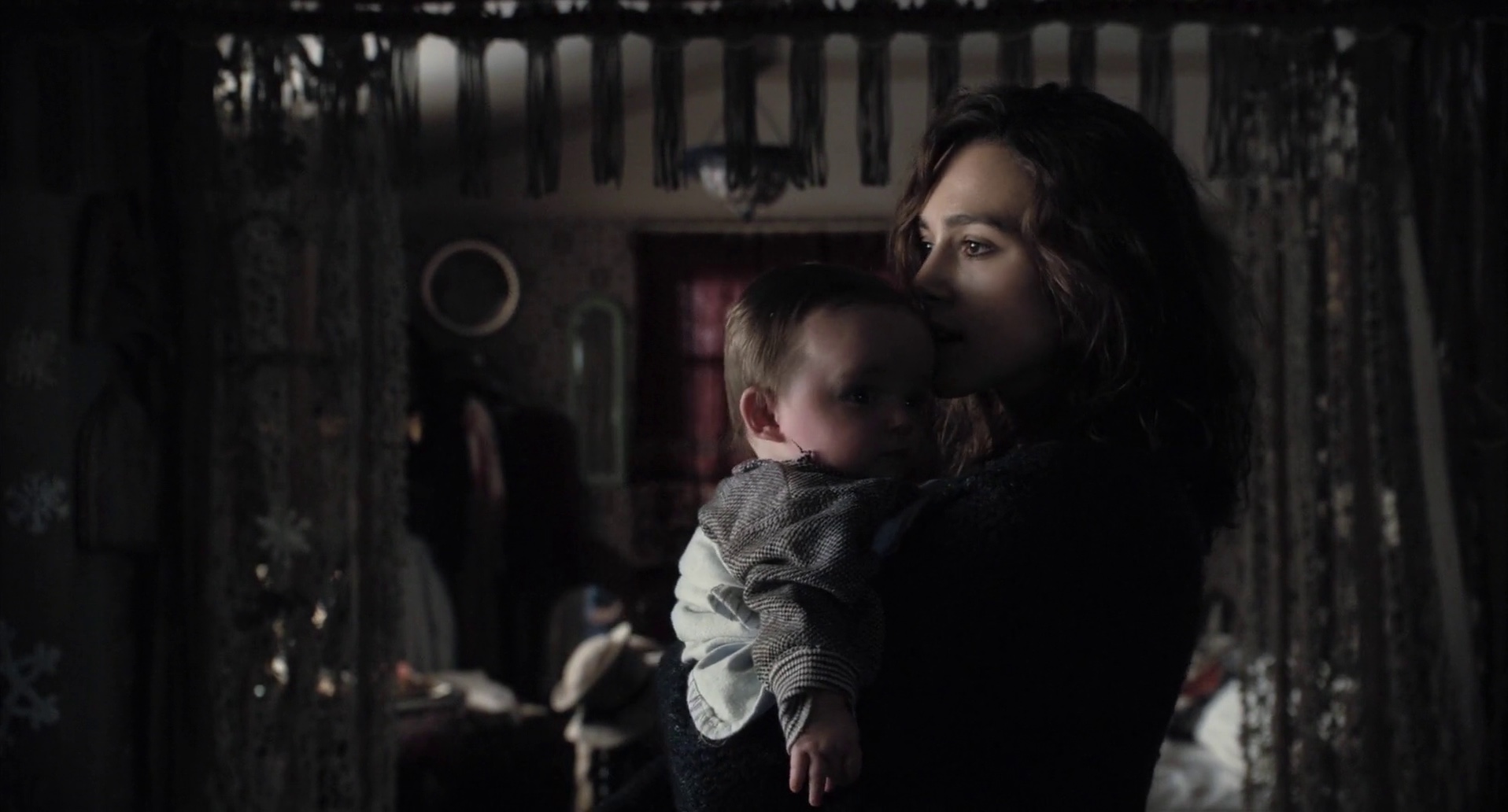
And here, in one of my favorite scenes that lasts for mere seconds, Keira Knightley moves across the floor, as the strong directional light coming from the left creates a beautiful chiaroscuro effect when she gently sways the baby:
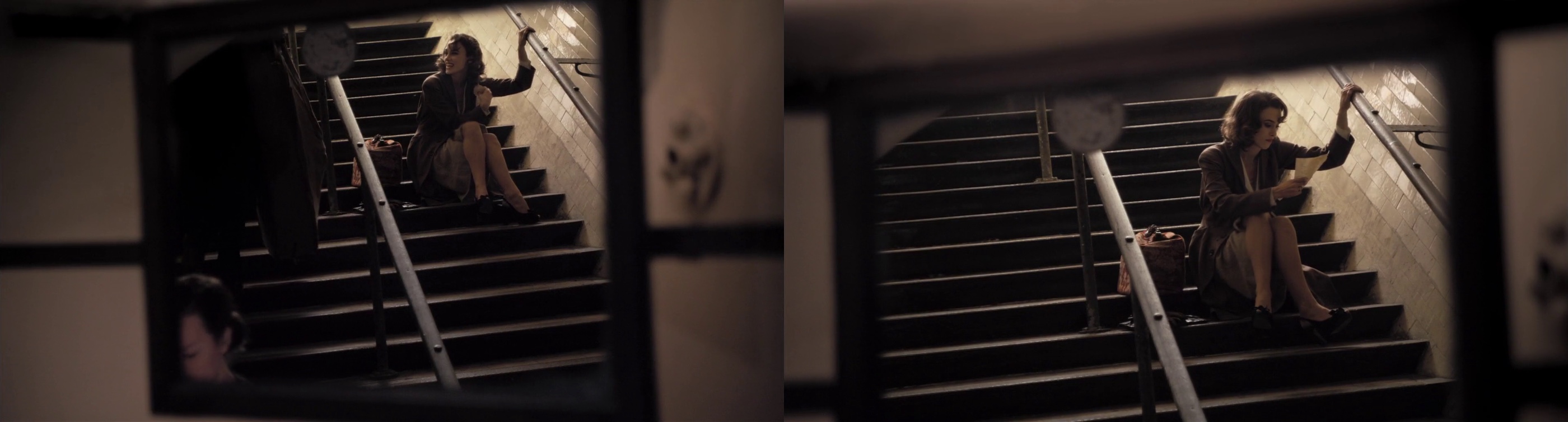
The feeling of loneliness in the scene where Keira’s character is reading the letter from her husband, sent across the Europe to fight in the war, is accentuated by yet another frame-in-frame composition, this time combined with slanted window frames reminiscent of the earlier pub sequences:
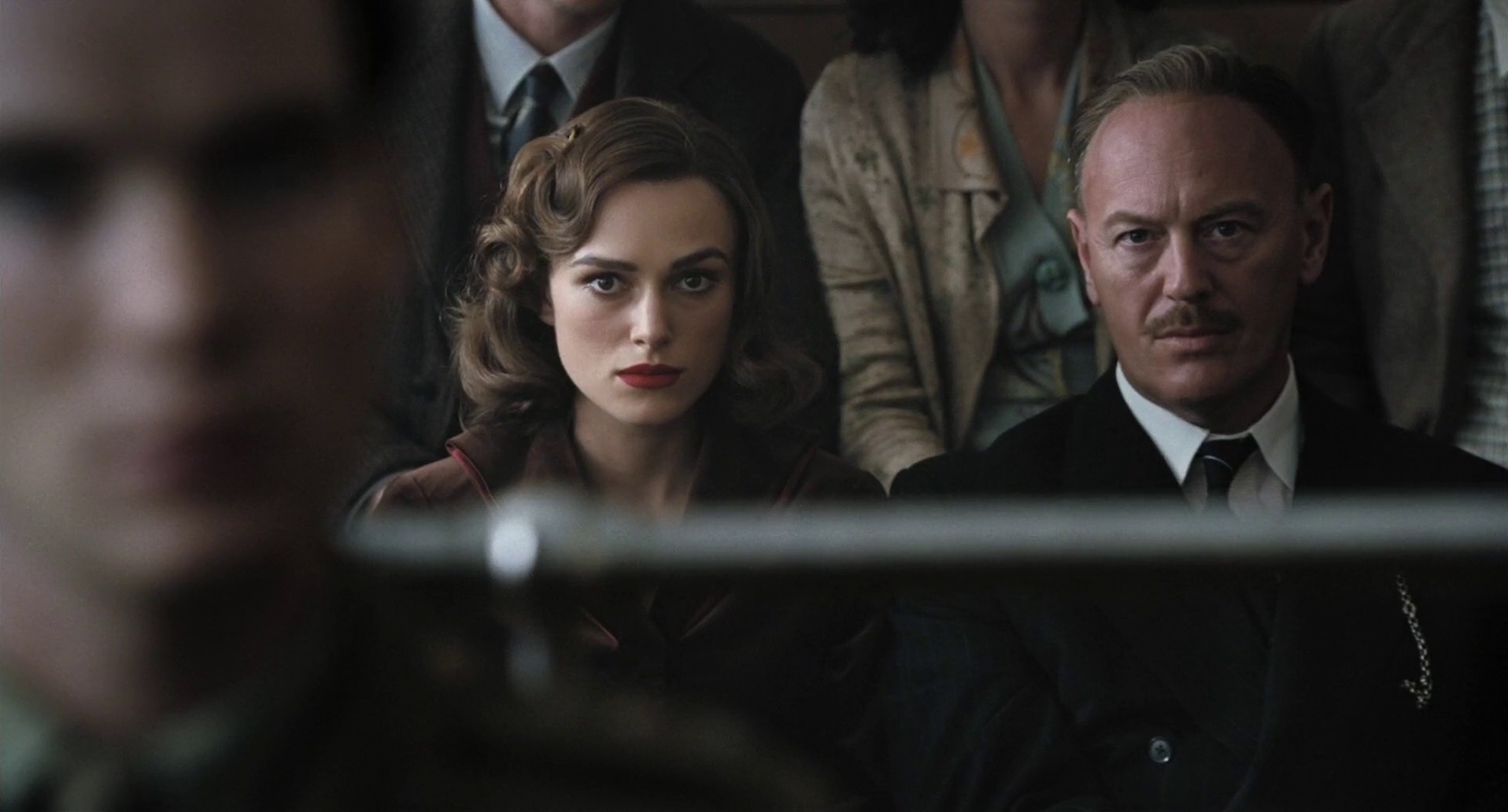
And a different variant of the same technique, effectively separating the scene into three groups – Cillian’s character standing close to the viewer, the group sitting in the back and the person who they all look at that appears to be behind the viewer to our right:
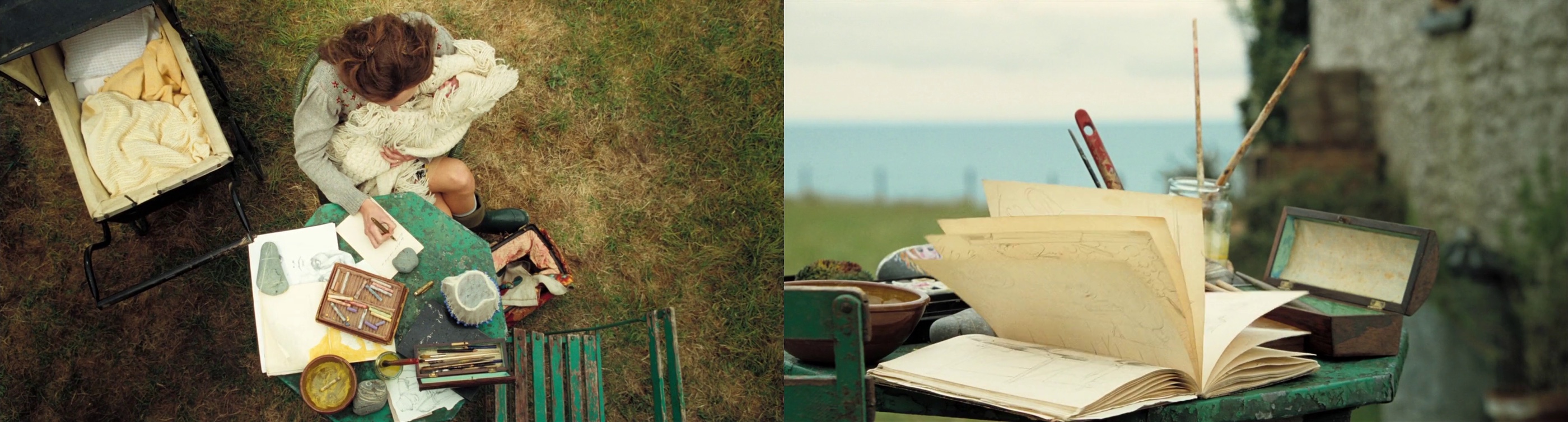
As the second part of the movie takes place in Wales, we get to see more of the outdoors. In this sequence that brings together a few of the techniques mentioned above, the worn out turquoise furniture is a perfect compliment to the greens and blues of the nature, as well as leather browns of the writing set:
Storyboarding is one of the first steps on a long journey that takes the written word of the book or script to the final finished movie. John Greaves is one of the more prolific storyboard artists in the recent years, with such titles as “The Bourne Supremacy”, “Tomorrow Never Dies”, “The World Is Not Enough”, “Children of Men”, “Chronicles of Narnia”, “10,000 BC” and the recently featured “Emma” on his impressive resume. I’m very grateful to John for kindly agreeing to answer a few questions that i had on the craft of storyboarding.
Kirill: Tell us a little bit about yourself and your path to become a storyboard artist on major Hollywood productions
John: I trained originally in fine art and photography. I started my working life as a photographer, but also drew cartoons and caricatures for various magazines. During the 80’s, I also wrote children’s books. Towards the end of that decade, a friend asked me if I would do a storyboard for a music video he was directing. Through doing that, I realized that this was probably the path I should be going down, as it involved aspects of everything I had been doing up until then.
Kirill: Are you usually the first member of creative team to join the director? What is storyboarding and what is the process of translating the director’s vision of the script into the keyframes?
John: The storyboard artist is usually brought on to the picture early on. There have been occasions where there has only been me, and the director. Usually though, the production designer has started to design sets and find locations. Directors work in different ways. Some have a clear idea of what they want, so I only have to draw up their ideas and fill in gaps, others like you to collaborate more, and some like to leave you to it and see what you come up with. Storyboard artists work in different ways, but I prefer to write a shot-list. From that, I draw a rough thumbnail board, which I will go through with the director. He, or she will then makes any alterations. I will then draw up the finished board.
Kirill: Your storyboards show a lot of attention to camera movement, main action focus and lighting. What visual cues are expected to be in the storyboards, and how detailed are they supposed to be?
John: My personal thought about a storyboard, and this is one that I have expressed whenever I have talked to students about it, is that it’s not about pretty pictures, but about information. For that reason, the board needs to be produced concisely, but quickly and with as much relevant information as possible. I use a lot of arrows with camera moves and will draw as many frames as are nessassary to tell the story.
Kirill: Does it happen that storyboarding changes the initial scripts as the keyframes are fleshed out?
John: Scripts are organic things and change all the time. Locations, sets, stunts, VFX all effect the script and are all reflected in the storyboard. Often the storyboard artist will make suggestions and these usually end up in the script as well.
Kirill: How long do you usually spend on a single movie and how many frames do you typically produce?
John: As I mentioned before, I will do shot-lists and roughs before I get to the finished board stage. The amount of frames I draw depends on the level of finish required, but between 25 and 50 per day.
Kirill: Do you prefer hand sketching or digital tools? What is your actual production process?
John: I tend to draw by hand, then scan it in and render on computer using Photoshop. With this, I can also replicate frames, or parts of frames and put in focus-pulls etc.
Kirill: Your recent work included such VFX-heavy movies as “Prince of Persia” and the sequels to “Ghost Rider” and “Clash of the Titans”. Does it involve more elaborate digital pre-viz sequences?
John: These type of VFX films do generally pre-viz sequences, but only really after they’ve been storyboarded. All of this becomes part of the organic process of film making. Things change all the time.
Kirill: As the industry is transitioning to 3D productions, how does that effect storyboarding?
John: To my knowledge, it does not affect the storyboarding process at all, just makes the shooting process a lot more complicated.
Kirill: Some of your productions, including “Prince of Persia”, “Children of Men” and “Chronicles of Narnia” involved multiple storyboard artists. What is the group dynamics and how is it different from productions where you’re the only one working on story boards?
John: I generally prefer to be the sole storyboard artist on a production, mainly because in theory it means I’ll be employed for longer, but when we work together it’s great. Often nowadays, with it being so easy to transfer large files online, we find ourselves working from home. I’ve just done a film from my home in London when the rest of the production were in Atlanta Georgia.
Kirill: What is the importance of black-and-white story boards? Why the color is excluded?
John: There is no need for colour as a film shooting board is simply that. A document that shows how the film will be shot. Colour would slow down the whole process, for me anyway. Colour is still used on boards for advertising, but that’s more to do with pleasing the clients.
And here I’d like to thank John Greaves once again for his work on “The Edge of Love” and agreeing to the interview.
Take you favorite movie and remove all the actors. You will see a combined creative work of two people – cinematographer and art director. In this conversation Sarah Horton takes a deep dive into the craft of art direction, shedding light on the fascinating fusion of the artistic and financial sides of movie productions. In the last few years Sarah took the role of art director on “The Bourne Supremacy”, “Aeon Flux”, “V For Vendetta”, “The International” and, most recently, “Hanna”. The second part of this conversation focuses on “The International”, an action thriller that follows Clive Owen and Naomi Watts as they unravel the role of a high profile bank in an international arms dealing ring.
Kirill: Tell us about your path so far in the movie industry
 Sarah: I never went to film school. I studied History of Art at London university and by chance, my summer job was working at the Edinburgh film festival. This was my first contact with film and it started to really interest me. Shortly afterwards I started working as an Art Dept. volunteer at the National Film and Television School just outside of London and realized that this was absolutely what i wanted to be doing; In those days the Film School only had courses for camera, direction and production so the students with graduate film projects were always looking for help on the design side. After having worked there for a while, I started writing to various designers and after a few more films, started work at Elstree Studios, which was then one of the major studios in UK, where films such as ‘Star Wars’ and ‘Indiana Jones’ were made. This was during the early eighties when many large-scale movies were being made in the UK, like “Labyrinth” and “White Nights”. I started working as the Art Dept Assistant on a movie called “Young Sherlock Holmes and the Pyramid of Fear” directed by Barry Levinson and produced by Steven Spielberg.
Kirill: And so you progressed to assume bigger responsibilities as the time passed?
Sarah: I literally learned my trade within the industry, and consider myself very fortunate to have had this chance. I learned from some wonderful professionals, many of whom are no longer with us. Their background were films like “Dr Zhivago”, “Lawrence of Arabia”, “2001” and of course all the Bond movies and I feel that what i learned was gold dust because it was that old fashioned way of making movies which doesn’t exist anymore. It is the best training I could have had.
Kirill: Do you see a difference between European and US movie productions?
Sarah: Not really. Most of the work that we do here is funded by Hollywood, coming to Berlin or London simply because the rate of the dollar against the local currency makes it economically viable. Most of the movies that i do are Hollywood or American-based productions, and the way they are made is very similar. There are some differences in crew structure, because of the unions but these differences are minimal. However, I also work on smaller local German productions for a very active German market – and they are quite different, simply because there is a lot less money available for each production. Having said that it’s still a market for a population of 80-million, many of whom are happy to pay money to watch movies with well-known stars in their own language.
Kirill: Transitioning into the role of an art director, your job is take the creative vision of director, cinematographer and production designer and make it a physical reality.
Sarah: My boss, the production designer, creates the visual identity of the film. My job as the art director is to realize that identity in physical form which takes the shape of sets and whatever else goes along with the script. The Production Designer establishes a kind of visual scaffolding, defined by color, light, texture and contrast in which I am free to operate. In discussions with the Production Designer, the Art Director is responsible for the construction of the sets and they can take many forms. It can be a set in the studio (like The Guggenheim Museum for “The International”), it can be a location where shooting takes place over a couple of days with minimal or more complex structural alterations of the existing space, including furniture and dressing, or it can be a mixture of both – a “set on location” – where a big set is built within an existing space, using the original features or not, as required by script, budget, logistics and director.
Kirill: In his interview for the “100 Careers in Film and Television” Jeff Mann says that “dealing with money and budgets is probably what I most dislike; trying to put a price tag on aesthetics”. Do you share this sentiment?
Sarah: It’s a constant struggle. As an art director, you’re expected to be both a financial and creative genius, coming up with solutions that don’t compromise the vision of the production designer but at the same time fit within the confines of the budget. It’s a give-and-take process, where the Art Dept budget is spread out over all the sets. However, since one can never predict precisely in advance what the parameters of each set will be, the budget often has to be redivided many times over. It’s a question of being able to manage the money available, but i see this as a challenge not a restriction. It doesn’t matter how big the budget is, there’s always never enough money! Whether you’re working on a $5M, a $50M or a $100M movie, you still end up having the same conversations about what is affordable and what isn’t. I think this is interesting, because it proves that it’s the same process, and one has to think outside of many similar boxes to find solutions to budget problems. I guess that on big budget movies you have the possibility to go into much more detail – which is where the differences lie – more sets, more stunts, more special effects, more options on how to shoot, just more of everything – while on a smaller production you are forced to reduce everything down to absolute essentials.
Kirill: Do you feel constricted when you operate within someone else’s vision?
Sarah: I enjoy the freedom to ‘play’ within an existing framework and find solutions which work creatively and financially. I wouldn’t describe it as being constricted – working with a Production Designer is a process of combining ideas to achieve the vision of the film. Ultimately, anything is possible to recreate – it’s just a question of time and money, so for me, the ‘art’ of what I do, if you can call it art, is when you put those restrictions in, that’s when it becomes interesting for me.
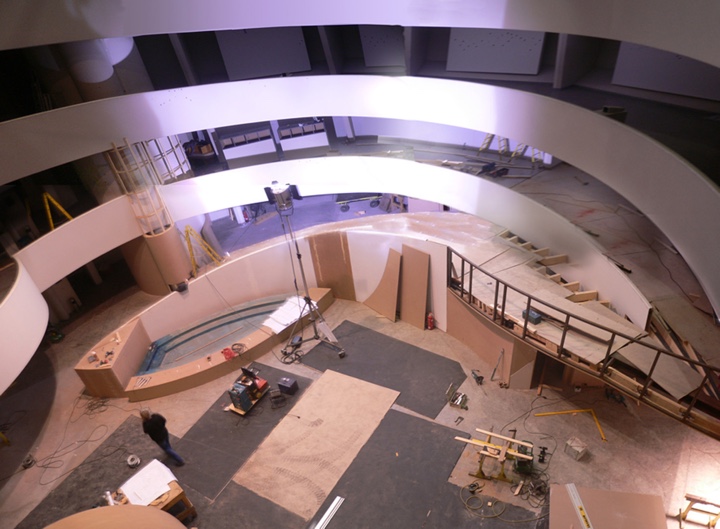
Kirill: When do you start working on the production?
Sarah: I start long before shooting begins, and continue up to the end of principal photography. An average shoot takes between 8 to 12 weeks but since it’s not possible to have all the sets ready and standing in advance of this, I work throughout shooting preparing the sets as they come up in the schedule. During pre-production most of the time is spent working out what each set is going to look like and preparing the construction drawings, surface finishes, stunt and SFX requirements, dressing, etc. Once shooting starts, it’s like a moving train which needs new sets to be ready for shooting sometimes on a daily basis. I’m always working one step ahead, getting the sets ready for the shooting crews, and as soon as they show up, i’m off to get the next set ready, while another team is pulling down the set that they’ve just finished on. I really like my job because i don’t have to stay on set all the time! (laughs)
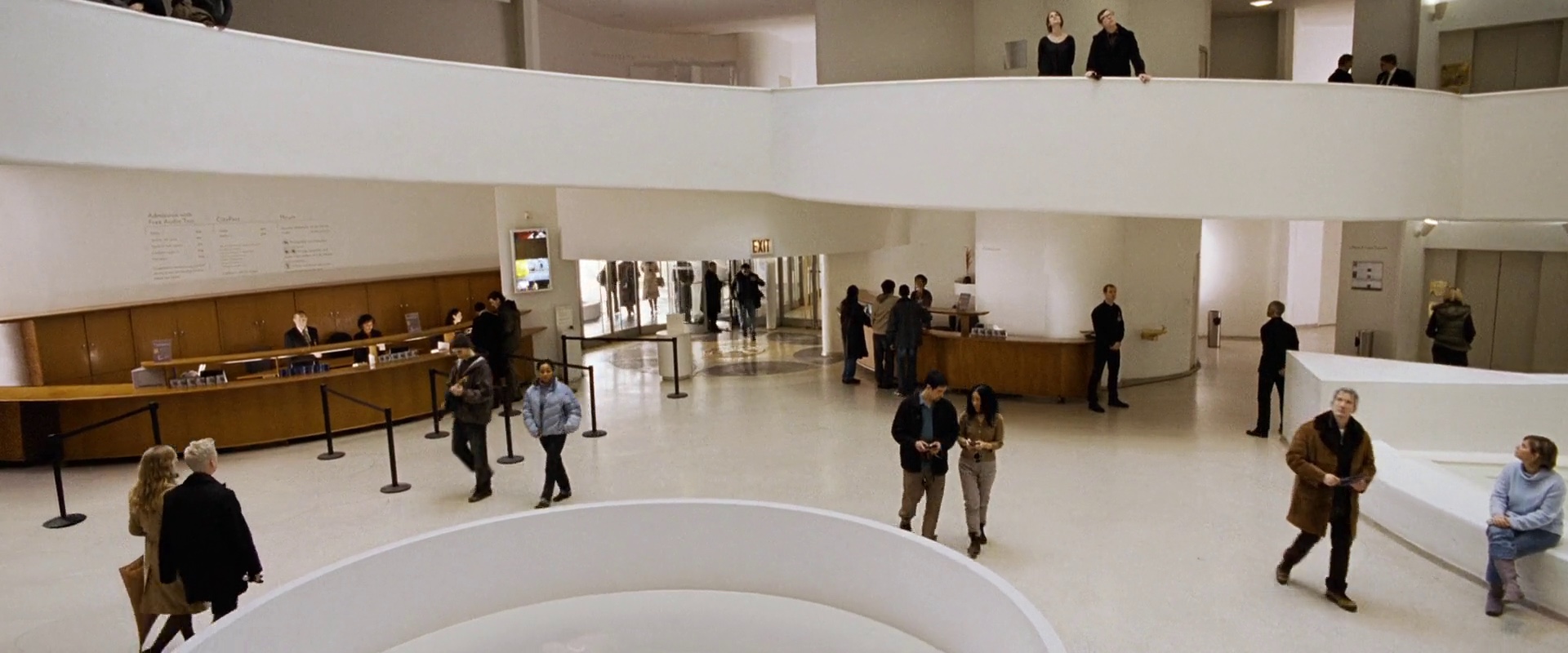
Kirill: You mentioned that anything is possible. What do you think about digitally-created fantasy environments of movies such as “Star Wars” and “Avatar”? What changes do you see in your craft of creating physical sets?
Sarah: It is changing, and it’s something that i observe more and more often. I think the approach to set building has changed but it won’t disappear. Compared to a production like “Young Sherlock Holmes” where something like 75% of the film were built sets and the rest a mixture of matte paintings, digital effects and animatronics, it’s almost the other way around these days. Having said that, my own experience is that visual effects are often sourced from the built sets using and extending from the physical surfaces and lighting. It’s much more difficult, time-consuming and expensive to start from nothing in the computer. And a physical set also allows the actors to directly interact with it, and all its furniture and props.
Kirill: The make-up designer of “Tron: Legacy” mentioned that almost all productions do reshoots a few months after the main shooting is done. Do your sets stay intact until the post-production is fully done?
Sarah: In the course of pre-production it becomes clear what the key sets are, the sets that are so expensive to rebuild that it makes it worthwhile keeping them with the option of a rebuild. When shooting has finished these sets are flat-packed, that is, they are taken apart and stored. They are kept until there’s a green light on the rough cut, which takes about 2 – 3 months after shooting is finished. The sets are scrapped when the reshoots are over. However, I should add that having the luxury of being able to afford reshoots is something that smaller German productions generally don’t have.
Kirill: How do you feel about the transient nature of what you’re creating?
Sarah: The funny thing is that i don’t mind that at all. I think that’s what makes my job so great – where else can I get to work on building a space ship for example followed by a medieval castle and then an iconic museum? Every set is the sum of many ideas – a statement of the film – and they exist for as long as is needed to tell the story. Film is story-telling. I am always looking for the next story and the next set. I was a little upset was when The Guggenheim was scrapped – it seemed to happen so fast! Striking a set happens in a tenth or less of the time that it takes to build.
Kirill: The real Guggenheim was not really an option given the sheer volume of destruction left by the hitmen by the end of the scene. In the “making of” video you talk about finding an abandoned structure in Berlin and recreating the entire location there.
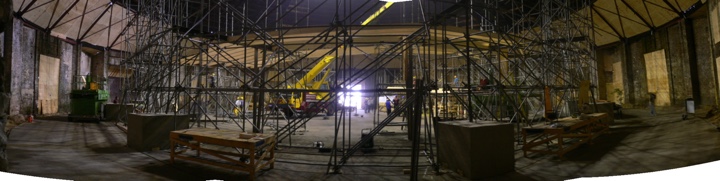
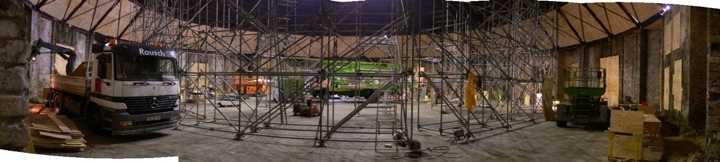
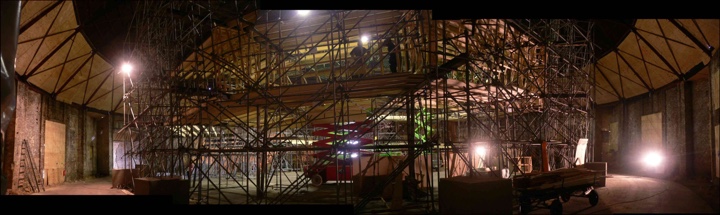
Sarah: It was right up the road from the studio and we could walk to it from our offices. It was an abandoned railroad shunting yard, and it was perfect. We looked at a lot of industrial spaces and we needed a span of 40 meters, about 120 feet, across without any pillars. It was very hard to find because most of the structures, like power stations, have some kind of support in the middle; this was the only form of architecture that didn’t have any support structure in the middle and was high enough to enable us to build the Guggenheim in it.
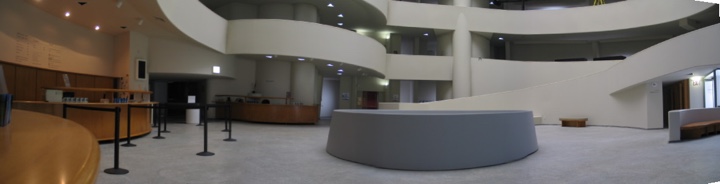
Kirill: And the goal was to create a one-to-one replica of the original?
Sarah: Yes, because we knew that we would be intercutting between the original and the set. For the scenes where Salinger (Clive Owen) looks up at the roof – that’s real. The chandelier that fell down at the end was built and added digitally to the scenes in the original building. All of the fight sequences were shot on our set. There’s a linking shot when Salinger comes in from Fifth Avenue into the foyer – and it was important that this matched to the built set.
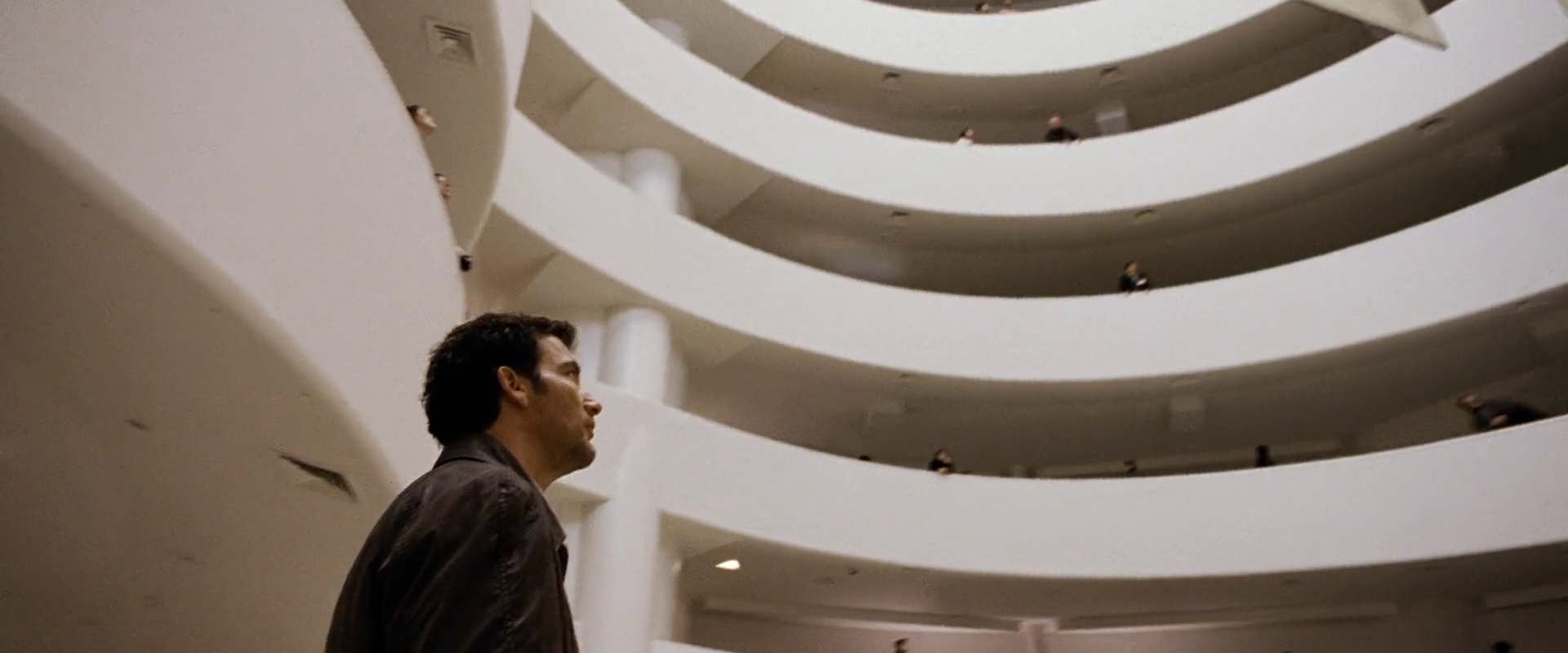
Kirill: And even though you did not use all the original materials, you started from the blueprints that you received from Guggenheim, building a sturdy enough structure to support the cast and crew?
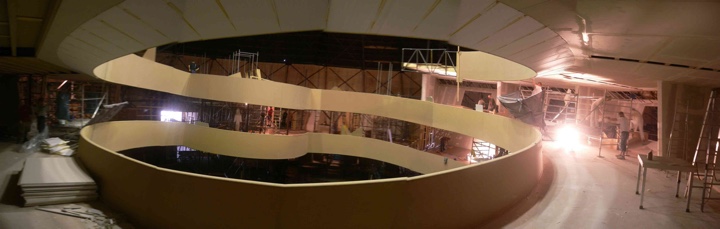
Sarah: We worked very closely with the Guggenheim. They sent us the CAD drawings which were tremendously useful. We built it to 90% of the real size, it had to be a little smaller to fit into the space. And we had permanent issues with the walkways, because the scaffolding frame had ramps which were cantilevered out four or five meters. So we knew that weight on the outside edges would be a problem, and none of us really knew how well the structure would hold up to the shooting crew. Crews have a tendency to all gather around the director [laughs] and the first few days were spent moving equipment and people to spread the loads which was pretty time-consuming until everybody got the idea.
Kirill: The Guggenheim sequence lasts about ten minutes in the final cut. How much time did it take you to create the set?
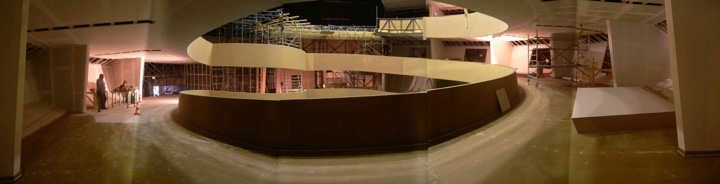
Sarah: We had 12 weeks to build it. I started on the film in April 2007, the construction started around July and we shot on it from September to November of that year – main unit and second unit.
Kirill: Destruction is the main theme of the sequence. Even though there are no explosions, and the building stands after the fight is over, there are thousands of bullets flying around, screens smashing, chandelier collapsing. Is there anything special you do when you build a structure destined for destruction and recreation?
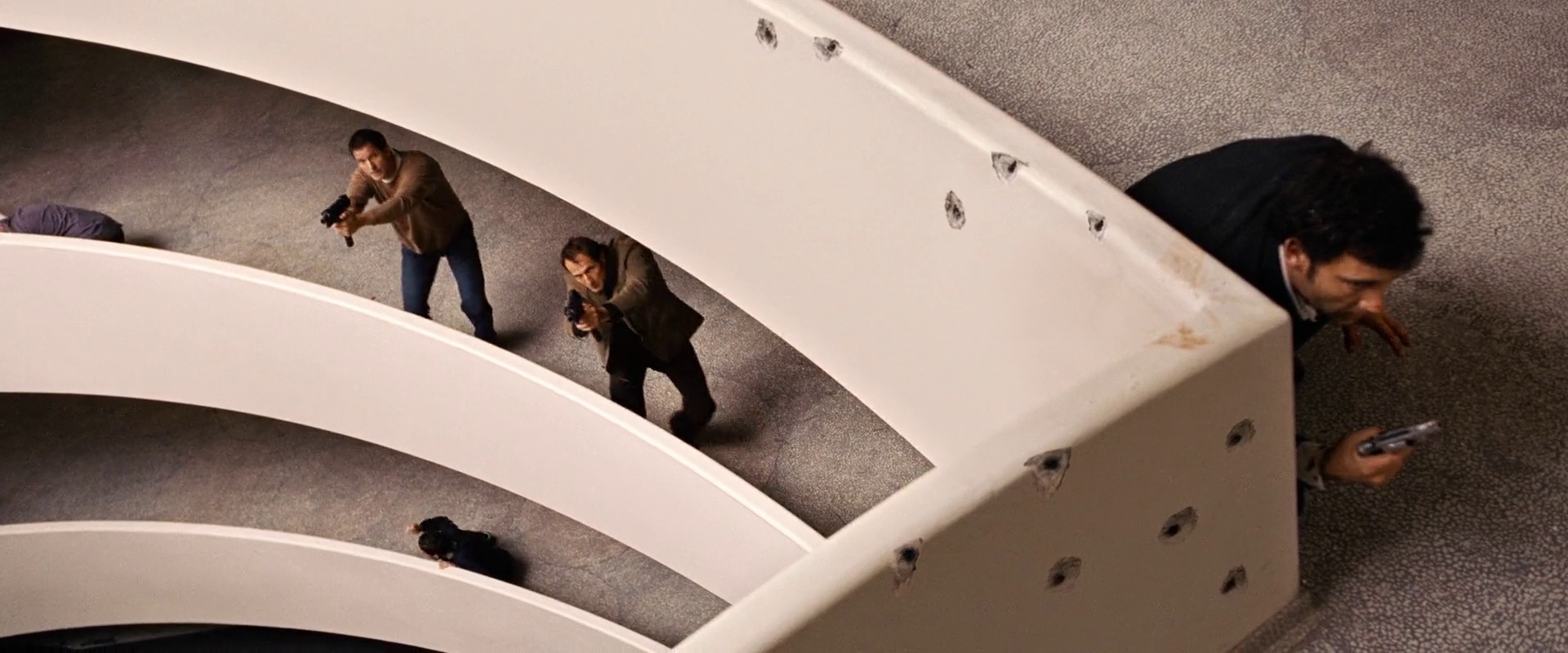
Sarah: We had some complicated breakaway walls. Breakaway walls are squibbed by special effects, who build in charges that recreate the ricochet of machine gun holes when set off electronically, in sync with the action. As the Guggenheim walls are all slightly curved, ramped and slanting, it was a real challenge to set up the breakaway walls. The shootout was shot by the second unit, and there was a phase where we were working in 24 hour shifts. The second unit would come in and shoot all the scenes in the daytime until about nine at night, and then either myself or the 2nd Unit Art Director, Daniel Chour, would get instructions from the first AD as to what would be shot the next day. Then a second shift of craftsmen and SFX technicians would come in and prepare new walls as dictated by the shot list and stunt action. It was very intense, but it was the only way to stay on schedule.
Kirill: There goes your favorite part of not staying on the set
Sarah: [laughs] I stayed overnight with the second unit. The second unit art director and i swapped, with one of us doing the day shift and another the night shift. So yes, i was much more active on this set, while the main unit were shooting all over Berlin on other locations – which was being taken care of by other people.
Kirill: Did you also create the art exposition itself?
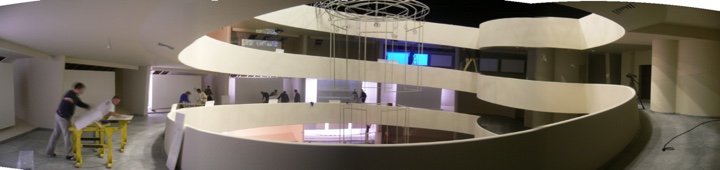
Sarah: At a fairly early stage Uli Hanisch the production designer and Tom Tykwer the director began to research the exhibition and as a result made contact with Julian Rosenfeldt who is a video artist. Tom and Julian made a concept together of the exhibition which covered all six ramps since the action plays from the top level down to the foyer. We built a polystyrene model of the entire Guggenheim Rotunda at 1:10 scale which was big enough to walk into, and into which Tom and Julian built the exhibition. Julian supplied all of the video artworks for the exhibition and we installed them using screens and projectors. Organizing this exhibition was a major job in itself for us, particularly because we had two phases of shooting. Initially ramps three, four and five were built followed by a revamp into ground floor plus ramps one and two. Of course the exhibition had to be revamped as well.
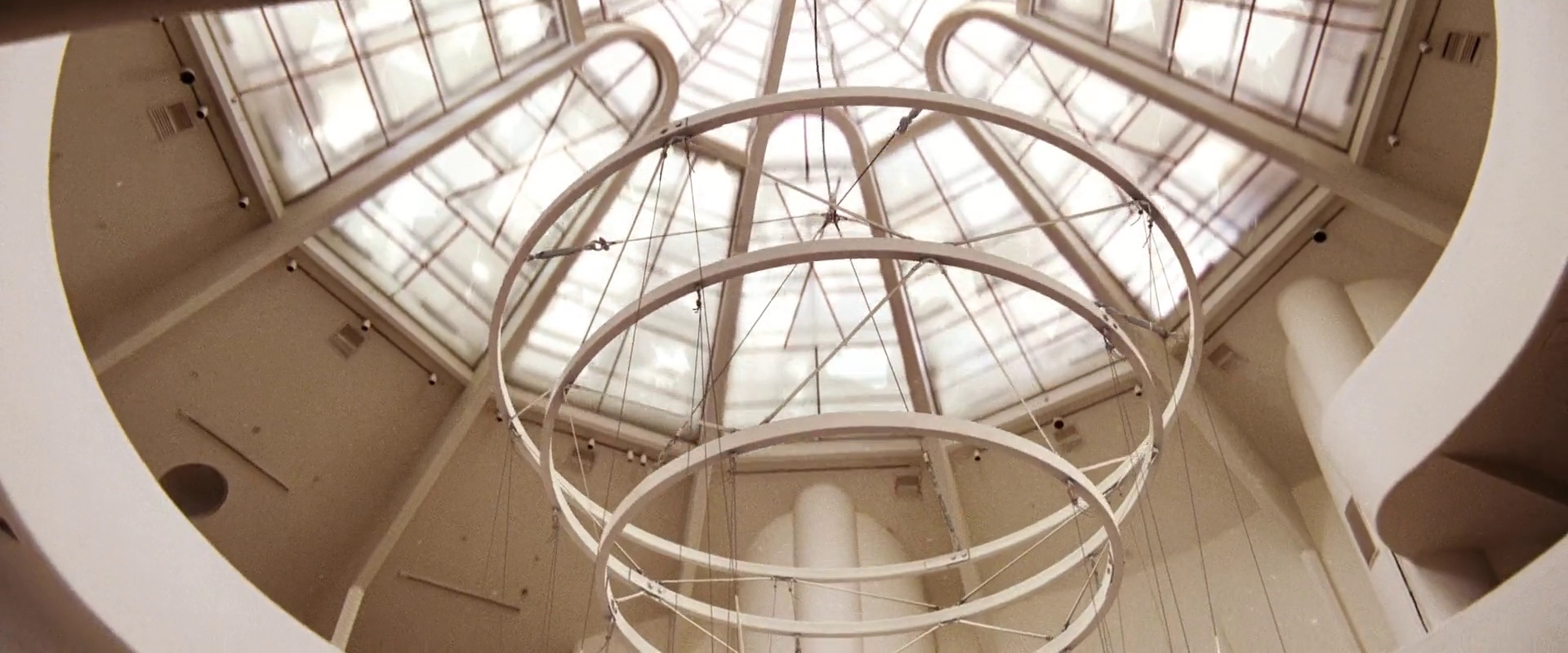
Kirill: What about the wide shot of the entire scene that gives a perspective of the overall destruction? Was that added digitally in post-production?
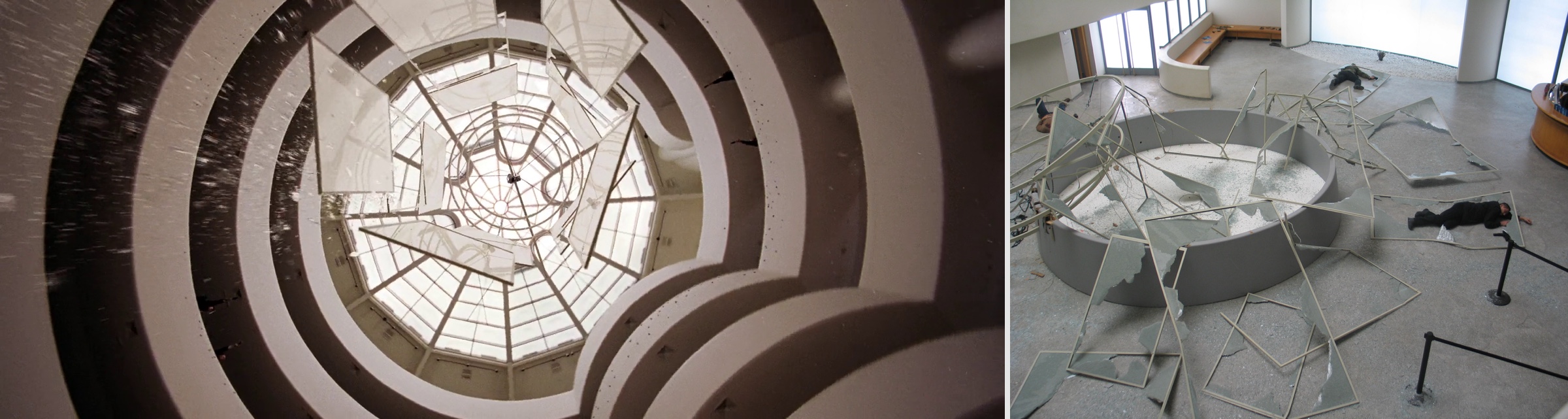
Sarah: No, that was built as a real set. There was an enormous amount of smashed glass on the floor, a mixture of real and rubber glass, much more than is actually visible on screen. So we built the chandelier intact, and a second time completely destructed on the floor. The fall sequence in between was a digital effect.
Kirill: The video exhibitions were integral part of the action sequence, allowing the characters to see each other.
Sarah: That was very much something that Tom took up at an early stage. Julian’s work lended itself very well to the idea that the characters see each other’s refections in the glass panels of the chandelier. There was also a connection between the stories being told in Julian’s videos and the action taking place in front of them. We hid all the projectors in boxes attached to the ceilings which go unnoticed since the eye naturally follows the action. We did have some issues with ‘bouncing’ images when the action was taking place on the cantilevered walkway immediately above. Fortunately you don’t see this in the movie!
Kirill: As you mention the eye following the action, i have a question about people who spend inordinate amount of time trying to find incontinuities or inconsistencies. Does that bother you?
Sarah: Not really! If the story is good enough, the inconsistencies are just a quirky side effect that does not detract from the film as a whole. People who spend time trying to find them are just as much fans as anyone else. There’s one particular shot in “The International” when Clive Owen escapes and there is a whole section of wall which simply does not exist in the museum itself. I guess that anyone who knows the geography of the Guggenheim might have noticed this, but it still doesn’t detract from the story, in my opinion.
Kirill: Do you spend extra time on such long scenes to make sure that you maintain consistency throughout the shooting?
Sarah: We do. Storyboards are really important for long action scenes and help to maintain continuity. We spent a great deal of time making sure that there was consistency on the bullet holes. We didn’t shoot according to the script and because of this, the number and position of the bullet holes varied, depending on where we were in the sequence. So we made huge templates using dust sheets to mark the position of the bullet holes for each section. This way we always knew where the bullet holes were supposed to be depending on which sequence it was. Even though this all happens in the background, it’s important to get this correct otherwise the audience would be distracted from the action.
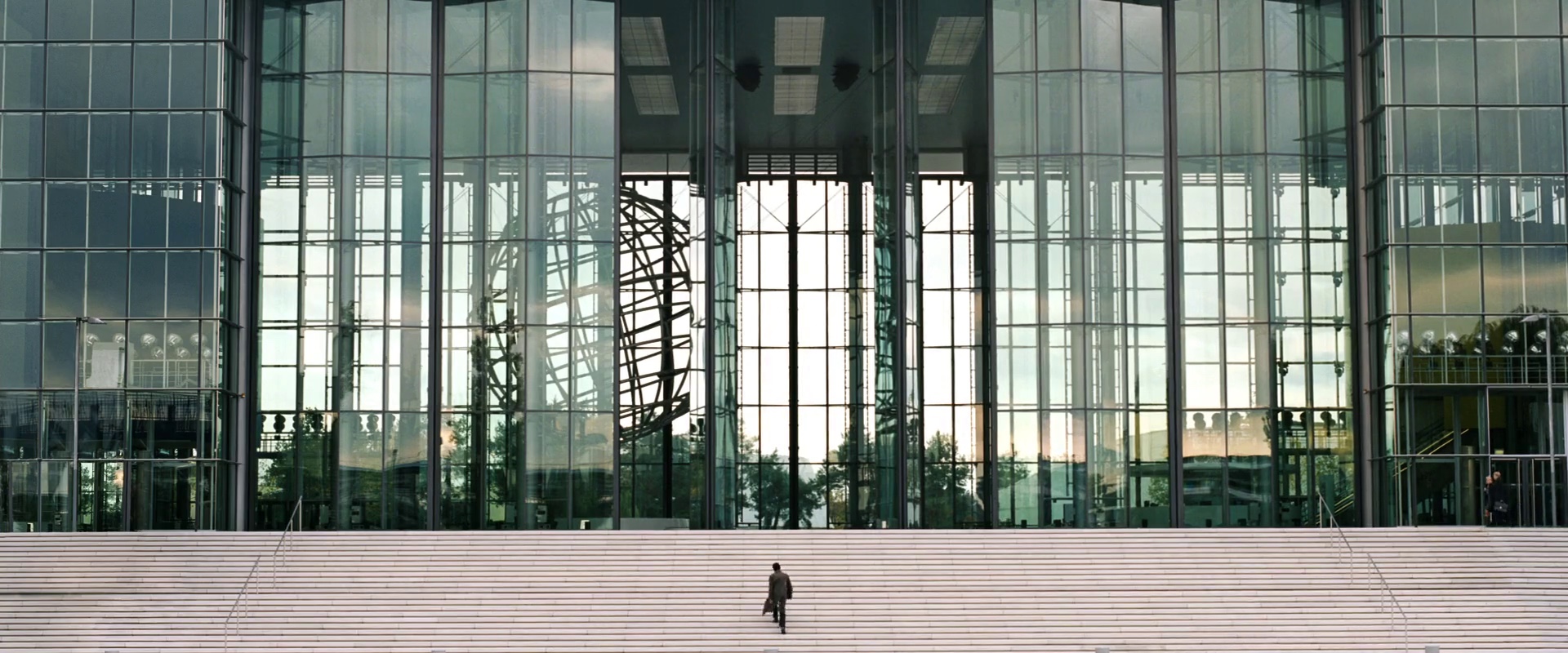
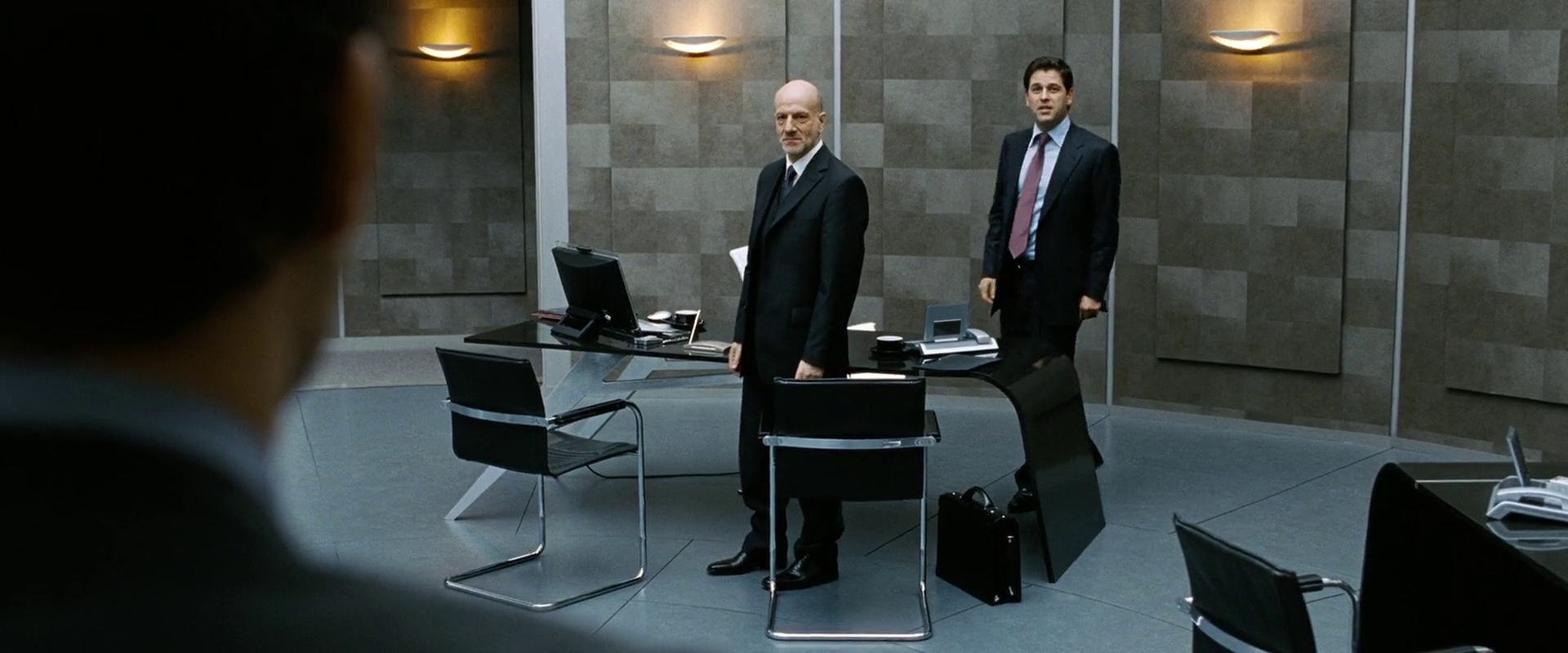
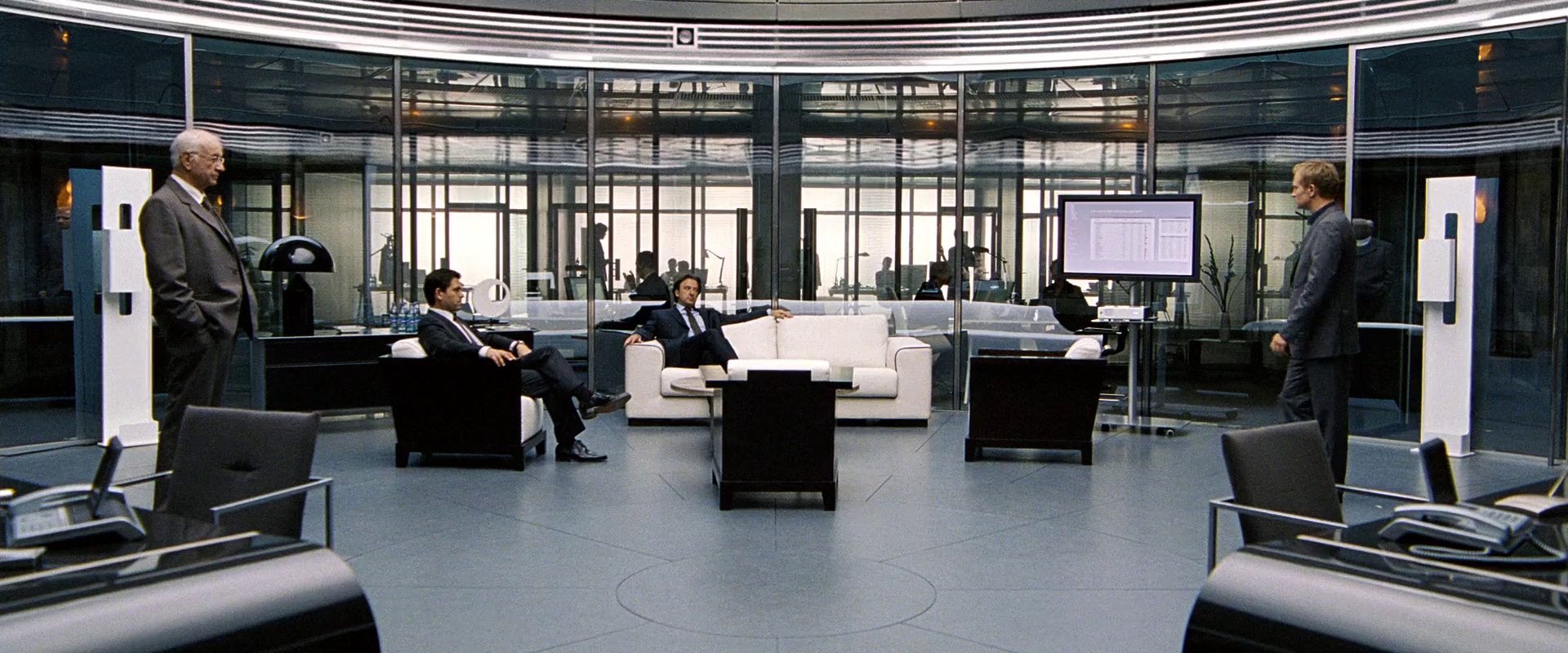
Kirill: Did you spend time on other sets? I was particularly impressed by the bank headquarters, with very stylish and spartan furniture, designed and arranged in a very attractive manner.
Sarah: That was another location in Germany about two hours from Berlin. It is the headquarters of Volkswagen in Wolfsburg, and the foyer with the globe is the main reception area. We also spent a lot of time on the interior of the offices rebuilding and converting several modern glass-and-steel Berlin office locations. It was an important element of the design that the coolness and minimalism worked within a realistic and believable environment without getting too ‘James Bond’ or futuristic.
Kirill: What about the overseas locations in New York and Turkey?
Sarah: When a movie shoots in several different countries you generally have an art director for each country. I was the art director for Berlin and Germany, which was the main chunk of the shooting. There was another Italian art director who did Milan and Turkey, and we had another local art director who did the last ten days in New York.
Kirill: Was it your most challenging production?
Sarah: Yes, I think it was the most challenging up until now and certainly one of the most fun as well.There was a great crew and the construction team was amazing. Recreating something like this is always about teamwork and I think everyone can be a little bit proud of what was achieved. Even if it was a one-to-one copy of an existing building and not ‘design’ in the purer sense, it was still a tremendous professional challenge and I am very happy to have been involved in it.
Kirill: Closing the loop on the evolution of digital productions, do you see your craft changing in the future?
Sarah: I see it changing, but i see that there will always be a demand for film sets. I think it’s important to keep up with new technologies and new software. It’s no longer just working by hand doing pencil drawings, but at the same time i don’t think that this will disappear either.
Kirill: Does it bother your eye to watch digital productions with computer-generated environments that, perhaps, lack the warmth of real-world textures and shadows?
Sarah: I thought “Avatar” was absolutely stunning. I enjoyed every minute of it, and it’s a huge achievement. I also think that 3-D means more people going back to watch movies in the cinema, at least in the short-term until 3-D television makes it into our homes. On the other hand, some of the great American TV shows such as ‘Game of Thrones’, ‘Boardwalk Empire’ or ‘Mad Men’ show that set design is alive and well! So I think it’s hard to predict the future; ten or twenty years ago nobody could have said or predicted what is happening now.
Kirill: Can you recommend some of your favorite movies, from the professional standpoint and in general?
Sarah: “The Assassination of Jesse James by the Coward Robert Ford” is my favorite production designed movie of the last few years. It’s so restrained but full of detail – i absolutely love it. I guess I’m a fan of design that supports but doesn’t overwhelm the action. Another favorite has to be “Eternal Sunshine of the Spotless Mind” – Jim Carrey is a fantastic actor. And “A Series of Unfortunate Events – Lemony Snicket” – the design is so playful and crazy.
Sarah has also graciously agreed to share a few behind-the-scenes photos of the Guggenheim recreation, conveying the scale and complexity of the construction process:

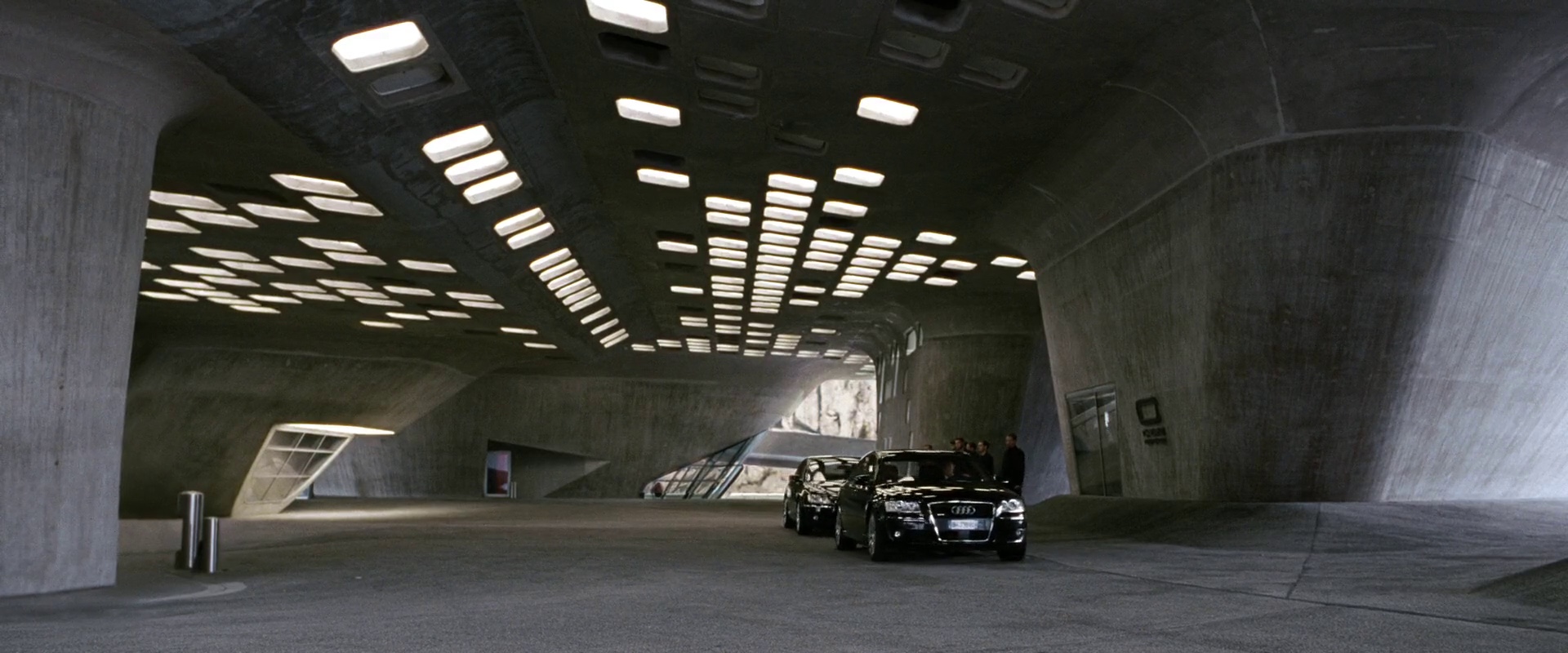
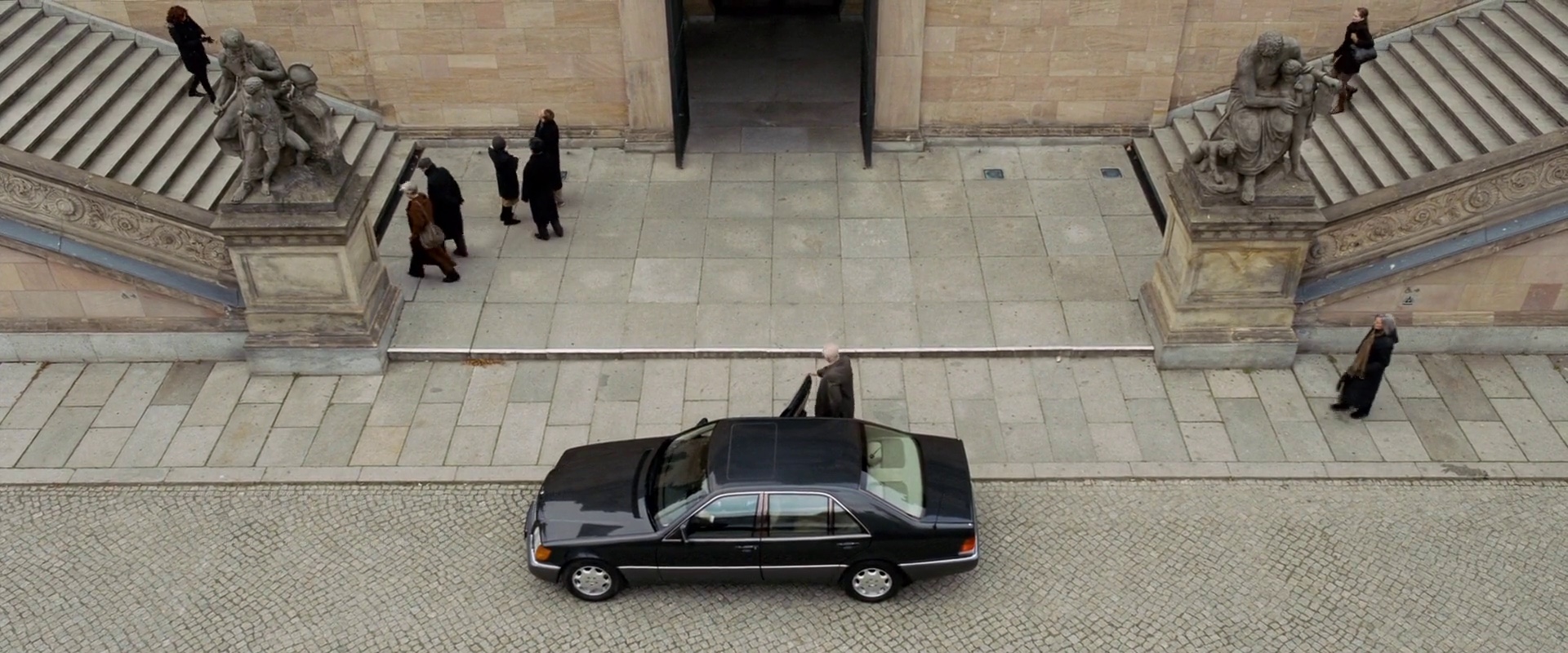
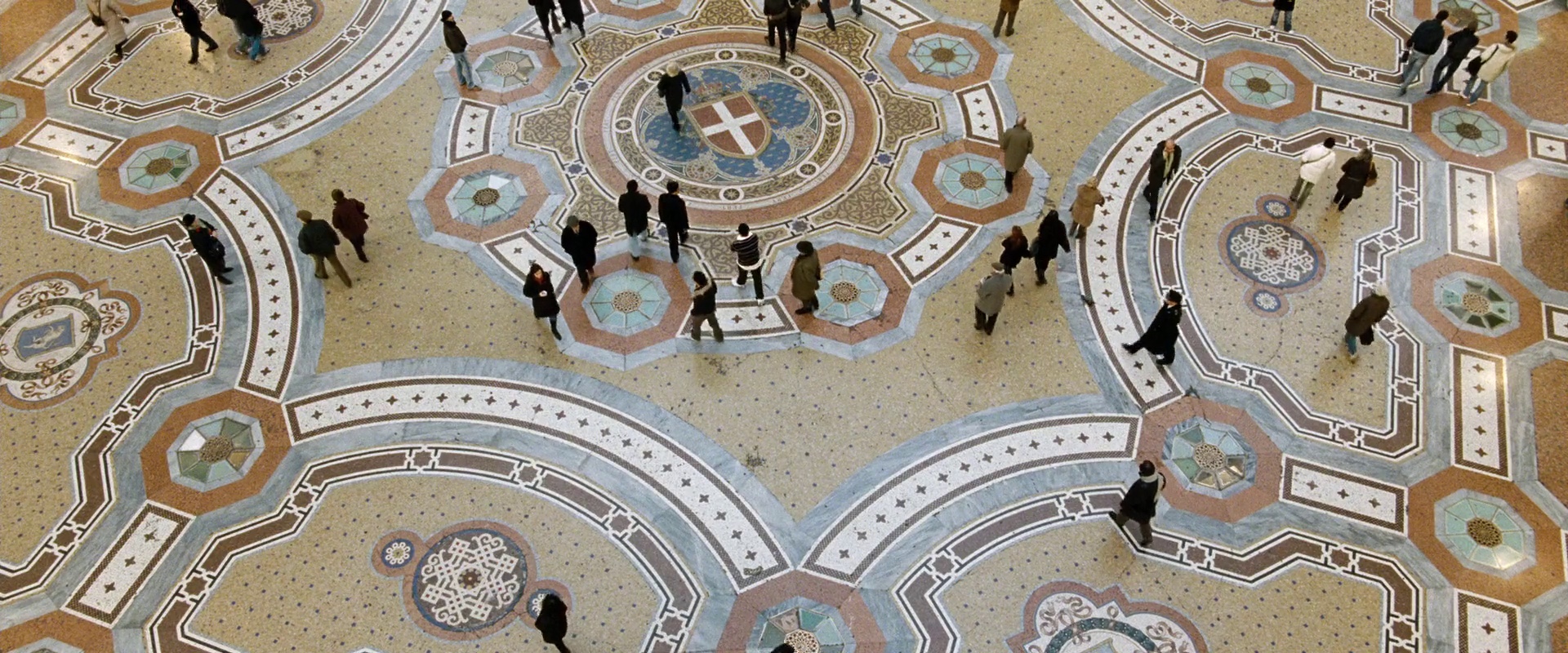
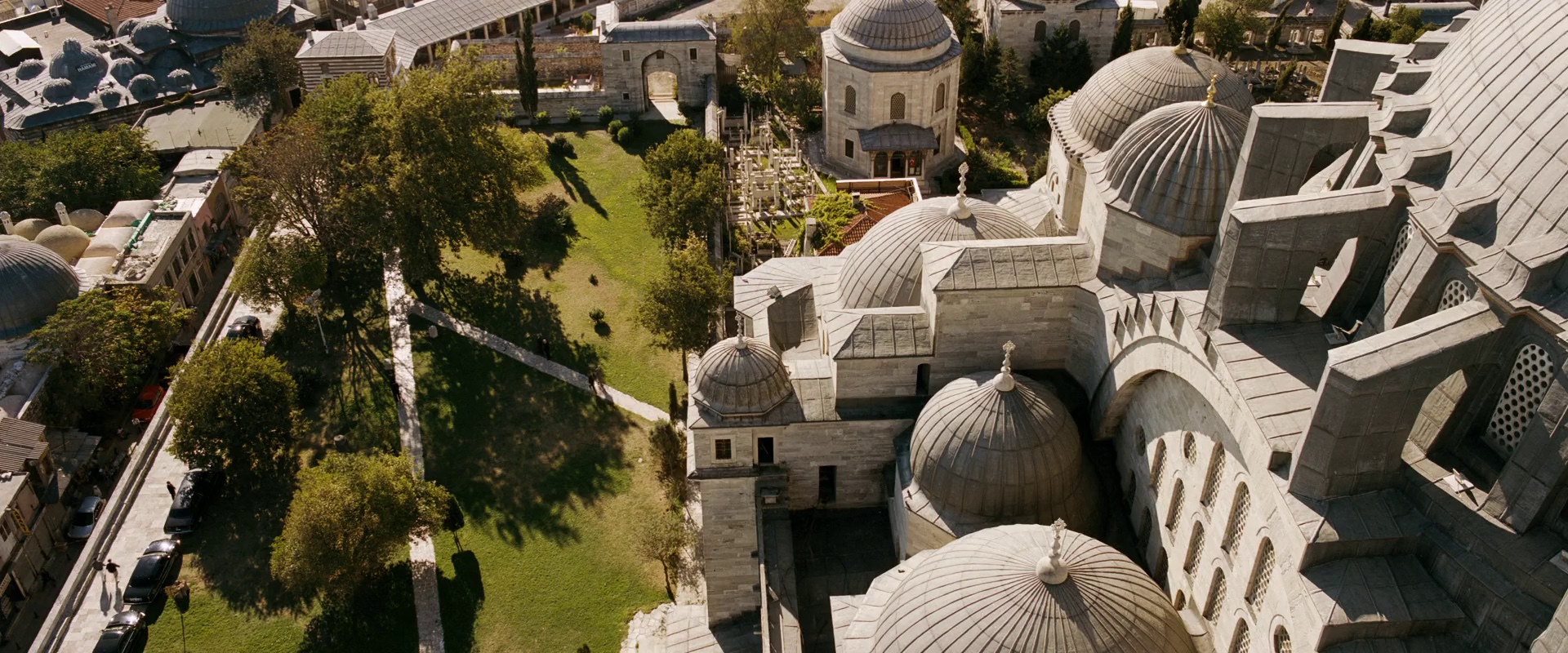
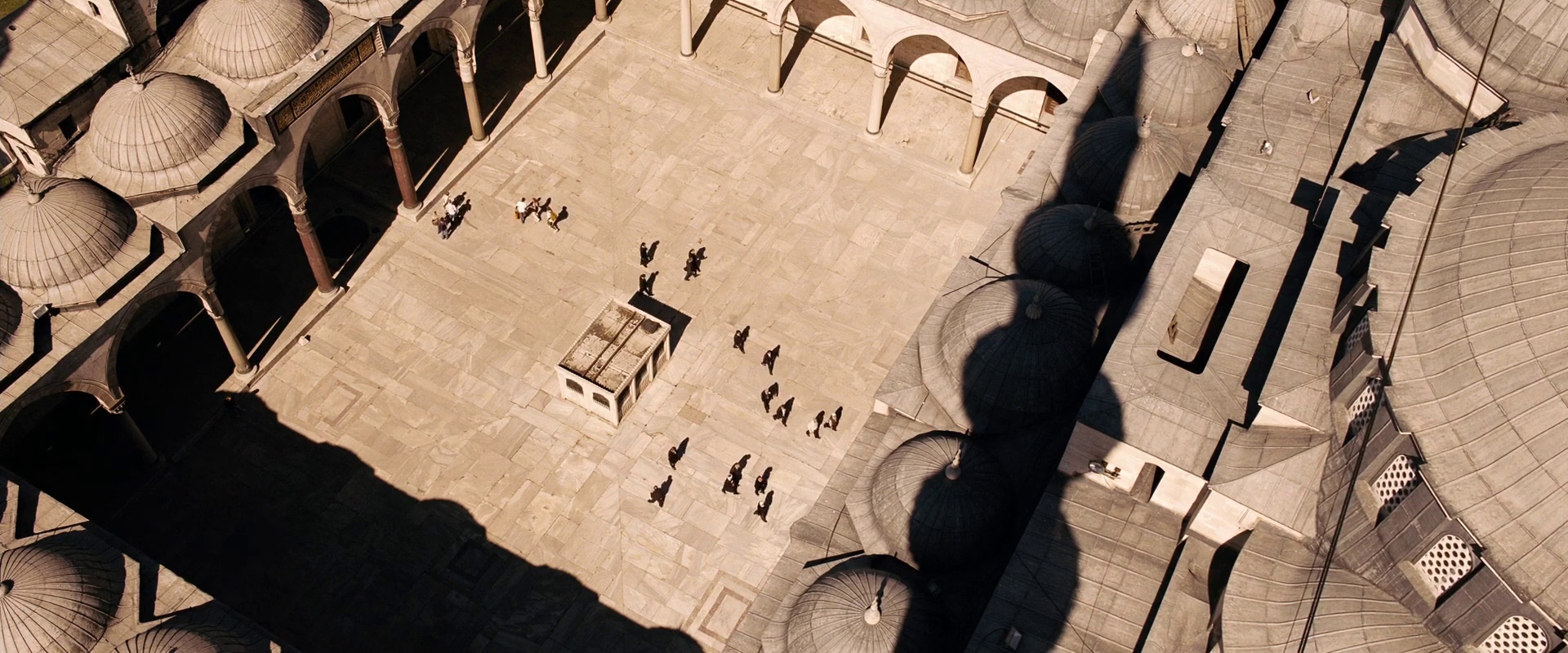
I’d like to thank Sarah for this fascinating peek into how movies are made or, in her words, “the artifice of illusion and the thin line that exists between what the brain accepts as ‘real’ and what not”. And here i leave you with my favorite establishing shots from “The International”:
Production design: Uli Hanisch
Art direction: Sarah Horton, Kai Koch, Luca Tranchino, Jennifer Santucci
Set decoration: Simon-Julien Boucherie
Costume design: Ngila Dickson
Cinematography: Frank Griebe
Director: Tom Tykwer