Here are some Swing links that you might have missed during the last week:
- Ken Kousen has posted the third part in his explorations of mixing Swing and Groovy, addressing the EDT aspects of his earlier post. Swing EDT rule is very simple – anything UI related must be done on the EDT thread unless explicitly stated in the API specification. Ken’s narrowing of the rule to apply to updates only is unfortunate and is the same as using synchronization on setters but not on getters. It might bite you less, but it will bite you nonetheless.
- Matt Nathan reports on cleaning his SwingX incubator space. His incubator contains components (clock, stopwatch, inspection panel), a number of effects, rollover support and scalable icons (similar in concept to Flamingo‘s resizable icons).
- Greg Brown has announced release 1.0 of the Pivot framework that aims to allow building high-quality, cross-platform applications that are deployable both via the web and to the desktop.
- Robert Bajzat has published beta 0.7 release of Thinlet Swing components. It has a number of widgets and utilities, such as balloon tooltips, balloon dialogs, form fields with validations and rich editors (including calendar and tree), simple charts and more.
- Geertjan Wielenga interviews the new lead of Spring RCP project. Lieven Doclo has taken over the development which has been stopped and started too many times before him, and time will tell how much energy will be left after the first few weeks.
- Unlike in the years before where JavaPolis Javoxx Devoxx has positioned itself as a conference with hand-picked selection of by-invite-only speakers, this year the organizers have decided to issue a call for participation. Three active and well-maintained Java projects will be there. David Gilbert will present a session on JFreeChart, Maxim Zakharenkov will present a session on SwingExplorer, and Alex Potochkin will present a session on JXLayer.
I have already written about the Ribbon control reaching beyond Office into the core applications that are scheduled to be shipped in the next Windows version. This is gaining even more traction with the inclusion of Ribbon in the official MSDN Windows Vista User Experience (UX) Guidelines. It had been also known as Command Bar and Fluent Interface in the different UI Design Guidelines, but it appears that the name “ribbon” is back.
The current preliminary documentation does not only provide the answers to “how”. One of the more important aspects is answering the “when” and “what not to do”. The introductory section delves into the different questions that must be considered before using ribbon in your application. And while the subsequent sections are mainly focusing on the different UI elements of ribbon, they also provide the “correct” and “incorrect” usages of these elements. Here are three examples of incorrect usages from the document:
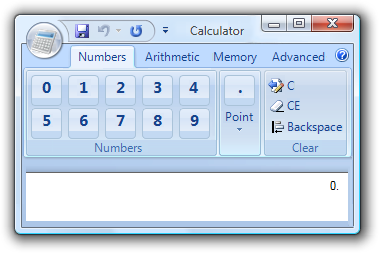
This is a mockup design of “ribbonized” calculator that clearly has nothing to gain from putting the controls into a ribbon. Following the usual physical layout of the calculator buttons allows users to quickly discover the functionality; there is enough space to arrange all controls so that they can be accessed with a single click; the number of commands is relatively low (in tens); finally, there is no “content area” for the calculator – the result is just a wide single line text box.
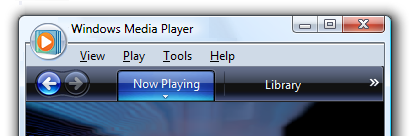
Here, the application menu button is added to a window with a menubar. The UX Guidelines are strictly against combining the application menu button with a menubar or a toolbar. In this case, the application menu button aims to replace the “File” menu, but all the other menus are still there.
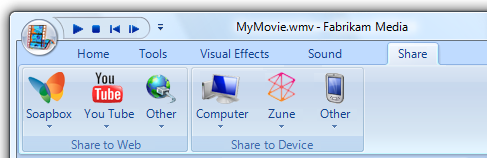
Here, all the buttons in the ribbon are menu buttons displayed at full size. According to the current guidelines, you might as well use the menu bar and save the vertical space.
The “Program Command Patterns” document delves even deeper into making the decision on presenting the UI commands, discussing when it is appropriate to forgo the ribbon interface and use the more traditional elements such as menu bars, toolbars and direct command controls.
Here are some Swing links that you might have missed during the last week:
- James Britt has an article on IBM.com developerWorks site on developing JRuby Swing applications with Monkeybars library.
- Jean Francois Poilpret continues tackling the more intricate problems with layout managers. This week he analyzes the real-time resizing of different components, including sliders, tables and scroll panes.
- Mikael Grev promises imminent availability of WebStart version of his media player. Currently hehas no plans to open-source the implementation, but the reasoning (no need for outside help) seems a little peculiar. I have repeatedly found over the past years that even if i am the sole developer on the project, it is the user feedback that is driving the project forward.
- David Benson has announced the initial beta release of JGraph X Swing diagramming library.
- Following the announcements on the Griffon project, Andres Almiray has updated the JideBuilder and GraphicsBuilder projects. JideBuilder 2.0 and GraphicsBuilder 0.6.1 are now under Griffon umbrella.
- Ken Orr writes about image-based method to create non-rectangular active (clickable) areas for Swing buttons. While this technique has its merits (splitting the work between the designers and developers is one such example), the needs of modern UIs render it somewhat obsolete. Such aspects as support for High DPI mode, skinning and animations require more advanced solutions.
- And finally, while not strictly Swing related, this might be of an interest to the readers. PulpCore is a new 2D rendering and animation framework for the Java applets available at Google Code repository under BSD license. Milpa is an example of PulpCore-based applet game, and it has all the characteristics of a browser-oriented game. It loads fast, has a lot of animations and is very responsive.
Here are some Swing links that you might have missed during the last week:
- The results for OpenJDK Community Innovators’ Challenge are in. Congratulations to Clemens Eisserer for the Gold on his XRender pipeline for Java2D, and to Roman Kennke / Mario Torre for the Bronze on their portable GUI backends.
- Ken Orr has announced release 0.9.2 of the Mac Widgets for Java library. Two biggest additions in this release are Heads Up Display and refactored UI delegate for source lists.
- Jean-Francois Poilpret continues his work on imporving the DesignGridLayout, writing about right-to-left (RTL) support. He tackles an interesting issues of languages with vertical orientation, asking for user help in testing the latest drops on Japanese / Chinese (vertical right-to-left) and Mongolean (vertical left-to-right).
- David Qiao has announced the first release of JIDE Data Grids product that aims to bridge the gap between the Database and the JTable.
- Christophe Le Besnerais continues his explorations of modern Swing interfaces. Combining a horizontally wrapping list with a JXLayer for mouse area selection, he presents a folder-like view with resizable flowing content.
- Richard Kennard has announced release 0.6.0 of the Metawidget library. New in this release – support for AppFramework, JBoss jBPM, JEXL and improved support for GWT and Android.
- Manuel Kaess extends his work on Vista-consistent Swing utilities to the message dialogs. Comparing the appearance of native Vista dialogs with the JOptionPane ones, he provides a custom implementation that follows the UX guidelines for Vista message boxes.
- Martin Kaba writes about the MozSwing project that aims to integrate Mozilla’s XUL framework with Swing. The advantage in using the MozSwing approach is that, you have both rendering and scripting access from a Swing application to almost any XPCOM components that can be embedded in a Mozilla browser – browser plugins. MozSwing plays Flash right out of the box, if flash is installed for Firefox.
- Fifesoft are the makers of RText text editor. This week, they have announced the creation of RSyntaxTextArea open-source project that can be used as a standalone syntax highlighting text component for Swing applications. It supports syntax highlight for 20+ languages, find / replace, macros, code templates, bracket matching and more.
- Ken Orr attacks the problem of JTable-in-a-JViewport and not filling the entire viewport. His solution employs a UI delegate that installs a custom layout manager on the enclosing viewport.
Finally, Jonas Bandi points to a gem in the Sun Certified Enterprise Architect exam preparation materials from the Sun Learning Center. The question is this:
You are architecting a real-time system with high usage and high volumes of transactions. You need an MVC application with quick presentation times resembling a thin client and will have several pre-populated views that can carry across several pages. The users must be able to quickly navigate between different sections of the system. Which three technologies will you need to implement? (Choose three.)
- A) MDB
- B) Swing GUI controls
- C) JSP
- D) EJB3 Entities
- E) Stateless Session Beans
- F) JCE
The solution – Options C, D, E are correct. What about Option B (Swing)?
Option B is incorrect because swing components are notoriously slow.
With such friends, who needs enemies?
