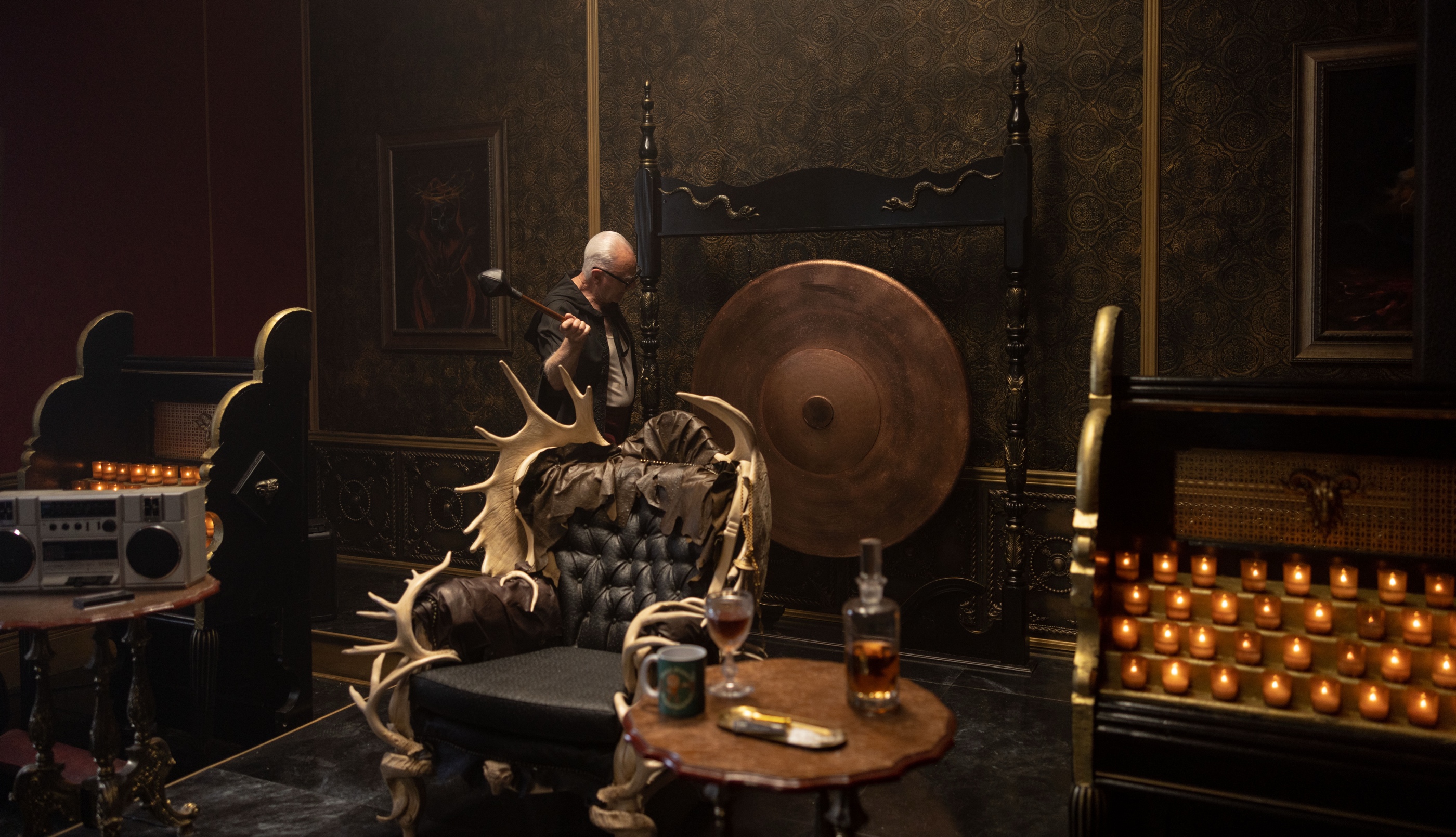
 Production design of "Psycho Killer" by Roger Fires, courtesy of 20th Century Studios
Production design of “Psycho Killer” – interview with Roger Fires
Continuing the ongoing series of interviews with creative artists working on various aspects of movie and episodic productions, it is my pleasure to welcome Roger Fires. In this interview, he talks about the role of the production designer, the changes that Covid brought to the industry, watching movies on the big screen, and his thoughts on generative AI. Between all these and more, Roger takes a deep dive into his work on the recently released “Psycho Killer”.
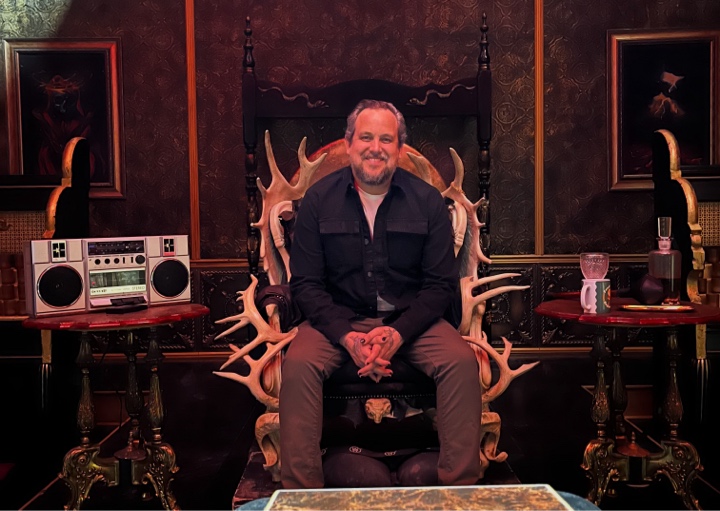
Roger Fires on the set of “Psycho Killer”, courtesy of 20th Century Studios.
Kirill: Please tell us about yourself and the path that took you to where you are today.
Roger: My name is Roger Fires. I’m a production designer, currently residing in Vancouver, Canada, and originally from Brazil. My passion for film started at an early age. My parents weren’t wealthy, and we didn’t travel the world. The thing that we used to do as a family was to go to movies and plays. When my mom went to do groceries or to a mall, she’d drop me off to watch a play, and she’d pick me up after. That’s how my passion for film and theater started.
I started with interior design and graphic design. In the middle of taking the graphic design course, one of the workshop tasks was to create branding for a travel agency inspired by a movie that we liked. It was right around the time “The English Patient” came out, and I wanted to design something related to it. My project had the ambience from the movie, extending to the uniforms and other elements. Then, during my presentation, the teacher started asking about the texture, the fabric, the outlets, the light switches and all these other things, and that’s when I saw that it goes way deeper than just that look and the concept behind it.
That’s when I started doing deeper dives. I was lucky that all my early jobs were connected to creativity. I was doing illustrations. I was doing vinyls and signage. I was doing fashion design. I was doing interior design. I was doing graphic design, with art direction and advertisement agencies. It feels like I was preparing my whole life to be a production designer, and touching every single aspect of the creative world on the way.
I had a band in Brazil for a while, traveling and doing a lot of things. After a while I wanted to go back and to follow my passion. When I was with that band, I was happier to see people wearing our shirts or doing the artwork, rather than making the music itself. That was around 2009 when I decided that I wanted to be in the movie industry as a production designer – not in Brazil, but in one of the bigger places like Los Angeles, New York or Vancouver. I remember I was talking with the father of my then-girlfriend, and he asked me what I wanted to be, what is my benchmark, who inspires me. I said the name of David Wasco, the production designer that worked with Tarantino and Wes Anderson.
We applied for the permanent residency while we were still in Brazil, then we got approved, and six months later we were moving and jumping into the industry here. I started doing graphic design on a couple of projects, and it wasn’t too long until I asked the production designer I was working with if I could work for him as an assistant art director. He told me that his art director was not coming back, and that I could be his art director. I did “Lost In Space”, got pulled into “Timeless” and a lot of other things. For me it was the matter of absorbing the knowledge and the experience, and trying to jump to the next step. There were some opportunities to make that next step, but I didn’t think that it was the right time. And then it happened at the perfect time, and that’s where I am today.
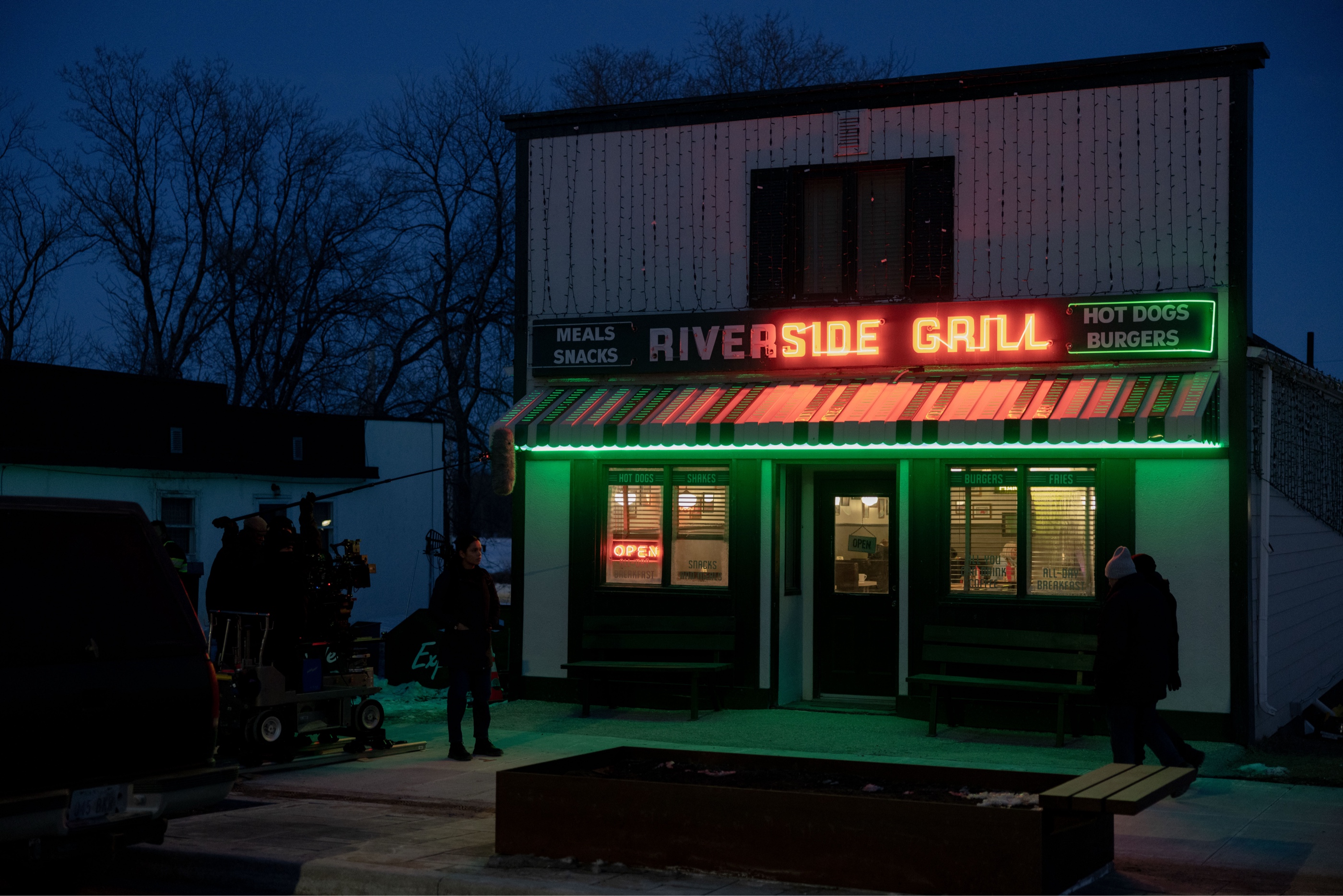
On the sets of “Psycho Killer”, production design by Roger Fires, courtesy of 20th Century Studios.
Kirill: Do you feel that the role of the production designer and what you do is well understood inside the industry? If not, what are the bigger misconceptions around it?
Roger: It’s been so many times that I have to tell people what I do. When people like the set, I am introduced as the set designer quite often.
I was just in LA, and I was talking with David Wasco who did this big exhibition about “La La Land” to educate people on the role of the production designer. There was a fantastic exhibition at the Academy Awards from the production design team of “Barbie” to show the process behind it.
We’re the first to get hired. We talk with the director to get the visual direction for the project. One of the things people don’t always realize is how early the art department gets involved in shaping the visual world of a film. There’s a lot of collaboration within the process. This partnership between the production designer and the director is not fully seen by a lot of people. The director Ilya Naishuller of “Nobody” had this funny analogy for it. He says that the production designer and the director are married, and we have a kid, and it’s beautiful. And when we’re about to shoot, I get a divorce and then he gets married to the cinematographer, but we still have a kid. And we still have to talk about the kid and what we’re going to do.
This analogy explains how intense that relationship is between the production designer and the director at the beginning of a project. When I present the pitch, it should align with the director’s vision, and then we elaborate that pitch into the project itself.
The misconception here is that I am not a set designer. Production design is about the broader approach of what the project is, from the details of the props and colors, to the relationship between actors and the set.
Kirill: What are the bigger changes that you have seen in about 15 years or so since you’ve started in the art department?
Roger: The TV sets were not that advanced back when I was starting out. Nowadays, the details are too on your face. You can get away with the amount of detail when you create something fantastical, like a spaceship. I worship Nathan Crowley. He did a brilliant job on “Wicked”, and that is a fantastical world as well.
But when you build a house and it needs a double hung window, you need to do it properly because people know what it looks like. People know how a door looks, and how high a door knob should be. These details become more critical. Now that everything is on streaming, people can go back and compare and see these jumps in continuity.
The biggest change that is happening today is AI. I hope that in the future AI becomes an extra tool. I hope that it doesn’t replace our brain, if you will. I hope it doesn’t take over the decision making process. We come up with ideas and concepts for the things that we want to do, and we pitch that to the director. AI can be integrated into this process to make it more streamlined. But I don’t want to use AI for anything that is on camera. I want to use it as a tool to help with the process.
3D printing has been a big change where you can design the model on a computer and print that to work on shots and ideas. Having said that, I love the idea of the handmade crafted foamcore models. It’s interesting to see how these two approaches compare when the director starts playing with the camera angles. 3D printed models are less manipulated. They become these art pieces that aren’t as easily manipulated once they have been made. If you want to change the color, or make the window bigger, you have to go back to the computer and change the model file. I feel that the old way had more respect for the craft of making those models.
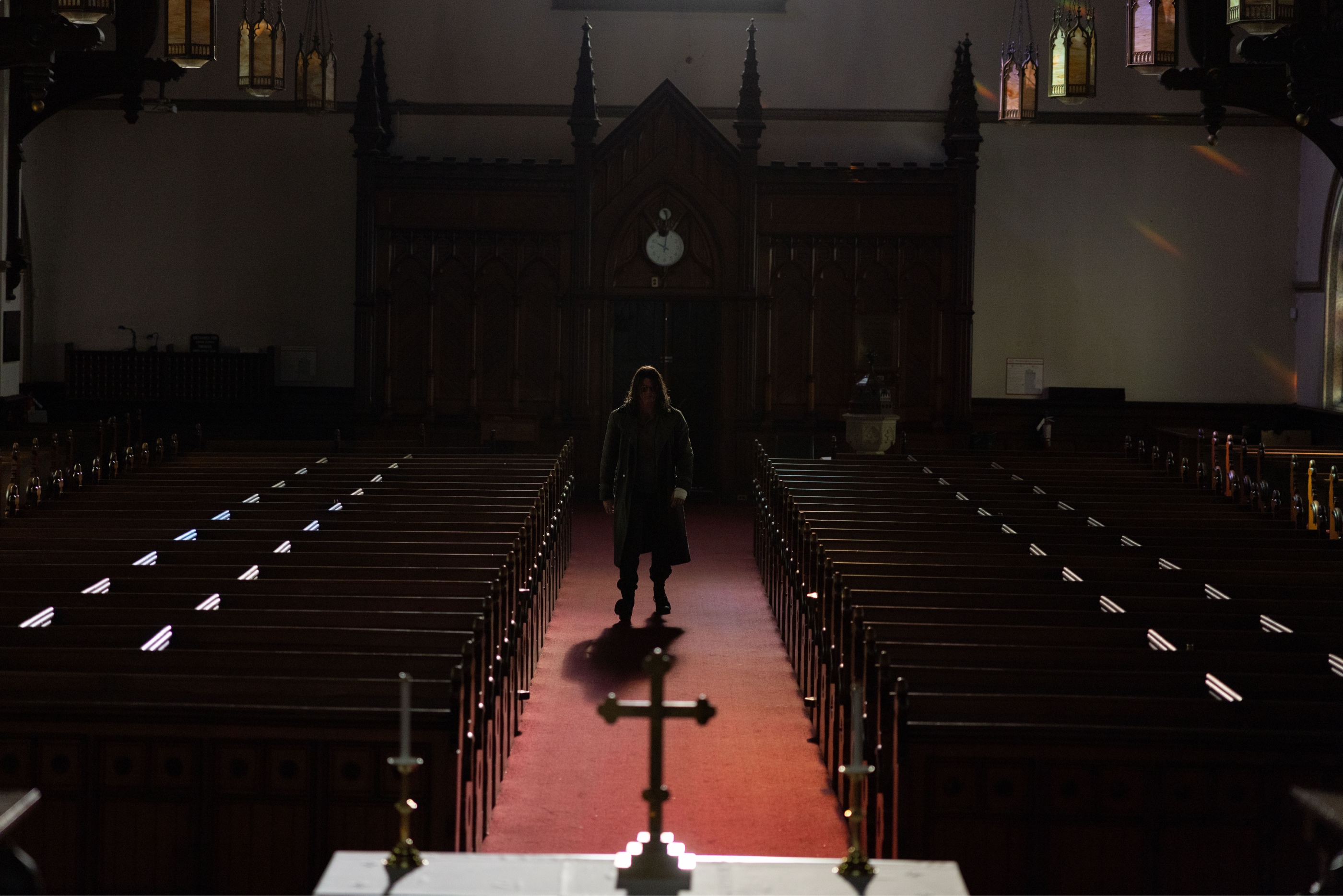
On the sets of “Psycho Killer”, production design by Roger Fires, courtesy of 20th Century Studios.
Kirill: How was Covid for you professionally? Do you feel that it’s fully over in the industry?
Roger: Covid was hard. There were so many more hoops to jump through to get back home and see your family, to go through the process of being there, to plan your day to start with testing. Then right after Covid we had the twin strikes, and I don’t think that everything has fully recovered yet.
It all accelerated the transition from the movie theaters to your living room, and the rise of the streaming platforms. When you talk to younger people and they ask you when this movie is coming out, you tell them that it’s in the theaters. And then the ask you on what platforms it is going to be. You see these different perspectives between the two generations on their preferences for these experiences. This shift in the perspective of the movie experience is still happening. We still have the theatrical experience, and I think every movie should be watched in the theater.
Covid did help a lot with the care we have for each other, and that is something that I experienced as a graphic designer and as a production designer. Health should always come first. If you’re not feeling well, you can stay home, get better, and then come back. We’re not going to stop the production. We’re not going to not shoot that day. Your health is more important to us. And if I have to wear two hats on that day or someone else has to do something, we’ll do it. You were always going to come first, and Covid helped on that. Go home, get better, and come back when you’re healthy again. Covid opened people’s eyes to see how things can spread, and how people can get really sick, and how much damage even mild flu can cause to immunocompromised people.
Kirill: You said that you want people to go to the movie theater. What makes it a better experience to watch a movie on the big screen?
Roger: This is how I connected with my parents. This is how I connect with my friends. Maybe “Back to the Future” is in the theater, and we’re excited, and we all go together. There’s a level of engagement in the movie theater that we’re not going to have at home.
It might be the most important movie that I haven’t had a chance to watch in the theater. I sit on my couch, and I get a text message or a phone call. I’m going to check what it is – and then you get detached from the movie. When you go to the theater, there’s a process. You dress up. You put on your shoes. You get in line. You get some pop corn. You sit down, turn off your phone, watch the trailers to see what’s coming. It builds up the excitement.
I was doing a commercial in Toronto, and “Oppenheimer” was playing close by in 70mm. I went to watch it, and they showed two trailers, one for “The Holdovers” and one for “The Exorcist: Believer”. It was an elevated experience with the 70mm texture, to see them projected on the big screen. You might have the best TV and the best home surround sound system, but you’re not going to be able to replicate that. It’s the engagement. You disconnect from the world, watch the movie, get out, talk about it, and enjoy the whole experience.
When I was on my way to becoming a production designer, that experience is what I wanted to achieve – to see my movie in a theater. And what I want to do now is keep watching movies in the theaters, and keep seeing people going to watch my movies too. You see people laughing next to you, people being scared – nothing’s going to replace that engagement.
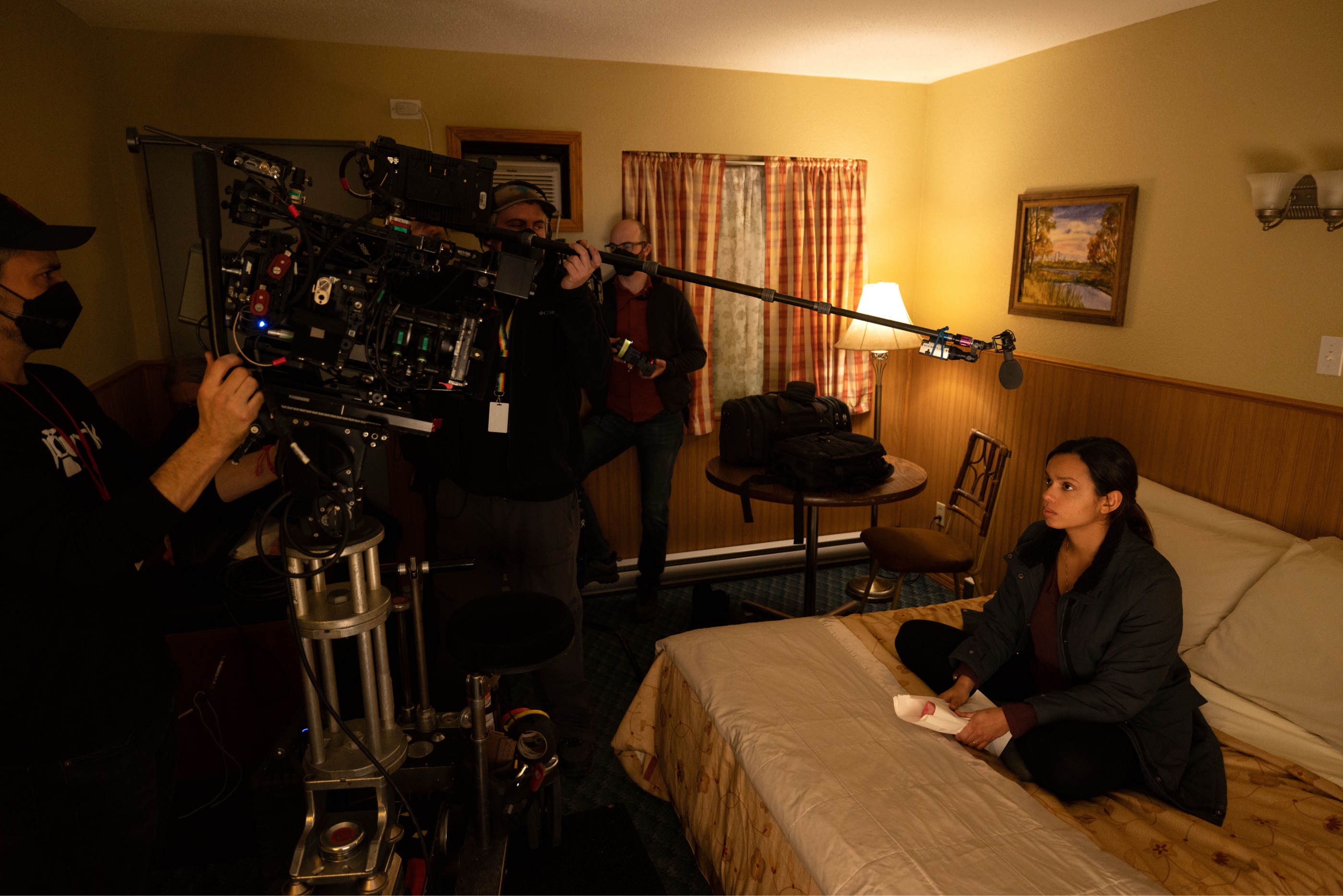
On the sets of “Psycho Killer”, production design by Roger Fires, courtesy of 20th Century Studios.
Kirill: Getting closer to “Psycho Killer”, how do you explain the enduring appeal of the horror thriller genre, at least in the American culture? What keeps these stories coming? What keeps the audiences wanting to see them?
Roger: It’s the rollercoaster effect. When you go to the rollercoaster, you’re scared. And when it ends, you want to do it again. You want to feel those butterflies in your stomach again. It’s the thrill of the haunted house experience. We watch horror movies to have that butterfly effect, and that is never going to change.
And at the end, depending on the movie, there’s a fulfillment of the evil getting punished. We want to see bad people being punished. That is what most horror movies give us. Some leave an opening at the end for the sequel, of course. But the main idea is that you see the hero punish the bad guy.
Kirill: What brought you to this particular movie or what maybe brought this movie to you?
Roger: I was on my way to a premiere in LA, and right before I was about to board, I got a call from my agents. I read the script on the plane, and when we landed, I got a message saying that they wanted to meet me the next day at 9:30AM.
I loved the script. I’m a huge fan of Andrew Kevin Walker, and “Stir of Echoes” that Gavin Polone produced is one of the best horror movies ever. When I saw their names attached to it, I thought to myself that I had to be a part of it. I talked to Gavin, and I had prior experience with the Winnipeg crew. I didn’t have time to put a pitch deck together, and I did send it after we talked. Then, a couple days later I got a phone call with an offer, and then hopped on the plane to start prepping it with Gavin.
Kirill: What discussions did you have around the visual tone?
Roger: We were going for a more subtle play on the cat and mouse game, on the good and evil chasing and clashing. Jane’s environment is cool and close to heaven. PK’s environment is warm and close to hell. We don’t show any red around Jane until she’s getting closer. The closer she gets to PK, the more warm and red you see around her. There’s a constant battle of colors and textures throughout the movie. We had a big wall of textures, colors, and palettes, and then a timeline of how they would get closer.
Kirill: Between sets and locations, what would be the split between these two in this movie?
Roger: It would be close to 70% sets and 30% locations. One of the motels was a location, and the other three or four are builds. Pendleton’s house is a full build besides the exterior. The Three Mile Island plant is a build. For obvious reasons, you can’t kill a priest in a church. So what we did is you see PK coming in, then he turns left, and we replicated that corner of the church on stage to be controlled.
We didn’t have a huge space to build the sets, so we had to fit them together. The back wall of Pendleton’s great hall is that church set. We built that well, dressed it as church, then struck it, and continued with it as Pendleton’s house.
The four motel rooms were similar to Tetris that would flip. The door would be on one side, and then we would flip that, and the door would be on the other side. For the back section with the hallways, the closet and the bathroom, we built that as modular pieces to mix and move around. That modularization was needed for the fast pace of the shooting that we had. Then we add swap wallpaper, paneling and everything else. It was a challenge, since we didn’t have a huge budget. We had to be creative in making all those motel rooms in the time and the budget that we had.
Kirill: There’s probably tens of thousands of motels just in the United States. Did you want to elevate those spaces a bit? How do you find the balance between the emotional part of it and the real world part of it?
Roger: One of the references that I brought to Gavin was Stephen Shore, and his Americana lifestyle photography. His book has a lot of photos of motels, in a more cold style. And we had another book of brothels with a warm look, as wanted that clash of colors as Jane gets close in her pursuit of PK.
Gavin was adamant that everything had to be real and unnoticeable. Nothing should pop out. If you search for Three Mile Island on Google, ours should look like it. Our motels should look like real motels. I am at the place in my career where I’m happy to create this canvas and be unnoticeably effective, to have the viewer engage with the story and the actors, and not be distracted from that picture.
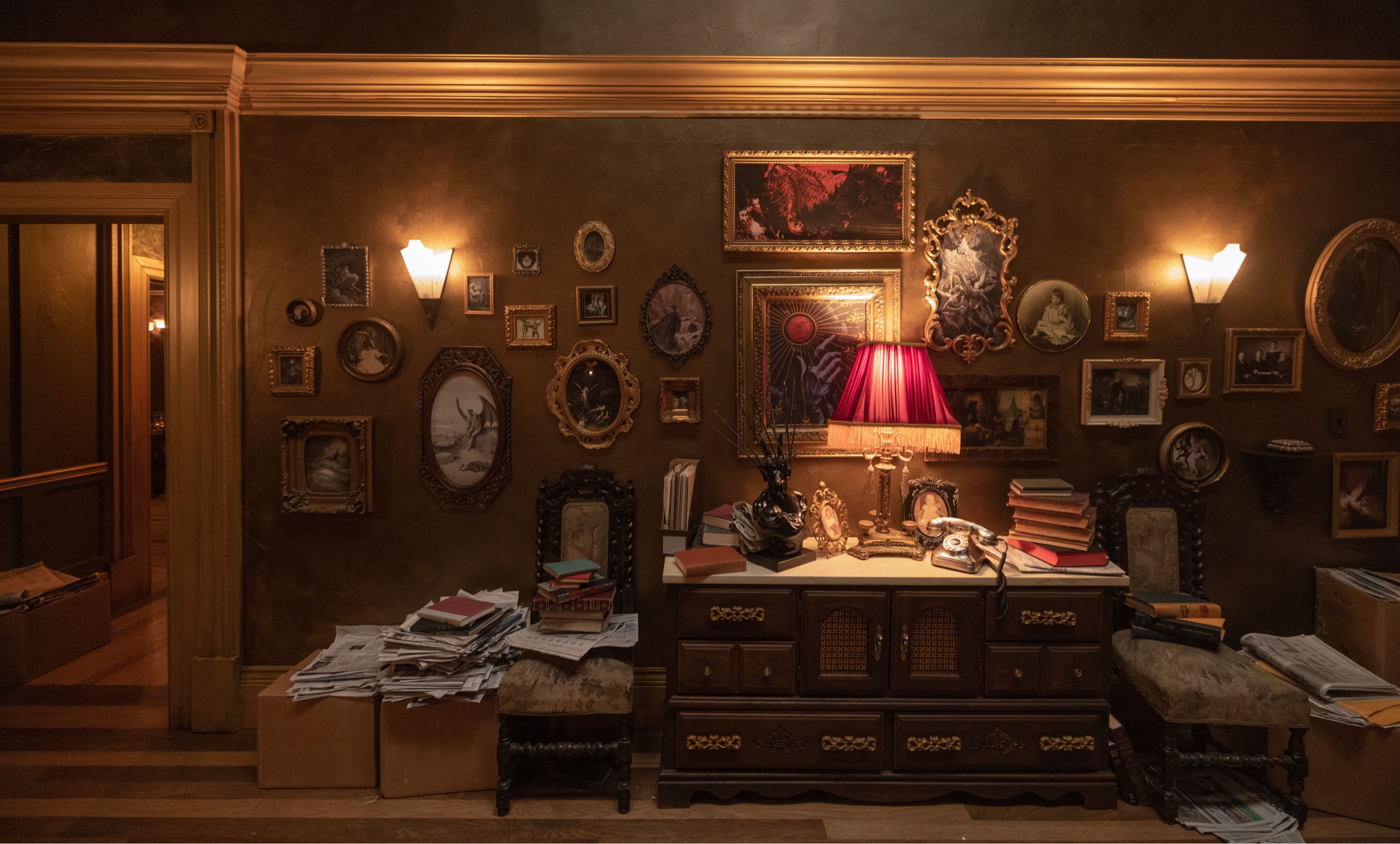
On the sets of “Psycho Killer”, production design by Roger Fires, courtesy of 20th Century Studios.
Kirill: How deep did the script go into the details of the Pendleton’s house?
Roger: The script portrays Pendleton as this buffoon. He was rich, and his habits and lifestyle followed his finances. From there we created the story that he used to live in a 25,000 square feet house, and it became a 12,000, and it kept shrinking – but his approach didn’t change. So he doesn’t have enough space for the books and the newspapers anymore, and he puts everything around the staircase. He built the great hall for his parties and his lifestyle.
Apart from the foyer, the whole house is covered with fabric to create the texture. There’s something raw about the texture and the wallpaper that worked so well on the camera. The first time that you see Pendleton as PK approaches and sits down, there’s snakeskin all over. There’s a snake wallpaper, and it’s scripted as imagery of the devil and hell. I pitched the idea to Gavin and Andrew to not be on the nose about the image of the devil. It’s the idea of the uncanny valley. You have a goat, but it has four eyes. You have this woman with a snake wrapping around her. These images are disturbing and uncomfortable.
The script described that the fireplace in the great hall had Lucifer with the tridents and everything else. Lucifer is the angel of death. The Bible representation of an angel is dove wings – and we transform that to have bat wings and snake eyes. It’s not a perfect image of what the devil would be, but a representation of the evil in the Bible. When we see the dining room for the first time, we see the devil and the bibles from the snake. The bedroom where PK decides what he is going to do has this landscape of hell on the wall. The uncanny imagery around the great hall is almost flipping the church upside down. The furniture is the transformed church pews. Our chandelier with the spikes is flipping the church chandeliers.
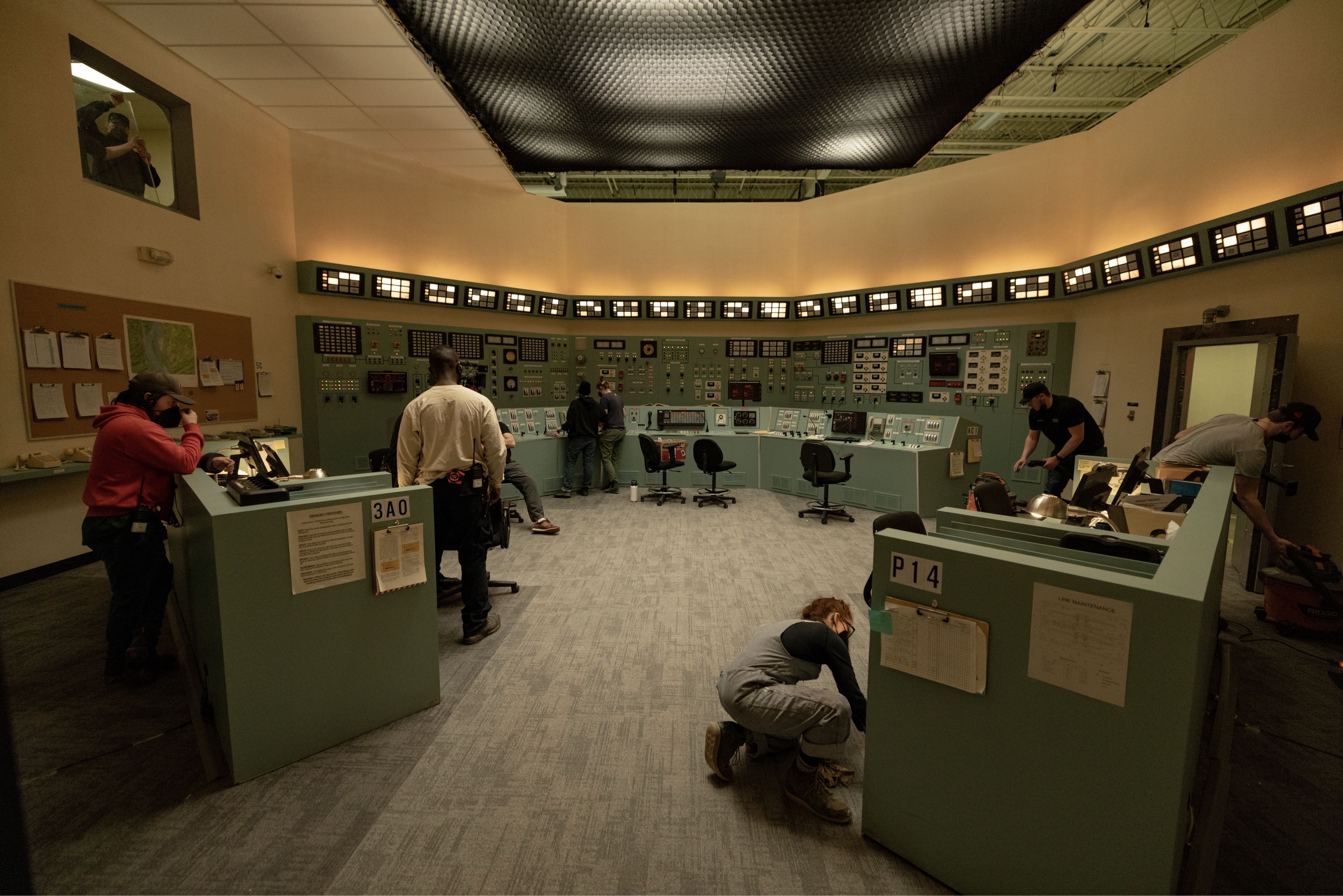
On the sets of “Psycho Killer”, production design by Roger Fires, courtesy of 20th Century Studios.
Kirill: How much work went into making the Three Mile Island facilities and that control room?
Roger: It’s a combination of a location and a set. The exterior is on location. When we go into the building, it’s a different place in downtown Winnipeg. And then we built the control room and two sets of hallways around it, and the second floor around the set for the final confrontation in the end sequence.
When we went to the Three Mile Island location, I measured the dimensions of that control room and the different elements in it. Then the director said it should be bigger, and we ended up making it a four feet increase. That also meant adding more panels, more LED screens, more controls, more buttons – along each wall of that octagon room shape. I worked on “Timeless” where we built the NASA launch control room, and we did plexiglass panels with different arrangements of buttons and lights. We ended up doing a lot of 3D printed buttons and consoles for “Psycho Killer”. It was probably the most labor intensive set that I’ve ever done.
If you look at the photos of the Three Mile Island facilities, I’d say we’re about 80-90% of what their control room looks like. The main difference is in how high that upper window is. The real ceiling is about nine feet high, but we made ours higher for the angle that we wanted to have for Jane.
Going back to the accuracy that Gavin wanted, we spent time to understand how the grenade explosion would affect the surroundings, and whether it would trigger the dynamite on his body. I had multiple meetings with the Winnipeg police officer that handles explosives to talk about that. Everything in that sequence is realistic about the Three Mile Island control room and the impact a grenade explosion would have inside of it.
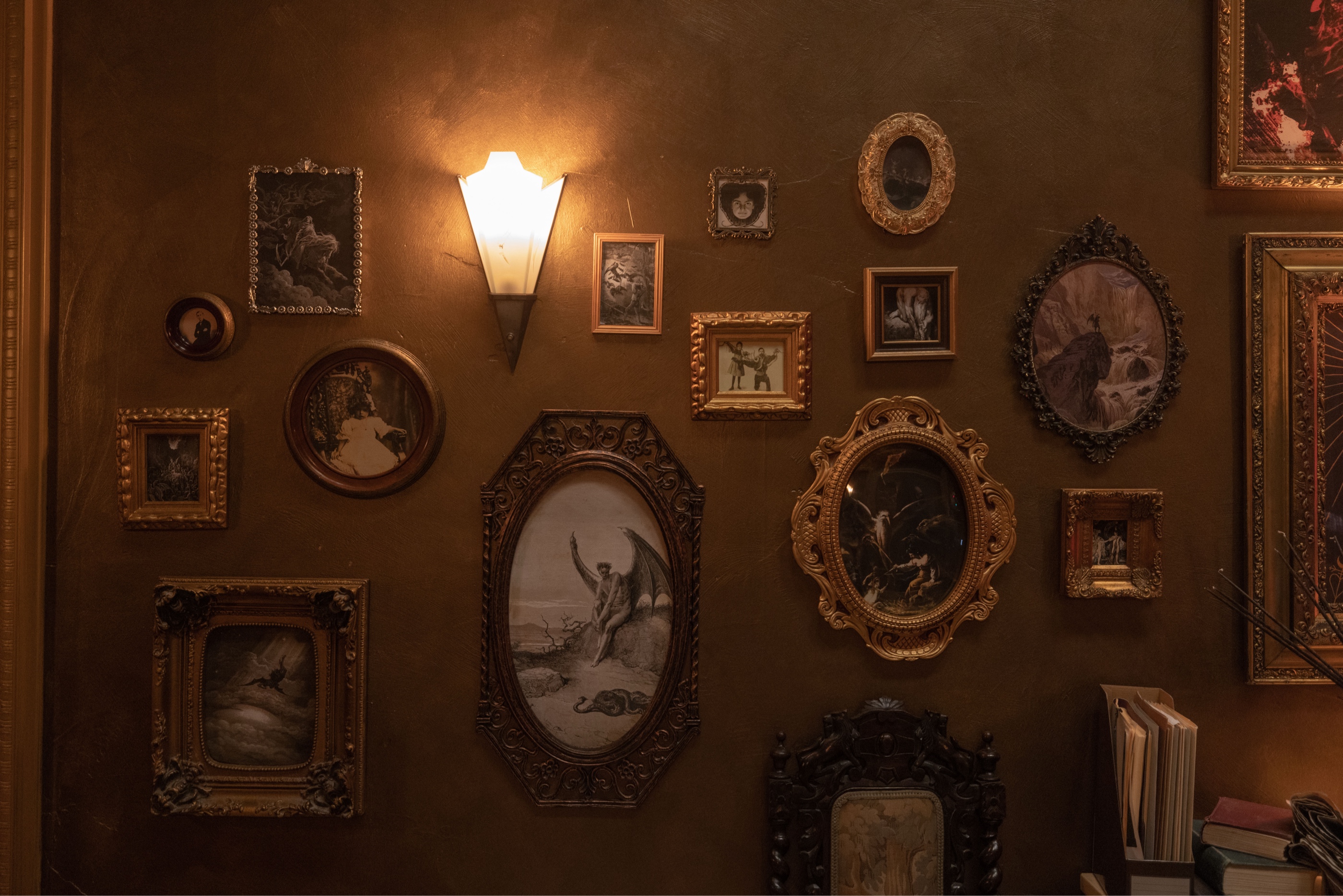
On the sets of “Psycho Killer”, production design by Roger Fires, courtesy of 20th Century Studios.
Kirill: Have you made your peace by now with seeing your sets getting destroyed, demolished, and torn apart, or is it still a little bit painful to see them go away?
Roger: It’s hard. I’m so hands-on. I’m on the site. I’m with the construction team. I’m there when they build. And I have a hard time to separate from the wood stage of the flats to the final set. I always look at what I should have done differently, because I have a hard time separating that emotion of the flats to what is there.
The Pendleton set was hard to see torn apart because it was such a fun design to do. I shared the concepts of the Pendleton’s house and the Three Mile Island sets, and then I took photos of the finished sets. When you put them side by side, it’s so close that you couldn’t pick which one was the concept and which one was the set photo. We were so happy with how that set turned out, and it was a sweet moment when we finished it. And then the movie is done, and the set is being torn down, and it was sad.
Kirill: What is the secret, or maybe the key ingredients, to longevity in this industry?
Roger: For any position in our industry, 60% is people’s skills. Be respectful. Understand your position that you’re a part of this big well-oiled machinery. Just one loose screw is enough for the whole machine to stop working. Understanding that and respecting the environment that you are in gives you longevity.
We’re in a time right now that we can’t tolerate disrespect. You need to work on your creativity and on updating your skills. You’re constantly learning on every project. And just be a human. This is what we all saw during the Covid years. We’re all human making movies.
There’s another thing. Sometimes a project perhaps is not reaching the audience the way it was expected. Every project has so many people that worked on it, hundreds and hundreds. When you bash that project with a rush critique, it affects a lot of people that put their hearts, sweat and love into it. Sometimes it’s a hit, and sometimes you miss a few spots. It’s such a big accomplishment to make a movie these days, and that should be celebrated as an achievement on its own. Making movies is not an easy endeavor. Respect for the process gives you that longevity as well.
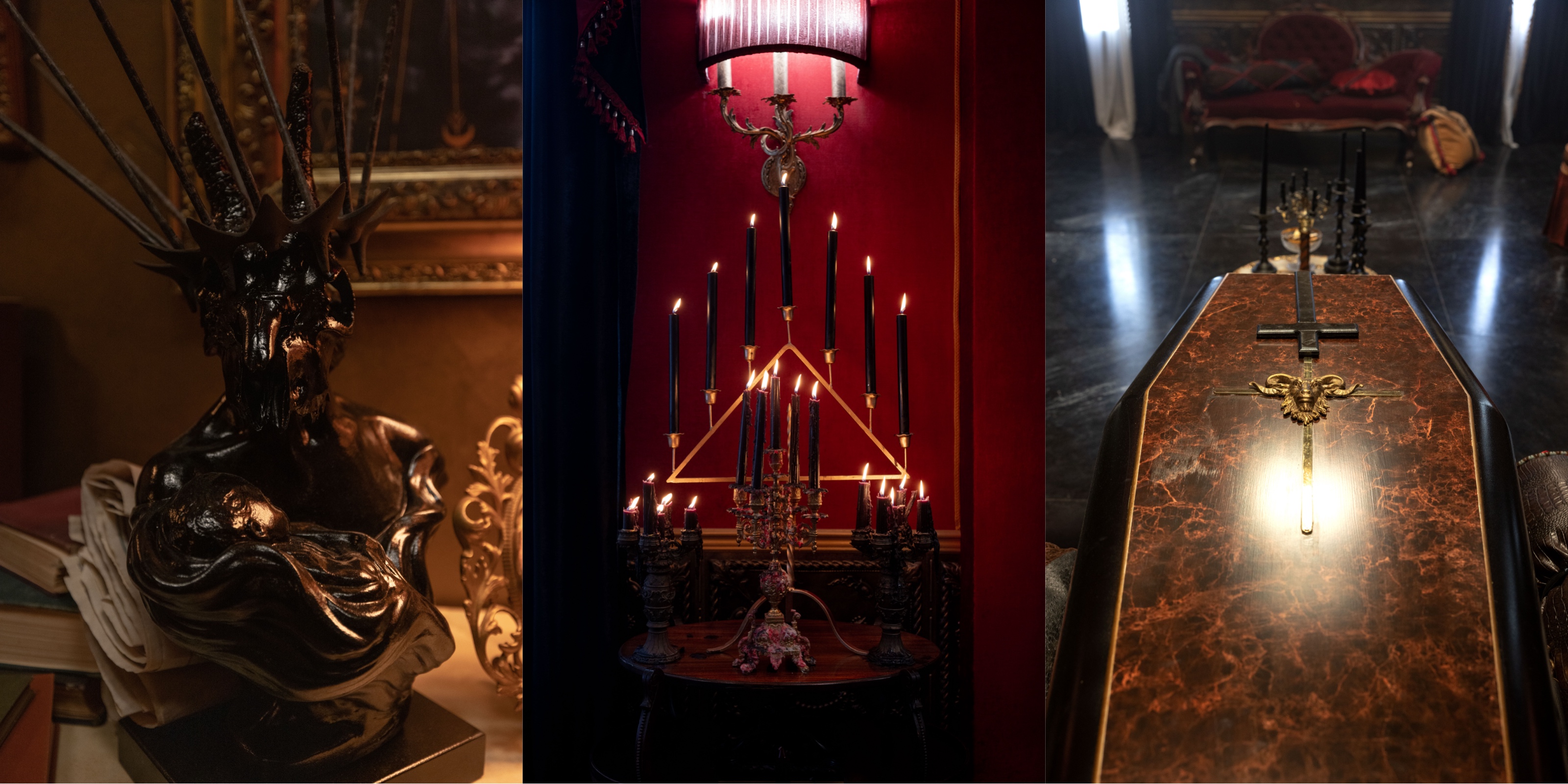
On the sets of “Psycho Killer”, production design by Roger Fires, courtesy of 20th Century Studios.
Kirill: What do you know now that you wish you knew when you were starting out?
Roger: I think it’s to not take things personally. Everyone has a bad day. Everyone has a different opinion. Your art does not necessarily reflect who you are. People talk to you and they say that they don’t want this, they don’t like the set, they don’t like the approach. It’s hard to not take that personally, and there were a few times that I got hurt at the beginning of my career. But I’m not the director. I’m not the producer. My job is to bring the vision of the director to the screen. You might hit here and you might miss there – but that doesn’t define who you are as a professional. Don’t take it personally.
Kirill: What would you consider to be the golden standard of production design of all time?
Roger: The beauty of the industry is that there’s so many people that shaped you, even if you don’t see it when you watch those movies for the first time. As I mentioned, David Wasco was a huge benchmark, not only professionally, but also personally. Nathan Crowley has this fantastic ability to create worlds. Rick Carter reaches so many levels of creativity. If there’s one movie that I watched and said straight away that this is what I wanted to do, it was “Pulp Fiction” by David Wasco and Sandy Wasco.
Kirill: What was the most memorable food you had during your time on this movie?
Roger: There’s a tapas place in Winnipeg called Peasant Cookery. The first day I went there was fantastic, and then I came back a few times. Winnipeg has a fantastic food scene. And it so happened to be that the son of my paint coordinator on “Psycho Killer” is a Michelin Chef in another restaurant. We went to that place, and it was one of the best meals I’ve had. But Peasant Cookery is fantastic. Every time I go to Winnipeg, I go there now.
Kirill: Do you miss Brazilian food now that you live in Canada?
Roger: I do miss it a lot. A few days ago I took my kids to this museum in Los Angeles. They had Pampa Grill which is Brazilian barbecue, and I had to have it, even as everybody else had something different.
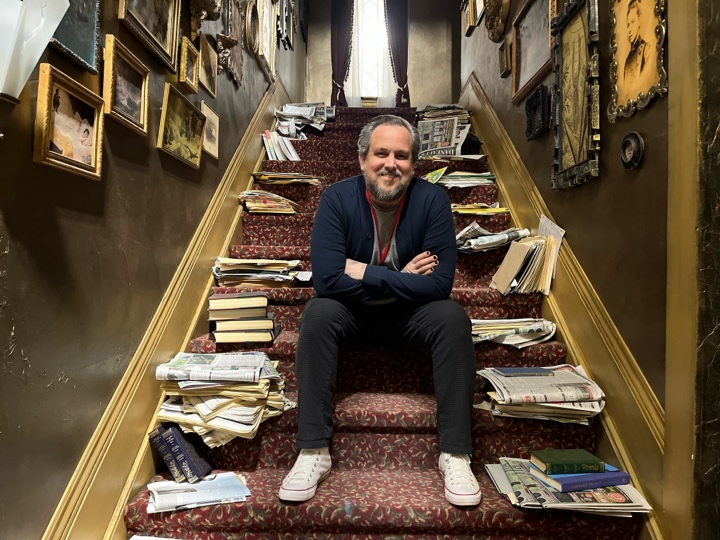
Roger Fires on the set of “Psycho Killer”, courtesy of 20th Century Studios.
And here I want to thank Roger Fires for taking the time to talk with me about the art and craft of production design. I also want to thank Kara Kitchell for making this interview happen. “Psycho Killer” out now in theaters. Finally, if you want to know more about how films and TV shows are made, click here for additional in-depth interviews in this series.
