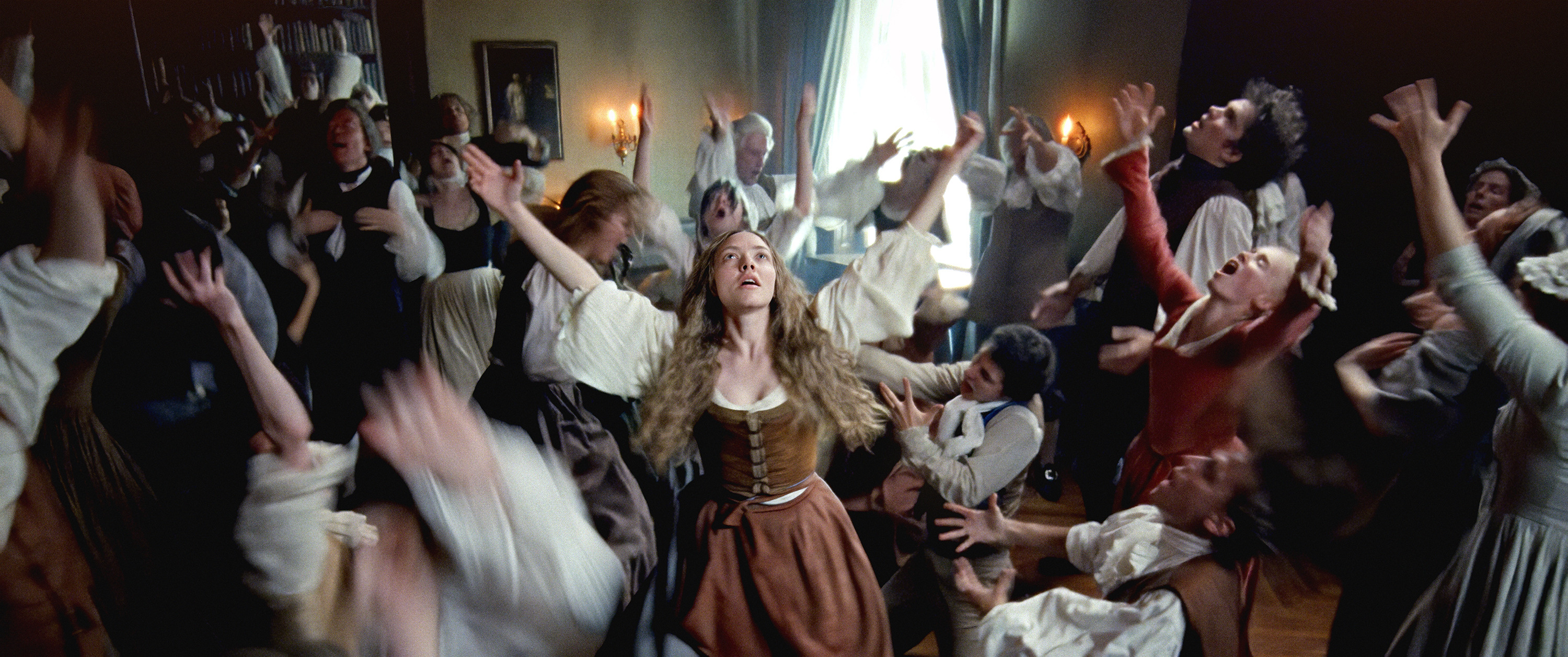
 Production design of "The Testament of Ann Lee" by Sam Baker. Courtesy of Searchlight Pictures.
Production design of “The Testament of Ann Lee” – interview with Sam Bader
Continuing the ongoing series of interviews with creative artists working on various aspects of movie and episodic productions, it is my delight to welcome Sam Bader. In this interview, he talks about the responsibilities of the production designer, the importance of layering for visual storytelling, what is art and what makes a great artist, and his thoughts on generative AI. Between all these and more, Sam dives deep into his work on the upcoming “The Testament of Ann Lee”, a wonderful reminder of the sublime magic of this delightful art form.
 Kirill: Please tell us about yourself and the path that took you to where you are today.
Sam: My name is Sam Bader and I production designed “The Testament of Ann Lee”. I grew up in the middle of the country, St. Louis, Missouri, and starting at a very young age, I found myself doing oil painting and figurative drawing. I had a lifelong fascination with cinema, and as I was growing up, it was that golden era of TV with “The Sopranos”, “The Wire”, and later on “Breaking Bad”. Those were my formative years, the lexicon of culture in my brain from music, books, movies and video games.
I went to college at the University of Southern California in Los Angeles, and I was circling around the film school without ever having taken a major there. My paintings attracted the attention of some of the producing students who were doing the thesis projects, and I was asked if I wanted to pitch to production design. I knew notionally what that meant, and I had certain intuitions about how to approach it, and I’m pretty proud to say a lot of those intuitions carried forth. It was reading a script, breaking it down, pulling references, doing drawings, trying to figure out the structure of what you have to build in terms of staff, as well as graphics and construction.
I had that experience when I was about 22 years old, and I was gravitating in the direction of the film industry. Having come from a place where there was no real industry knowledge of what that meant, I followed the proverbial North Stars. Out of college, I was lucky to intern at Indian Paintbrush, where Wes Anderson’s whole team worked, reading and writing script coverage. That was still miles away from what I would end up doing, but I made good friends with the people who ran that day-to-day office. They put me in touch with a phenomenal production designer named Adam Stockhausen, who hired me as an art PA.
That’s when I moved to New York, and I wasn’t totally sure what I was going to do. I had a painting studio. I was working a construction job for set building. And Adam hired me to be on “Bridge” of Spies as the art assistant in the design office. I clasped at that quite firmly, and you could draw a pretty linear line from that point in 2014 to now. I stayed in the art department, and gradually – and then suddenly – went from having not ever drafted or done graphic design or organized databases of reference imagery, to doing all of those things over 7-8 years.
Once I was in that seat, I knew I wanted to be a production designer. There’s a tradeoff between striking out on your own in indie productions and staying in the big art departments. You can go out into the world, design little things on your own, and climb that ladder. Or you can stay in the “incubator” of these massive art departments with white glove teams, some of the best draftsmen, concept illustrators, graphic designers, getting to be on the floor, seeing how bigger construction and scenic teams make these worlds. I stuck to the latter pretty narrowly for the first half of my now 12-year career, and would jump out and design a commercial or design a $600,000 indie feature – trying to have one foot on both sides of the line.
And then, around 2020-21 I got to leap up and be an art director in full, which meant managing construction, managing scenic, overseeing all the designing, all the drawing, working with a production designer. I got a ton out of that. On some of these projects that I art directed, the overall budget for just wood and paint and foam exceeded the cost of a lot of middle indie features. That helped me fortify a level of knowledge and gain an amount of confidence that I am grateful for.
There were moments when I did question it. Should I be out just designing indie? Am I losing nine or ten months doing a TV series or a studio feature? But looking back on it, all of these things really harmonized for me around the time Mona asked me if I wanted to design “The Testament of Ann Lee”. I could not have done the work I did and managed the team I did, had I not really cut my teeth in that arena.
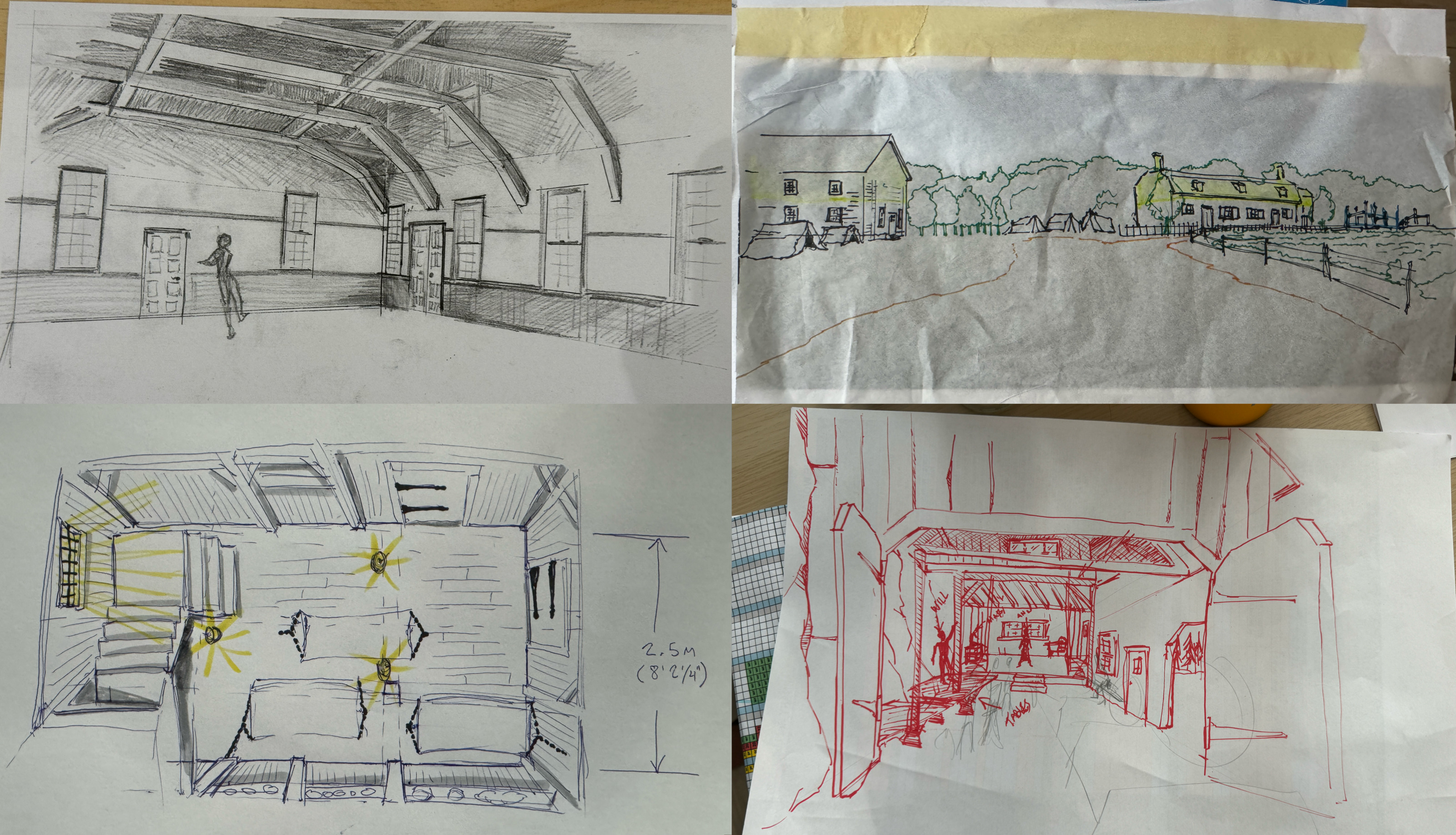
Mood sketches for “The Testament of Ann Lee” by Sam Bader. Courtesy of Searchlight Pictures.
Kirill: How do you see the role of the production designer? What do you feel are the bigger misconceptions about it from the outside of the art department?
Sam: I think a production designer stands at the crossroads of the directing side and the producing side. It’s a little cheesy to say, but you are designing the production. You’re not just designing the film. You are working with producers to frame out the scaffolding – financially and logistically – of how you’re going to achieve this film with the money and the time you have.
If you were to ask the average person what they thought a production designer did, you’d get an answer about having the sets, the paint finishes, the furniture, the aesthetic, and the visual through line of the whole film. That is certainly true, but the misconception is the extent to which you have to shave down the contours of this whole machine, in terms of staffing and locations and budget and timeline to make it work.
You have to be able to draw and illustrate and communicate ideas on paper. And you have to be able to pull abstract ideas out of yours and the director’s heads, and communicate them to a vast group of people who are all coming with their own sensibilities.
Another misconception might be that everything that you see in front of the camera was touched by a designer. On a very small movie where you are doing everything, that might be more the case. But on most films, you have to ingest imagery, ingest information, ingest ideas from a director, and then communicate them to other people with the trust and the knowledge that they too will interpret and produce their version of what they think it is. And then it’s your job to absorb all of what you’re being shown, and know how to tweak it, and edit it, and understand the extent to which you should tell somebody that something doesn’t work at all. You steer the art department and your artists to make them motivated and inspired to do their work.

Production design renders for “The Testament of Ann Lee” by Sam Bader. Courtesy of Searchlight Pictures.
Kirill: Is it a little bit of a blessing and a curse that once you become a production designer on these bigger productions, you’re also an accountant, you’re also a people’s manager, you’re also a nanny, that you’re a master of all crafts, but can’t have enough time to dive into the artistic side of it as much as you would like to?
Sam: You only have so much time, and then there’s the time you’re willing to devote on top of the hours you’re technically in the office. A constant tension for me is that the day gets populated with the former. You’re an accountant, you’re making schedules, you’re being sort of a people’s therapist.
I constantly have these ideas kicking around in my head. I came from a drawing background, and I’m sitting here right now in my office with a straight edge and a pencil and markers and Photoshop and all these other tools. I used to sit in those seats and do those other roles, so I am comfortable to find an hour to pull in a location photo or pull in someone’s white 3D model and paint something, even if it’s quick and loose.
Everyone is different. I can compare it to making a painting. You don’t start by literally taking a pencil and drawing every eyelash until you have a beautiful iris and a pupil. You sketch gesturally. You sketch out the contours.
I’ve built a level of comfort where, depending on the director and their level of comfort, I can show something that is rough, as long as it has a good idea and good character. It keeps the ideas flowing. It gives a person something they can sink their visual teeth into and chew on. I’m not going to silo myself into an office and spend three hours making a beautiful image. Even on bigger productions like “The Testament of Ann Lee” and the thing that I’m working on now, you have money and time, but it’s still never quite enough to spend 12 weeks with people to just draw everything out.
It’s very fluid. I oscillate pretty rapidly between going into a producer’s office to talk about a schedule or how we’re going to get the cost of a bill down, to eating lunch and drawing something, to walking into my art director’s office in the art department to show them a rough version of something.
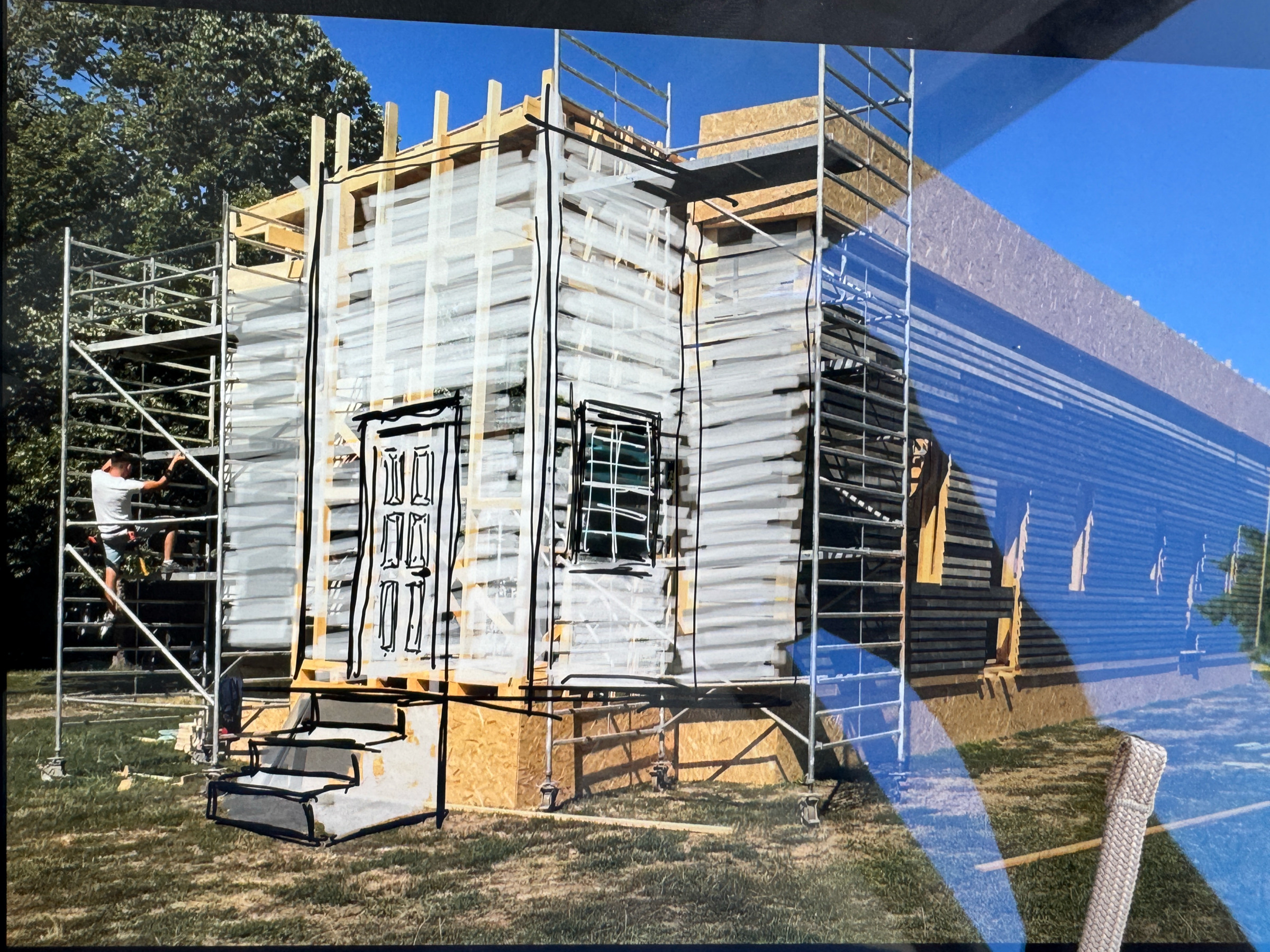
Production design renders for “The Testament of Ann Lee” by Sam Bader. Courtesy of Searchlight Pictures.
Kirill: I was looking on your website and I loved how you say that you build vibrant, layered and authentic worlds. What does layering mean to you, and why is it so important?
Sam: On “The Testament of Ann Lee”, it was layering in terms of the research and the history and understanding the logic of different spaces and how they interplayed in a pre-photographic time. You have to interpret paintings and drawings and text of the era. That’s one kind of layering.
Layering has multiple meanings. One example is building up the Lee family home, the textile mills, and the workshop. There was a version of the script prior to my jumping on where people went to a workshop to work and they came home. Then we did some light historical reading, and we learned pretty quickly that this is a pre-industrial time. There weren’t warehouses and factories. They didn’t even exist for another 40 years. The 18th century is quite unfamiliar to most people, and it was familiar to me at the outset.
You internalize how cities functioned, and how spaces interplayed with one another, and what Christchurch meant relative to the marketplaces where people would go every day. Then you end up with something that’s narratively and spatially very layered.
Then you have layering of bottom underpaintings, large artwork, big furniture pieces, and drawing in all the details. I don’t like walking into a set where somebody puts three obvious pieces of art up. Such sets only have these little contained moments. My sensibility is more of vérité. I want to know that when I walk into the dwelling of a family of five in 1750s Manchester, it feels real. This space needs to feel dense. It needs density in its layers.
Then, of course, you get into the realities of time and money. You can’t cherry pick every last little stitch of what goes into a set to make sure it’s absolutely perfect. You start to make judgment calls with Mona Fastvold the director and Will Rexer the cinematographer. Where is the camera going to be? Where are the lights going to be? What needs to feel like a shape in silhouette, and what is really going to be lovingly swept across?
It’s the creative side where good designers deeply understand how to communicate on a shorthand with costumes, directing, cinematography, and even editing to a certain extent.
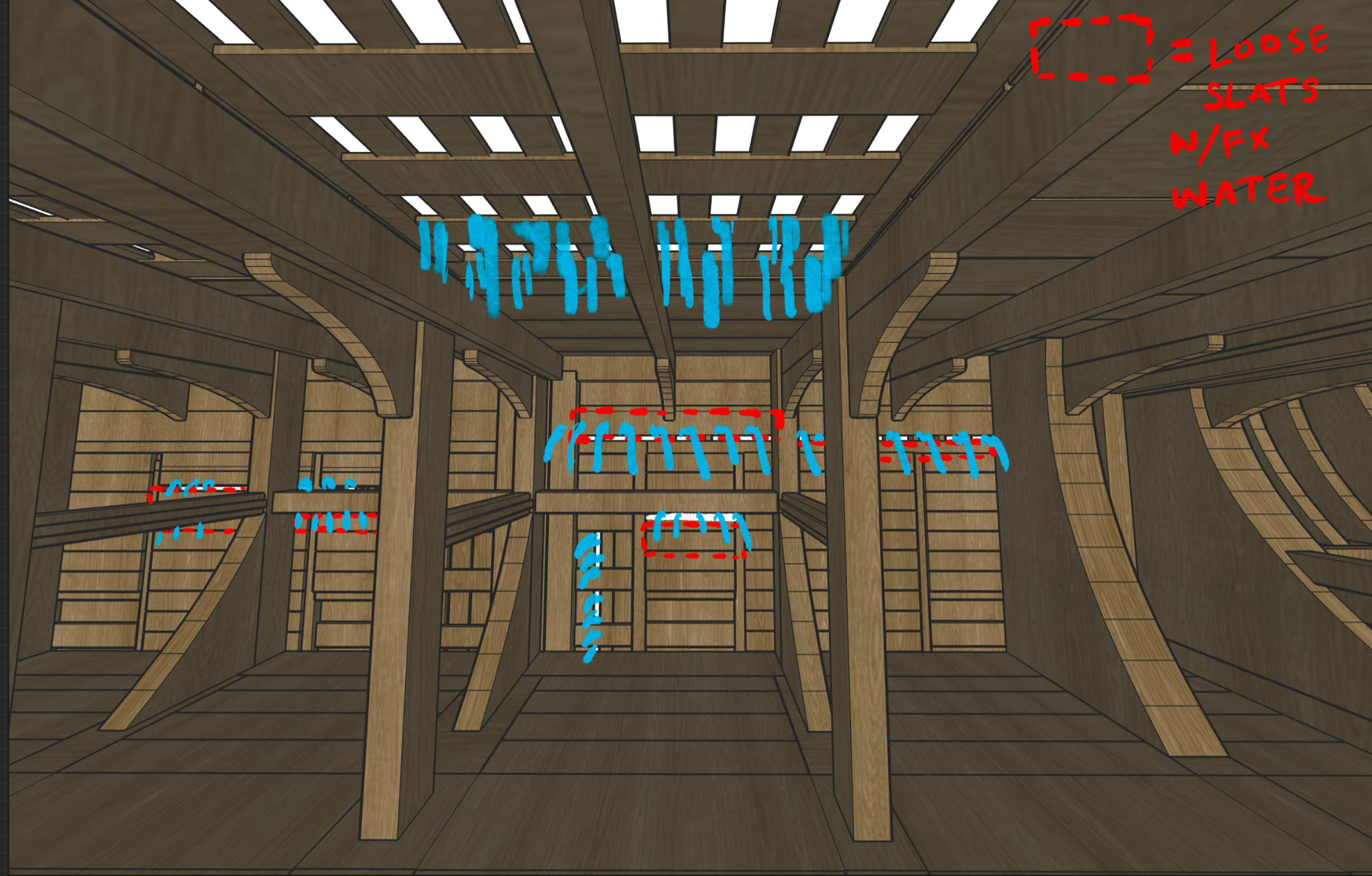
Production design renders for “The Testament of Ann Lee” by Sam Bader. Courtesy of Searchlight Pictures.
Kirill: This next question is something that I’m struggling to find my own answer to, which is about nature versus nurture. Do you feel that some people have this almost divine spark in them that makes them great artists, or can anybody be nurtured or trained to be – maybe not amazing – but great at art?
Sam: That’s a big question. I think an artist exists within most, if not all, people. And then, in order to be a great artist, you have to be able to harmonize a certain amount of neuroses. You need a healthy amount of self-doubt in you. You need to keep questioning and striving for something that’s closer to perfect. You need to have a level of comfort and time to get to sit with your thoughts and to self-examine. And in almost a psychoanalytic sense, you need to be able to see yourself in what you want to say with more clarity.
The term art itself is one that I’ve been hearing since I was a young child. I’ve oscillated a lot on what it exactly means to me. Anyone can pick up a pencil and a sheet of paper, and spend 15 minutes and produce something that is technically fitting the loosest definition of art.
Great art is an extension of something in your soul, a wound, a certain question you’re trying to answer that is, on some level, unanswerable. I don’t think that art’s job is to answer questions. It’s to pose them in the most vibrant and inviting way.
Kirill: Alanis Morissette is one of my all-time favorite singers. The thing that strikes me about her and some other artists is how painfully open they are about their own insecurities and their own struggles. I would never be able to talk as openly to the world about myself as some of these great artists are.
Sam: I agree with that. If you talk to a person who spends their time thinking about and enjoying art, and you ask them what their favorite pieces are – whether they’re songs, films, or paintings – and you peel back the layers of any of those, it exposes a vulnerability. You said insecurity, but I would rather say vulnerability.
In a psychoanalytic sense, analysis is the process to unearth those core insecurities and vulnerabilities, and make peace with them, and feel comfortable wearing them more than you would otherwise – almost like taking off a shell.
In the context of “The Testament of Ann Lee”, you look at Mona who is the auteur – the writer and the director, and Amanda, whose performance is so raw and so vulnerable and so daring in terms of how she was willing to be depicted. This film absolutely fits that criteria.
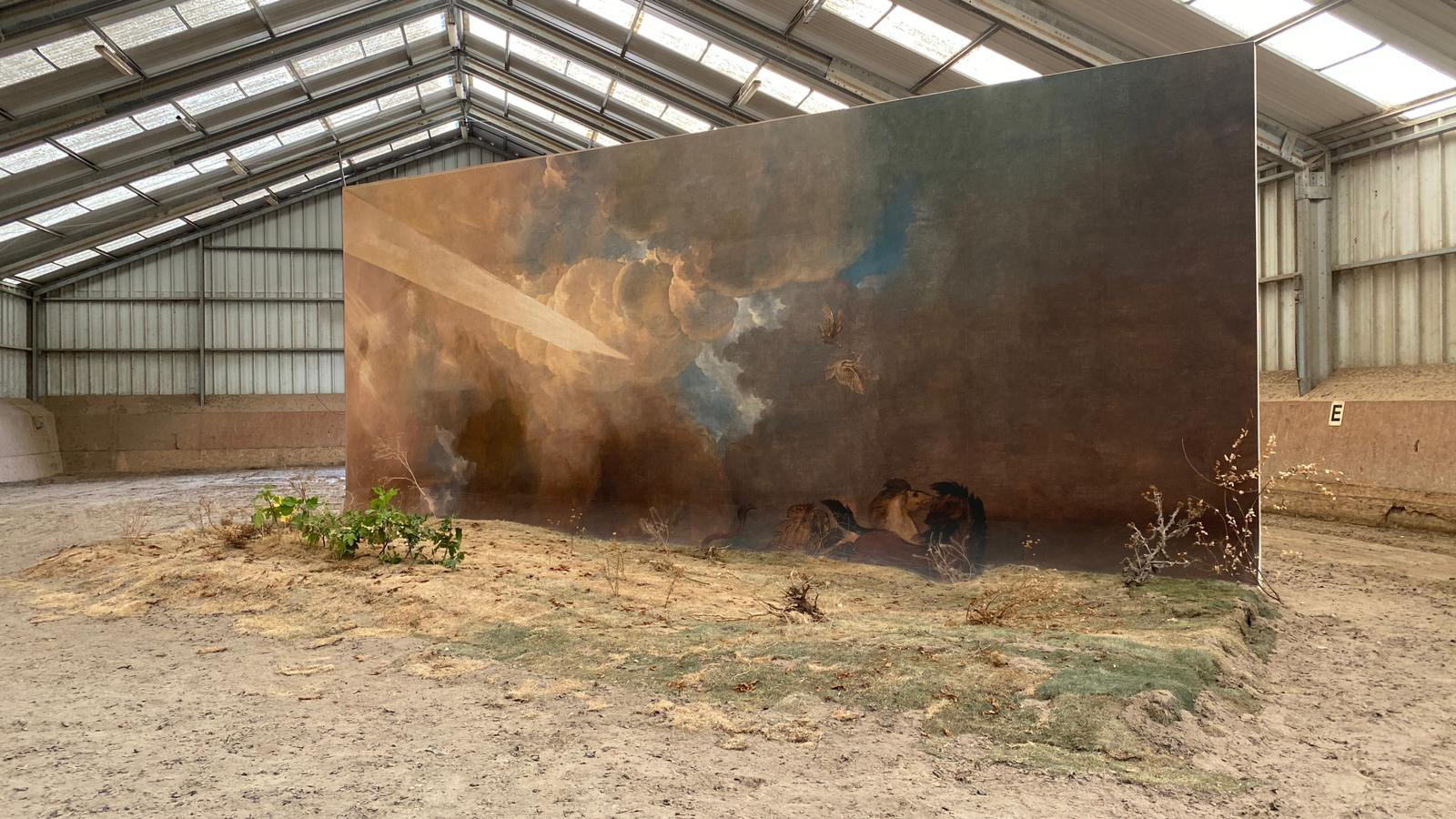
Set design for “The Testament of Ann Lee” by Sam Bader. Courtesy of Searchlight Pictures.
Kirill: Looking back at these 12 or so years of your career so far, what do you feel are the biggest technological changes that you’ve seen in your field?
Sam: 3D printing is definitely one. The fidelity with which you can pump out a piece of detail, like a cornice or a piece of crown molding – that is incredible. I’ve taken a little time to tinker around with AI tools that are at the front of people’s minds. We haven’t used any AI on this film, as we were a little bit before the generative toolkits came in.
Another thing that comes to mind is the speed of things – the speed of download or upload time, how quickly you can generate live lighting renders. You can open a V-Ray render, stick some lights in, move through a space, put on a headset, bring a director in, and let them walk into a pre-visualization of what is going to be built. It’s a huge advancement in how aggressively you can move through this process. Cameras have gotten smaller, easier to cool, and more affordable. Software and hardware on the design side have gotten more affordable.
It’s no secret that we utilized pretty much old analog techniques throughout this film. We had a matte painter who’s been doing this since the ’70s, and he did our matte paintings. But what excites me about that is not making a movie in the exact manner one would have in 1982 or 1967. It’s more about creating assets by hand, with the soul and warmth and texture that I don’t think the best renderers can match. Then those can be scanned in, collaged out, de-focused, photogrammetried, and turned into something that is old, but new.
In any new technology, the medium is a vessel of the old, to paraphrase McLuhan’s quote. I love celluloid and I love painting. And I love that you can bring those things into a digital space and create something that’s a little bit new.
Kirill: Getting to the movie, what drew you to its story?
Sam: It’s the challenge of that pre-photographic era, and the task of understanding what a passage of time from the 1740s to the 1780s would mean in the context of a feature film. We’ve seen many films that are set throughout the 20th century, and everybody has a distinct and siloed sense of the aesthetic of each decade in the 1900s. But when you get to the 1700s, it’s so much murkier, because it’s so much further back in time. I was drawn to that.
I was drawn to Mona’s confidence. I was drawn to a film that depicts an egalitarian existence, and leads with a message of community and finding harmony through existence among nature and living off the land. It’s not really utopia, because in the back of our head we all know that it can’t ever be achieved. And ultimately, the promise of the Shaker movement can never be fully realized.
It does tie back into the art conversation. Perfection does not exist. You can strive to get as close to it as possible without ever touching it. That spirit resonates and pulses throughout the script, particularly towards the end, and I was drawn to that.
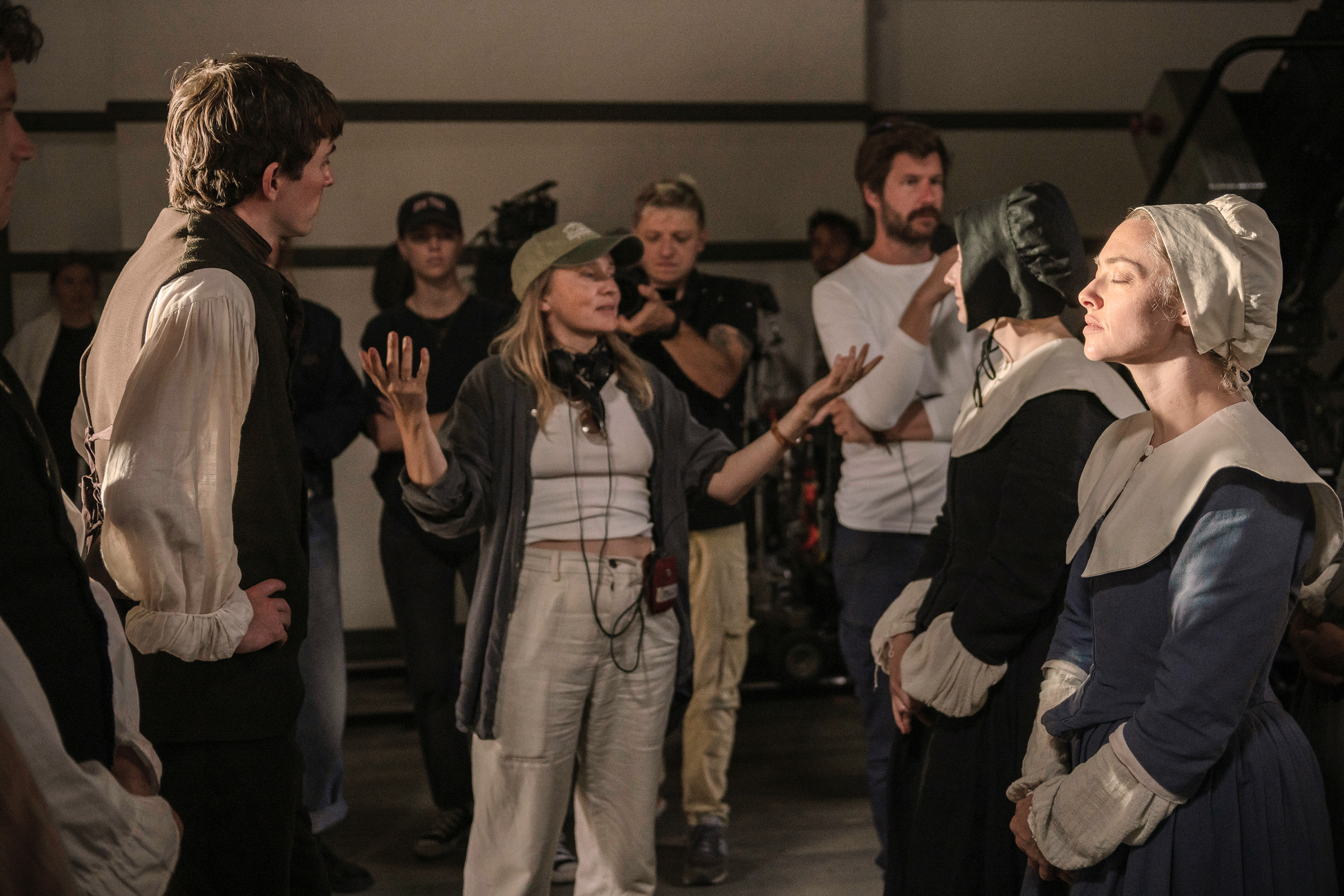
On the sets of “The Testament of Ann Lee”. Courtesy of Searchlight Pictures.
Kirill: How do you do research these days into something that is a couple of centuries removed from us? Is it the traditional route of libraries and museums, the digital route of archival websites, or a mix of the two?
Sam: I do a mix of the two. You try to find these threads you can pull on. The provenance of the image is who the artist was and the circle of people they were working with. You find an image that is right for some reason, and the more you understand who made it and where it came from, the more you build out a web of different artists.
I started at the New York Public Library in the old picture collection. It’s an arcane room of filing cabinets with a giant six inch binder of a directory. You’re going through what they have on England in the 1700s, 1710s, 1720s, etc – and it’s the New York public librarians who cut out illustrations, woodcuts and photographs, and put them into these old manila envelopes.
I walked into the Schwarzman Building on 42nd street with a little home scanner and a laptop, ideally early in the morning where I had a little bit of table space, and I went through everything. I pulled and scanned old survey photographs and drawings from that era. I do free association, ingest anything and everything that feels like it might have a home, and I have an InDesign document open while I do that. I build out the scaffolding of a film where each spread is a set. You break down a script, and any time there’s an environment that has to be designed, it gets its own folder that I later populate with those scans.
On films where I’m relying more heavily on photography and contemporary artists, Instagram is a great place. I’m resistant to just picking the most obvious dozen artists or photographers of a time. I want to find something no one’s seen before. The reality is that, to a large extent, the references flow through draftsmen and illustrators and set decorators and graphic designers. What comes out is, in some way, a representation of the imagery they were seeing. So the more niche and obscure sources I can find, the better the end result is. It goes back to that layering and that density.
I like a layered and dense library of images that I want everybody to spend time in and understand how to navigate. There’s a certain element of being a librarian or a clerk in that filing process.
Kirill: What color choices did you make? What colors did you want to focus on, together with the director and the cinematographer?
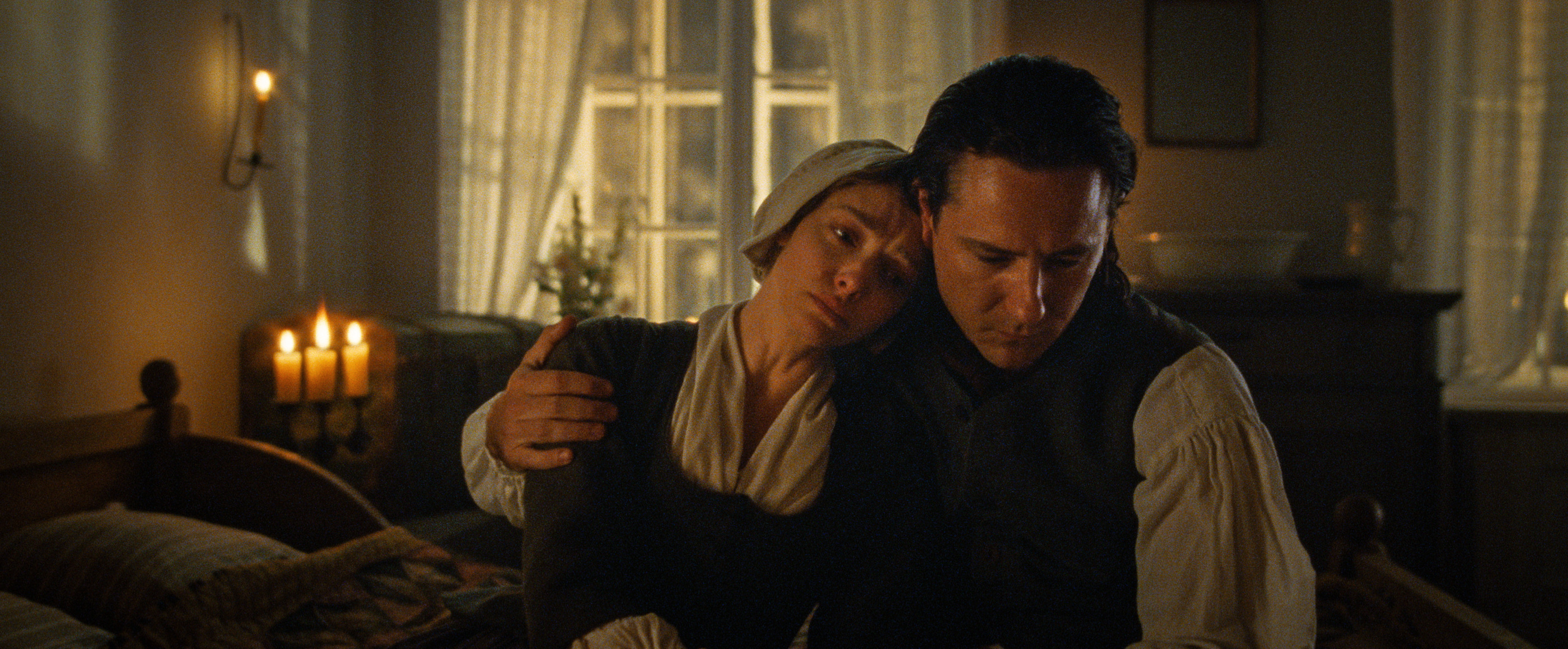
Sam: We knew that Manchester wanted to be murkier, darker, more earthen and more muddled. Within that, I found a palette of burgundy, maroon, olive drab green and sage. It’s a home amidst what was a lot of old wood, because we wanted it to feel like it had been there for a very long time.
And the ship almost tells you what it wants to be. To use Mona’s phrase that I can remember really well in our first meeting, you spend all this time in these small, cramped, confined spaces with clutter and people. Then the movie cuts, and you’re in the wide open sea, and it’s horizontal landscape and it’s blues – ocean blues and sky blues – and the beige of the sails. There’s not much to unpack beyond what it would necessarily be by virtue of it being a ship.
Then, when we got to the New World, we wanted it to feel more freshly sawn, newer. Mona and I arrived at one of those moments where I knew that it was going to work out, where we both arrived at Vilhelm Hammershøi, the Danish painter. We took his muted powder blues and yellows, against darker black and charcoal tones.
For the Shakers, it’s a little more nuanced than simply the ship. It’s about these structures existing harmoniously with nature – subtle greens, browns and taupes that don’t fight the costumes too much. We embrace the reality of that environment. We did not want to take very many liberties with the Shaker aesthetic because it’s so well established. We ended up with measured, dusty and more muted palette tones.
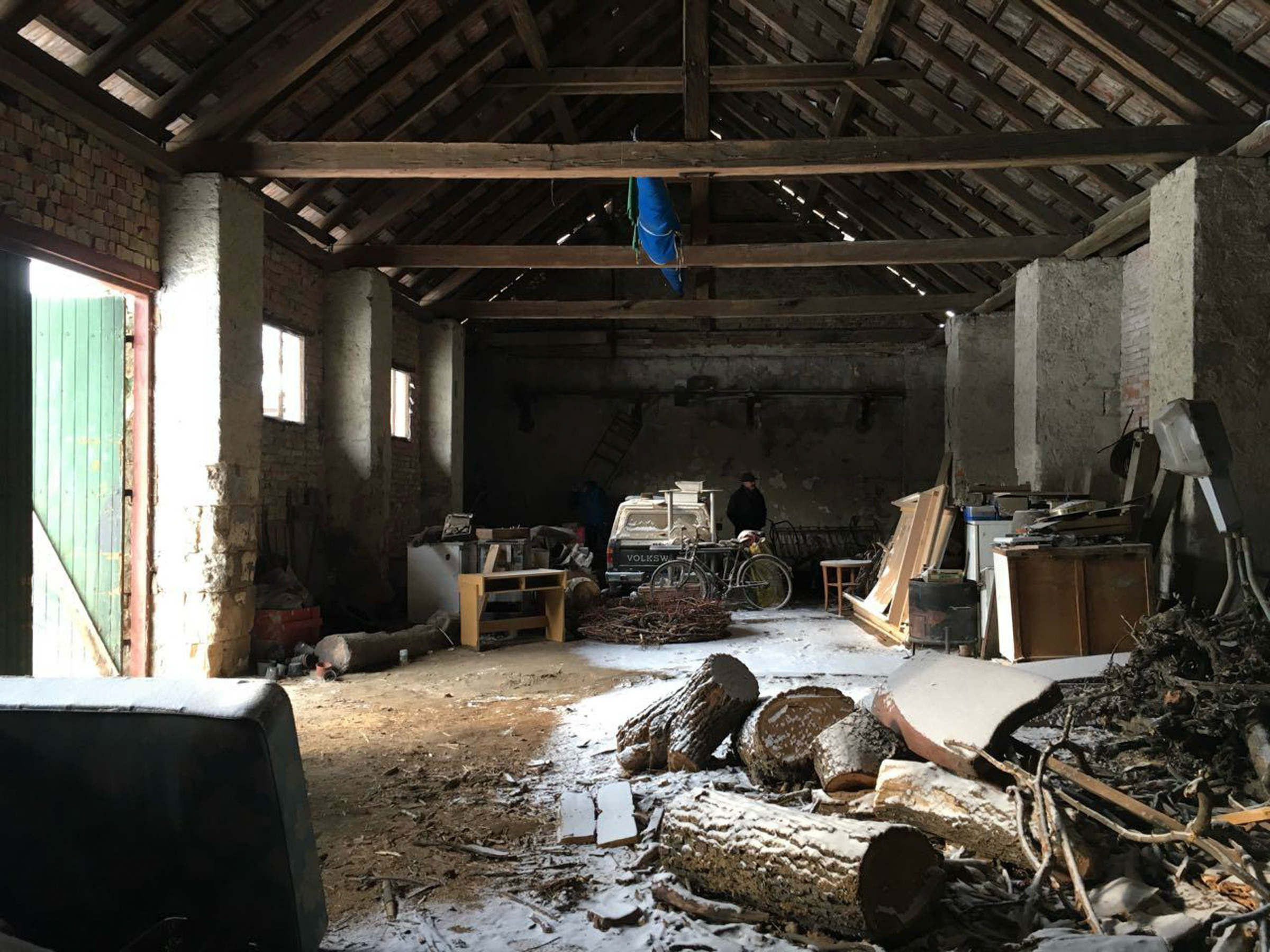
Set design for “The Testament of Ann Lee” by Sam Bader. Courtesy of Searchlight Pictures.
Kirill: Going back to doing vérité approach, how do you find the balance between staying true to the time period and elevating the storytelling for the viewer?
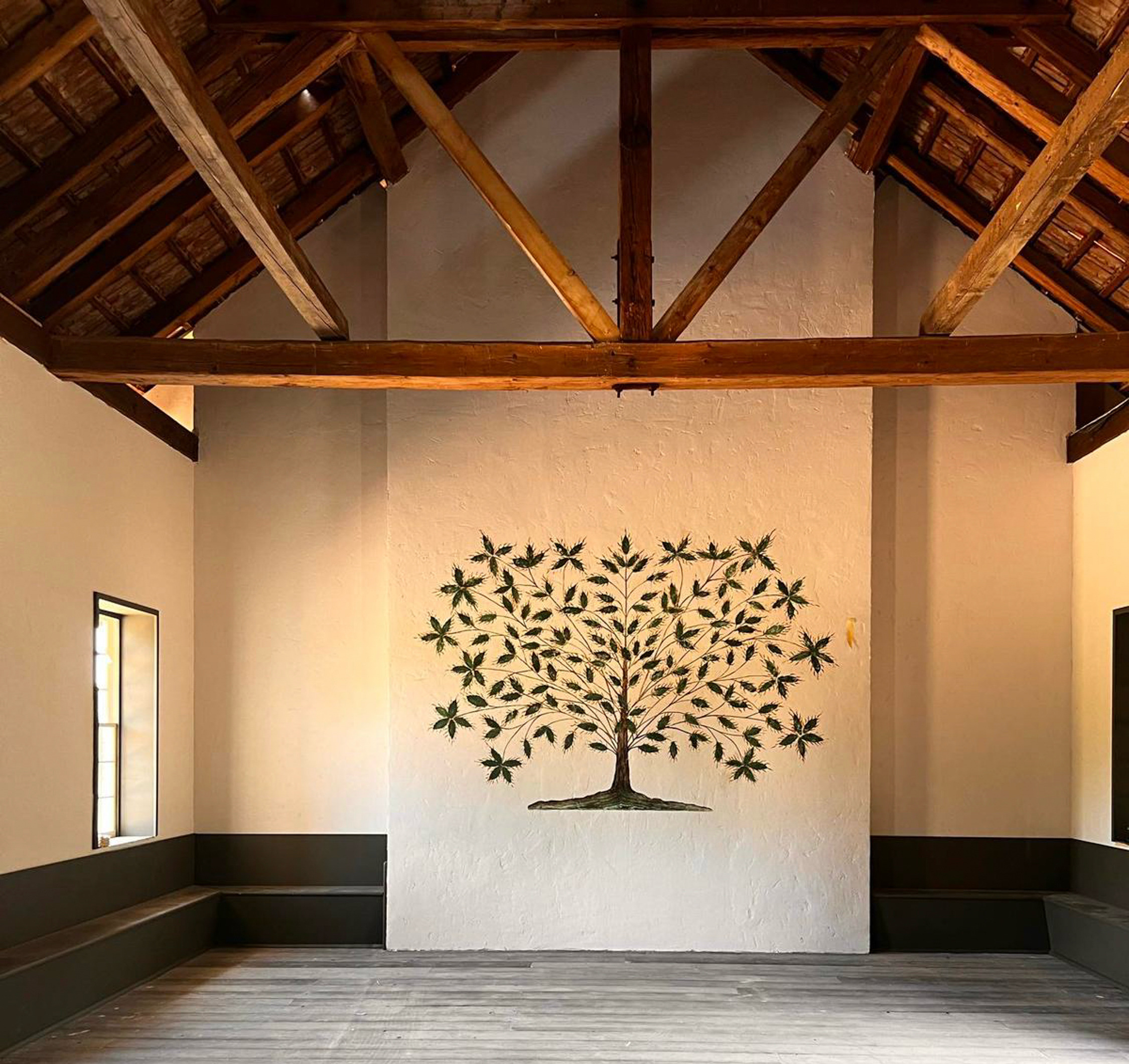
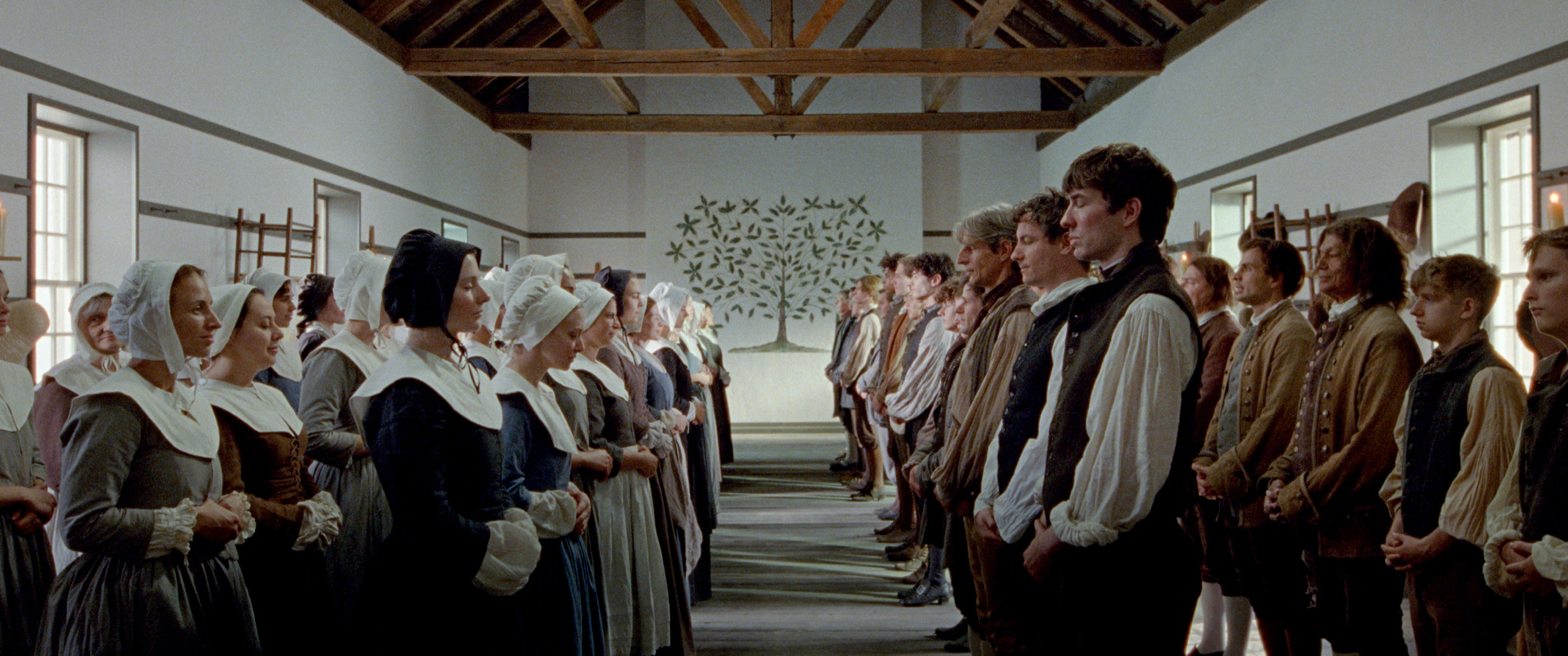
Sam: There’s so much great symbology in the Shaker art, the gift drawings, the spirit messages, and even some of their village views. There’s a lot of published work on how they drew the land. I knew we couldn’t make a film about the Shakers without finding a subtle and organic way to incorporate those into the design. The tree in the meeting house is a flourish that we decided on quite deliberately because we loved that kind of naive hand that they were made by.
When it comes to the Shaker side of the film, we adhered quite religiously to it with a few exceptions. The mill that gets burned down has symbological ties to cave paintings. You have fringe followers of this movement out in the backwaters of Massachusetts. They might have painted something along that style on the walls. That is the biggest way in which we took liberties. Other than that, we really grounded ourselves in what the reality of the Shakers were.
Kirill: You’re filming in Hungary, while hiding not just Hungary, but also everything modern, to make the viewers see Manchester and New York in the 1700s. How did you approach this?
Sam: By virtue of how we put this production together, we largely sidestepped any real risk of being too close to contemporary Hungary. We also built a few medieval and Mancunian sets in our backlots. We used signage, dressing, layers, and fabrics, adding some messiness to it, and coupling it with the magic of the matte paintings as a tool to orient us spatially. Those added enough intrigue and density so that, to my eye, we don’t feel lost in something familiar.
We built a very ambitious amount of sets for what we had in terms of time and money. It was a trick of finding hospitable structures that we could own, where we could tear down everything that’s not load-bearing, completely clad, redo the floors, redo the ceilings as much as we could. And we coupled this with the knowledge that we were going to be using the real Shaker villages in Pittsfield, Massachusetts.
The magic I think is really how do the matte paintings establish a world for us? How do they orient us to the tighter work of tracking with people and streets? The set decorating side and the prop side are challenging here. There’s so many great 19th century Central European locations. If you wanted to do 1890s Paris, you can find a perfect location where you would not have to do much to bring that to life. Our set decorators Lauren, Mercédesz, Krisztina and I were meticulous in what we could pull in from England. We were looking at what we thought looked of that late Tudor and early Jacobian world – and then we built the rest.
They build things marvelously in this country, and they paint marvelously. One of the benefits of being here is they do it in an efficient and cost effective way. You can lean on that here for this budget in a way you couldn’t elsewhere. We built much of the Shaker furniture that we shot here.

Set design for “The Testament of Ann Lee” by Sam Bader. Courtesy of Searchlight Pictures.
Kirill: When the camera shows the streets of Manchester and the streets of New York, how would you break it down into what existed, what was decorated and what was painted?
Sam: Much of the architecture below the middle line of the frame existed. It was heavily painted, roads were added, furniture was added, signage was added. Then, above that middle line for most of those frames, it’s on the illustrative side of the painting.
For the streets of New York, like the intersection of Broadway and Broad Street, we had a great backlot that had the right bones. We clad it, painted it, and did storefronts and signage. And then, 3-4 meters up were those colonial Georgian window panes, casings, pendants, and parapets. I love composing those deep background moments. I know the ship was in the South Street Seaport, and I understand that they walked up towards the central artery of New York at that time. It’s that layering that tells you quite quickly where you are relative to where you just were.
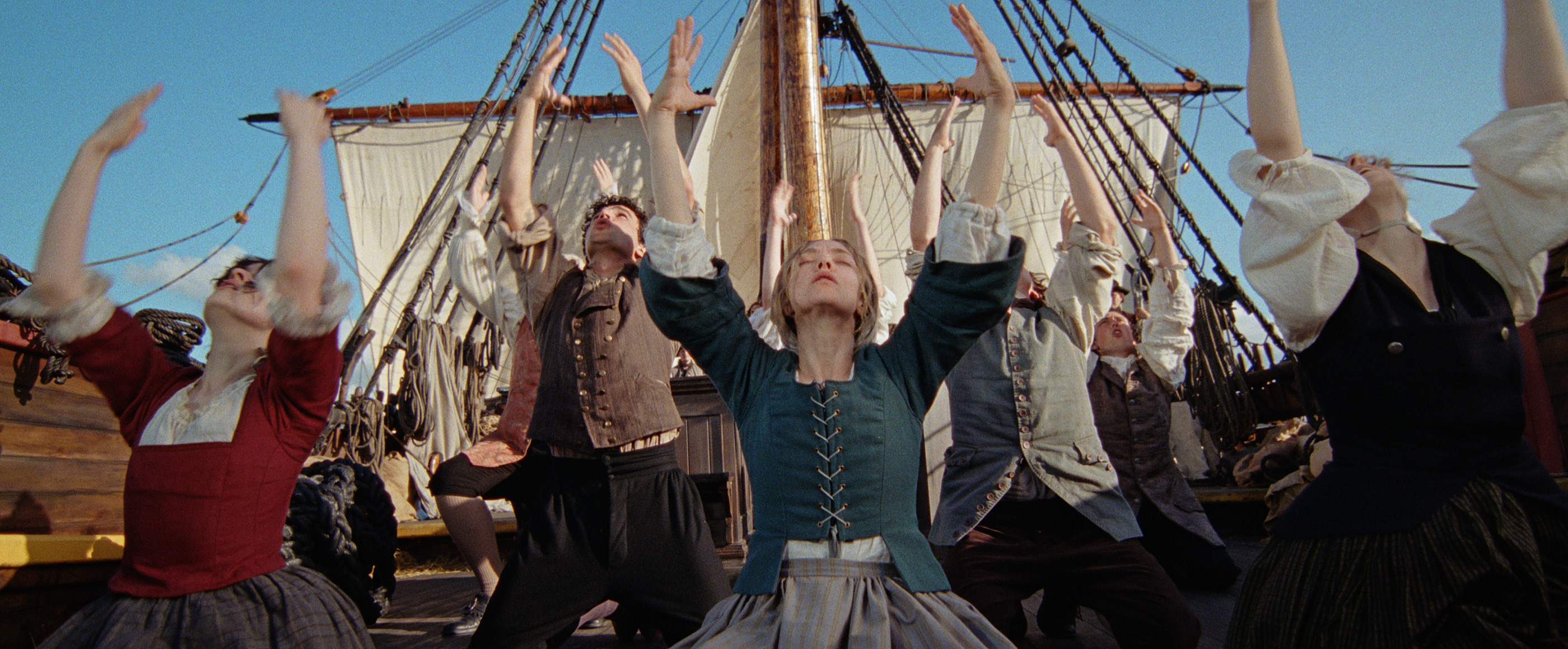
Production design of “The Testament of Ann Lee” by Sam Bader. Courtesy of Searchlight Pictures.
Kirill: What about the ship that takes them to the New World, above the deck and below the deck? Was that built on set?
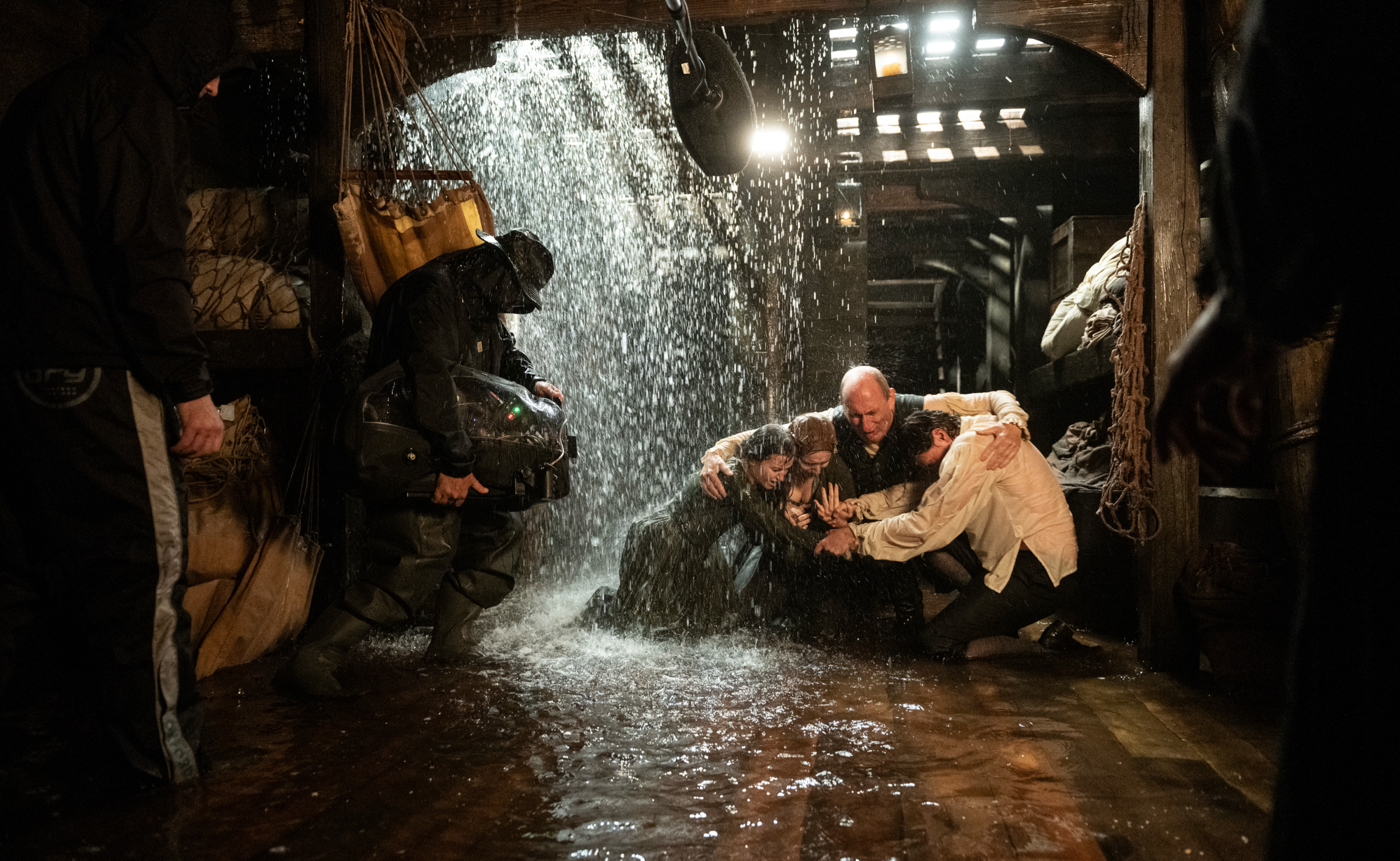
Sam: Partially. We shot on a real ship in Gothenburg, Sweden, that we took over. We pretty much cleared everything out. They had these massive, two ton cannons. It was a constant negotiation. How much can we broom these out of our set, because there are balance and weight considerations. The below decks is a museum with stanchions, projector screens, and wayfinding signs. We cleared it, and did all the furniture, all the hammocks, all the netting, all the fabrics. We cladded all of the infills along the ship and along the deck so that William [cinematographer] could move that camera around because that ship never left the dock. It was sitting there, and we did some background replacements.
For the dense flooding sequence, we went into some old wooden structures in one of these backlots, cladded it, added our architecture, dressed it, and did the whole flooding rig. A lot of that stuff you see towards the later part of the voyage, when it starts flooding, that’s all a pseudo build.
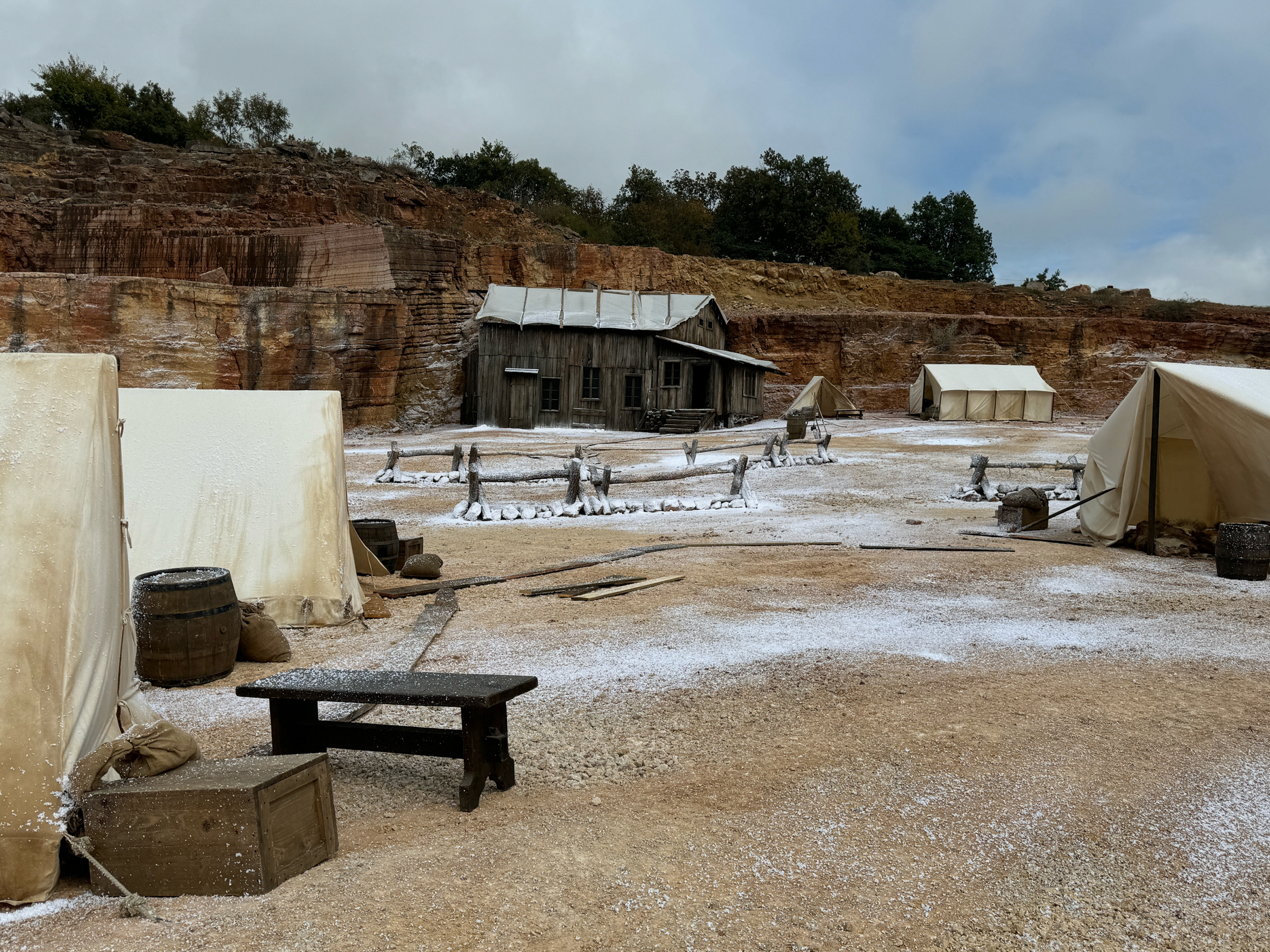
We did a lot of hybrid building. We built the Shaker meeting house facade completely from scratch. We built the house that burned down completely from scratch. But most other things were a subtle combination of finding a good base layer to start to construct on top of. You save a lot of time and money by not having to have a construction crew erecting tons of scaffolding. That stuff can take weeks, and it’s weeks we didn’t have. We were quite deliberate with what we chose to build.
On the sets of “The Testament of Ann Lee”. Courtesy of Searchlight Pictures.
Kirill: What was the location of the big church in Manchester where Ann Lee and her followers go to proclaim their new religion?
Sam: That was about 30-40 minutes outside of Budapest, on the Pest side. It’s a Roman church built around the 13th century. We extended the outside with the iconic Christchurch architecture, but everything you see inside is existing, with exception of the soft goods, the pews and the altar. It was a really great starting place.
Kirill: I also loved the prison cell where they take Ann right after that church sequence.
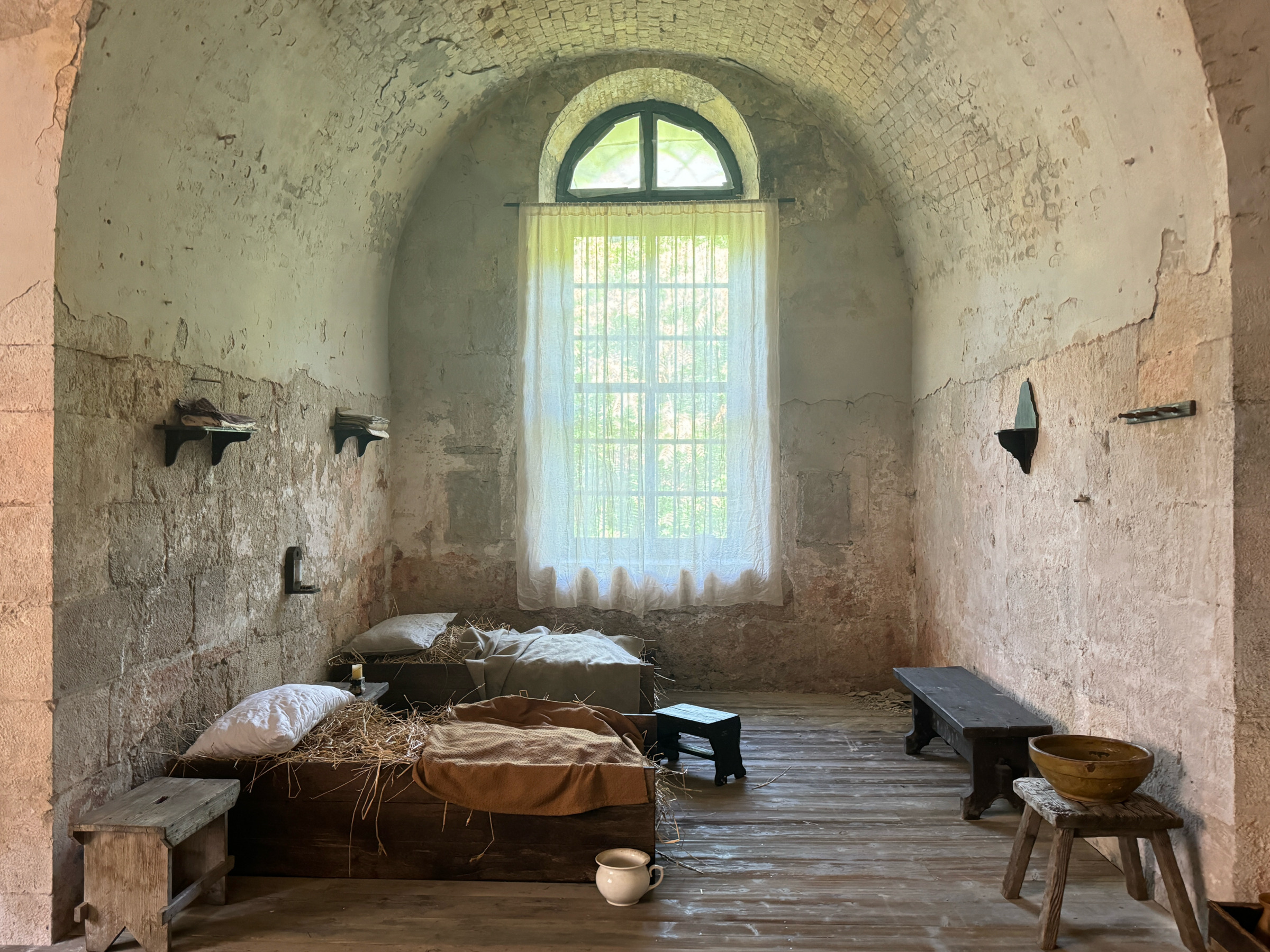
Sam: That was in a place called Komárom which is an early 19th century fort up near the Slovakian border. We shot the infirmary in there, which is a set I personally adore. We put so much detail into all of that dressing. That’s where we did the prison exterior and interior. In general, we pared those sets quite aggressively into the smallest number of locations.
When William and the rest of her followers go up to the windows and you see that central holding courtyard, that was the same location, about 300 yards away from where we found those great prison cells.
Kirill: What were the most challenging set, the most challenging sequence, and the most challenging day for you on this film?
Sam: The most challenging day was waking up at 2:30 in the morning to do two or three flights from Budapest to Gothenburg to meet an art director in Sweden, to walk the ship, to give the notes, and to do some drawings in an office, only then to fly back out the next morning at around 4 AM to be back on location. We had a few rounds of those deeply challenging days, just from a time standpoint.
The most challenging set to find a location for and to realize was the meeting house, because it was so specific to the choreography, and finding that scale was hard. We went through many iterations of budgeting where we were trying to build it from scratch. We wanted to build the full meeting house – interior and exterior with the great vaulted ceiling and all the other things. Then you look at the numbers, and all of these ancillary costs ended up showing that it was not feasible.
And then we found this old concrete warehouse, that was a drop space for junk on this farm. It had a beautiful old wooden vaulted ceiling. Once they told us we could completely clear it out, and we could knock out every single wall that wasn’t load bearing, and clad it into the deck and the floor and the beams and the windows and the peg rail and all that – that was quite challenging. We also needed to interrelate that to the wholly constructed facade of that narrative space where you are constrained as you move windows and doors around to create a harmonious composition.
That ripples out to the build that you’re doing. And it also has to maintain the specific proportions that all the Shaker meeting houses had. It was a lot of drawing and redrawing. You find that you can only get this window this close before there’s a big cement beam, things like that.
Set design for “The Testament of Ann Lee” by Sam Bader. Courtesy of Searchlight Pictures.
The labor mill that burned down was easy to conceive of, to an extent. But then we had to keep borrowing resources from it to finance the rest of the major sets in the film. As a result, we kept cutting the budget of that down and coming up with ways to find old salvage barn wood. We don’t have the ability to have scenics in a shop doing aging for 20 days. So we kept the Hungarian team there, and one of our set designers was there full time. It was about 2.5 hours away from all the other locations, and she had to go live out there. I would make it out there 2-3 times a week to give notes and to see it. Those were equally challenging sets.
For the sequence, the Townley home in Manchester where most of the dancing takes place is probably one of the most filmed sets in the movie. The movie spends about 20-25 minutes in there. There was an appetite to be able to flow in and out of spaces, and be able to peek around corners, and have this door open. We found a good location for it, but embracing the full scope of that world was a challenge to figure out.
Kirill: What would be your elevator pitch for why this movie must be seen on the big screen?
Sam: It should really be seen on the big screen, and it should really be seen from a print. There’s a softness to celluloid being projected that is irreplicable through DCP or through any kind of streaming. There’s so much chiaroscuro in this film, and yet we didn’t just treat it as negative space to disregard. There’s so much subtle texture and information that you really feel when you see the full moving picture.
The legacy of musical historical epic is such that it is a more elevated experience to be in a room with a group of people. It’s such a unique film. It’s such a captivating experience that transports you into that world. Experiencing that in a sizable room full of dozens or hundreds of strangers absolutely elevates that experience.
I want everyone to see the movie. I would deeply encourage anyone who can to go see it from a print. The next best thing would, of course, be just being in a room full of strangers experiencing this striking story.

Set design for “The Testament of Ann Lee” by Sam Bader. Courtesy of Searchlight Pictures.
Kirill: There’s a strong tendency to affix labels to every story, that this one is a drama, and this one is a musical, and so on. And it feels like “The Testament of Ann Lee” wants to defy these traditional labels. Should it be viewed outside of the “established”, so to speak, genre boundaries?
Sam: Yes, and it’s one of the things that makes this such an exceptional film to be coming out right now. We are in another swing of the pendulum, where I hope audiences are softening their understanding of what these delineations mean. We’re in a time where people really want to play with that.
The bold and remarkable and celebratory thing of this film is it shatters it. You could try to talk about it through the prism of genre. Maybe it’s a gothic historical opera with miasmatic dance. There’s a sexual component, but it’s not a romantic thing.
It is a wholly unique brainchild of somebody who certainly was not thinking about any of their projects through the prism of a film. You can call it a period film, but that is such a sweeping label. It’s a safe out, if you want to not be constrained in any way. I don’t see it as a period film. It’s a sort of a neorealist, pseudo art house, but with mainstream appeal [laughs]. It’s an amalgam of a lot of things.
Going back to one of your initial questions, what makes for bold and unique art? Everything is derivative, but the more you can pull from all of these different art facets of yourself and your sensibilities and your taste and your lexicon, and the more cleverly you slice out these collage pieces and compose a film object, the more novel it becomes. You watch certain films and you know what they owe their vision to. I think it’s very hard. People mentioned “Andrei Rublev”, “Barry Lyndon”, “The Tree of Wooden Clogs”, “All My Good Countrymen” and some of the Czech new realist stuff. To a certain extent, those things are so obscure in the minds of many film viewers, but also it’s really none of those things either. That’s part of what makes it such a kind of bespoke object.
Kirill: That’s a beautiful thing about this art form that you don’t need to be pigeonholed into any particular expectations.
Sam: And you do your best when you really shirk those. The more you can put any anxiety about how it’s going to be perceived aside, the more you can venture out and do something like this.
Set design for “The Testament of Ann Lee” by Sam Bader. Courtesy of Searchlight Pictures.
Kirill: You briefly mentioned generative AI. How do you see it today – a curiosity, a tool, a threat?
Sam: Anyone who takes the position that it’s going to come in and produce art that moves people is drinking the Kool-Aid. I know that it is a threat to the bottom lines of people who are trying to earn a living doing this. And even if the tools don’t fully supplant the human hand, they probably will be used as a leverage for people in power to cut down the amount of time they pay somebody to do something. In that sense, they are a threat.
But I do look at the magical thinking around AI in 2025 much like the magical thinking around crypto and NFTs and more formerly the Internet and what it was going to be. You can go back and read media or watch interviews, and so many of those things have just bore out to be inflated, intoxicated perspectives.
It’s all at once alarming and not alarming. I’ll quote our great director – it’s a typewriter, not an author.
There is a thing that really worries me the most about AI in the context of film. I was an art PA making the lowest rate, doing a lot of clerical stuff, doing lunches and all. That’s where I started, and I am concerned that the streamlining of some of these tools will push productions who are already looking for ways to do things more affordably to eliminate or limit those roles. This is almost more of a threat in the post-production or in the VFX world, than it is in our world, but it is a concern in the physical production side.
You’re not putting a topsoil down to produce the next crop of great people who had to do a version of what I did. That makes me extremely worried because then you’re cauterizing off the bottom and you’re not allowing blood to flow. Of all the speculation swirling around about AI, that makes me quite concerned.
I’m a humanist and an optimist at heart. I think that people want to help people, and even if these tools become compelling and efficient, humans will want to keep giving work to other humans. That element is so absent from so many of the debates I hear about AI.
I don’t know what art is, if it’s not born out of a very human need to express. We’ve been heading in this direction culturally for a while. Look at “Crime and Punishment” from Dostoyevsky and “Moby Dick” from Herman Melville. My God, does finishing a book like that leave you in a very different place than where you went in?
I didn’t come from a culture of literati artists. I had to find my way there. There are a lot of cherished people in my life for whom art does not occupy as big of a space as it does for the people who are in this room right now. And so, the extent to which most people don’t see that as the job of art sets the groundwork for all of this slop to fill in the middle, and people can build an economy around it that more or less functions in the same way.
The other side of it is that a new generation of artists will in some way learn that they can train a model to produce bespoke and novel things – almost like the way hip hop and sampling blew the lid off of music in the ’70s and the ’80s. Maybe this will be the new debate to grapple with as we discuss what is art.
Production design of “The Testament of Ann Lee” by Sam Bader. Courtesy of Searchlight Pictures.
Kirill: In this context, I’ve started thinking about some of the best stories in the film world, like “Godfather” or “Forrest Gump”. I don’t see how a machine, in any shape or form, can arrive at the level of storytelling in “Forrest Gump”.
Sam: I don’t either. There are moments in those films that hit you right in your gut. Maybe it can get close. Maybe it can look and feel and sound very much like those films. But I’m yet to be convinced that anything that is pumped out of a model will make me feel the longing I felt when Forrest could never get Jenny, and that interrelates to the jilted lovers that I had in my childhood. You have to stimulate some part of the viewer’s or the reader’s soul. And I have a hard time seeing how that’s going to happen.
Kirill: What do you know now that you wish you knew when you were starting out?
Sam: Don’t feel that you have to be formally educated on how to use these complicated and scary looking software systems like AutoCAD or light renderers. Take four hours a day on the weekends and on the holidays to just learn it. Use YouTube or any other place to learn. Don’t act like those things are unacquirable. That would be a material bit of advice.
The other one would be that all of the painful and difficult things that befall you will leave you better in the end. As long as you’re a good person and you operate honestly, your career will endure. Don’t catastrophize the rejections or the failures because they are the things that fortify you.
Set design for “The Testament of Ann Lee” by Sam Bader. Courtesy of Searchlight Pictures.
Kirill: Now to your favorite things. What would you consider to be your all time favorite films from the production design perspective that have shaped you, or have left you speechless, or have defined your field?
Sam: I saw “There Will Be Blood” when I was still in high school, and I didn’t know what I was watching. I was fortunate enough to get to shake hands with Jack Fisk the other week. The amount of intentionality, authenticity, and that coherent believability to everything you’re seeing blew my hair back.
Looking back further, and these films found me later, I would take “Barry Lyndon” and the work that Jacques Tati did on “Playtime”. It’s amazing what they built for that film. Kubrick gets at something quite deep and literary for me., and the work that Ken Adam did on “Dr. Strangelove” was phenomenal. Spielberg’s “Hook” has lived in my head for a long while now.
Another one that I don’t invoke as much these days was the moment when “The Royal Tenenbaums” trailer came out on TV. I knew straight away that I needed to see that movie. That early-middle Wes Anderson work is astonishing.
Kirill: A couple of years ago when all these video AI models started coming out, everybody was “reimagining” different movie franchises in the style of Wes Anderson, and yet nobody was acknowledging that it took the human mind of Wes Anderson to define that style to begin with. There was nothing generational there, only regurgitative.
Sam: It’s completely regurgitative. It’s a gumbo. It’s putting a lot of things in a blender and then drinking whatever comes out.
Kirill: Gumbo is good when it’s done well, but not like how these models are doing. Those are like gumbo made by somebody who has no sense of smell, sight, or taste.
Sam: Exactly.
Kirill: And speaking of food… Out of all the places that this particular movie took you, what was the best cuisine or the best dish that you’ve had while making this movie?
Sam: Oh, that’s easy. There’s a Middle Eastern restaurant in Budapest called Goli. I’m back in Budapest now, and I probably go there three times a week. They take cake, handily.
One more would have been getting proper ramen in Gothenburg, which is hard to find here in Budapest. They also have these nice restaurants by the dock with pickled herring, cabbage and potatoes, deep in its flavors.
Production design of “The Testament of Ann Lee” by Sam Bader. Courtesy of Searchlight Pictures.
And here I want to thank Sam Bader for taking the time to talk with me about the art and craft of production design. I also want to thank Kara Kitchell for making this interview happen. “The Testament of Ann Lee” starts its theatrical release in United States on December 25. Finally, if you want to know more about how films and TV shows are made, click here for additional in-depth interviews in this series.
