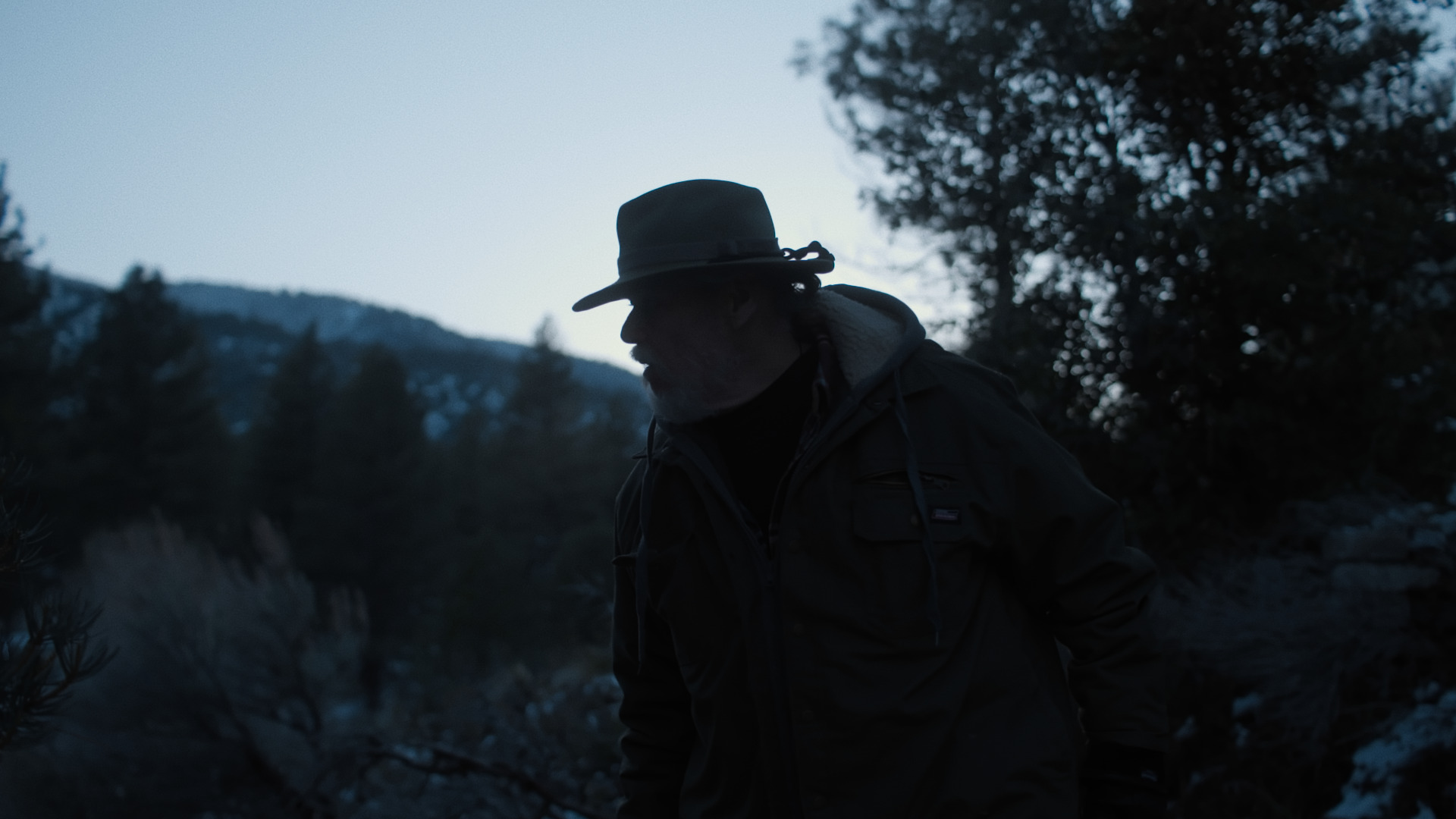
 Cinematography of "Herman" by Jess Dunlap.
Cinematography of “Herman” – interview with Jess Dunlap
Continuing the ongoing series of interviews with creative artists working on various aspects of movie and episodic productions, it is my pleasure to welcome Jess Dunlap. In this interview, he talks about the transition of the industry from film to digital, finding the balance between technology and art, the meaning of art, and advice he gives to younger cinematographers. Between all these and more, Jess dives deep into his work on “Herman” that is releasing on video-on-demand channels tomorrow.
Kirill: Please tell us about yourself and the path that took you to where you are today.
Jess: I’m a cinematographer, currently based in Los Angeles, but I am originally from Massachusetts – not too far from Boston. I went to Emerson College to study film and specialize in cinematography. I didn’t know until late in my childhood that I wanted to do anything in film, or even anything artistic long term. I did have artistic passions like music, but I was a science and math oriented student. I excelled in math, biology and chemistry, and I thought that’s what I wanted to study.
Then I reached a point later on in high school, where the standard setup of academia felt frustrating. I felt a lot more drawn to my artistic side, and it was music that opened up my eyes to the fact that one can pursue something artistic. So in a lot of ways, I abandoned my math and science oriented self, and decided to pursue filmmaking, almost on a whim. I was not super obsessed with movies, and it was a total 180-turn in my life at that point. It really felt like I was abandoning that more technical side of my mind.
I went to film school thinking that I would be a writer and a director, and that it would be a purely creative artistic process. Then I started working on a couple of short films during my first freshman semester, and I saw the role of the cinematographer, and I saw that it was obviously a perfect marriage of the technical and the creative. I saw that I didn’t have to abandon that math and science oriented side of myself. I saw that I could still exercise those parts of my mind, but be creative at the same time. Typically it takes me a while to make major life decisions, but that one came pretty easy. I watched the DP shooting on my first or second short film at Emerson, and I knew that it was what I wanted to do.
From there, I kept on pursuing that path. And since then, it has maintained its complexity, and how it challenges my left brain and my right brain at the same time. I love it.
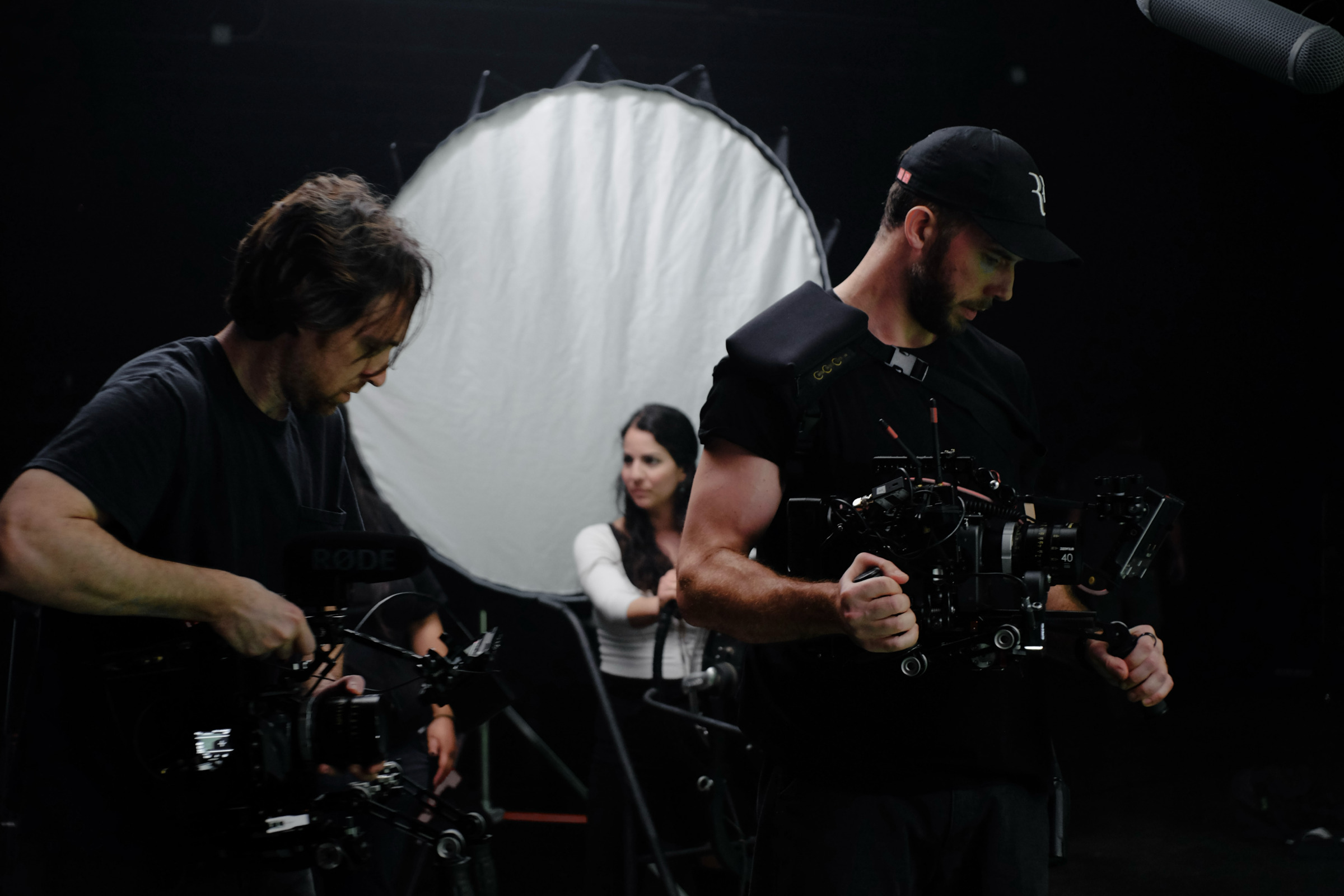
Jess Dunlap (right) on the sets of “Herman”.
Kirill: In this marriage of technical with artistic, do you find that one is more important, or is it a balance of the two?
Jess: It’s definitely a balance of the two. At times you do need to weigh one heavier than the other. You need the ability to go really technical when you need to, and the ability to go really artistic when you need to. If you’re not a highly technical person, it’s fine. There are ways to pick up the slack. Once you reach the level of cinematographer, you have camera assistants, you have a gaffer and a key grip who handle almost all of the technical issues for you. You don’t need to be an extreme technician.
Even within the artistic side, we’re exercising those capabilities of our mind that work with geometry, space, and physics. It is a role that’s well suited to someone who thinks in those ways.
Kirill: Do you feel that your field lost something important in the transition from film to digital?
Jess: Yes, at least from the perspective of a cinematographer. When I went to film school, we were shooting on film. Digital only started to really take hold at the end of my time there, so most of the bigger projects that I shot were on 35mm and 16mm.
When film was more dominant, the experience was that the cinematographer was the only one on set who knew how it was going to look. Maybe the camera assistant or the gaffer had an idea, but the cinematographer was really the only one who knew how it was going to look in the end. There was the monitor, but it was for framing. It wasn’t for lighting or exposure. Nobody knew what the mood was that was being created. The director described it and had their vision of it, but at the end, it was in the mind of the DP. Selfishly, it was fun. It was fun to be on set feeling like a kind of magician who has all these creative visual ideas running through you. Everybody else wanted to know how their work was going to show up – the costumes, the make-up, the production design.
Nowadays, a little of that is lost. You only need to look at the monitor to see what your work on costume, makeup or sets looks like. In some ways that’s good, because you can make more efficient decisions. But there’s something lost in the experience of the cinematographer.
There’s another difference in how much care went into shooting on film. It’s a more delicate process where mistakes matter more, and mistakes can be more expensive. The way we shoot on digital is you keep on doing more takes. You have time, and you keep on going, and you eventually get your take, but there’s something that is lost in there. There’s a little less pressure for everybody, including camera operators and even actors.
Kirill: A few years ago, Jayson Crothers said that every time you roll the camera, that’s specific tangible dollars that you’re spending.
Jess: That’s not fun sometimes, but other times it can be. It gives gravity to the moment. If an actor does something incredible that you know isn’t going to be repeatable, and you nail the focus – then that sound of the film spending money turns into something worth ten times as much as the film itself costs.
Kirill: Do you feel that there is almost too much choice between lenses and sensors and camera bodies and lighting equipment? Is it difficult to keep track of everything that is happening?
Jess: It’s difficult to keep track of how many options there are technically now. Luckily, the higher end gear doesn’t change too much. It’s happening more on the lower end, some of which didn’t even exist a few years ago. We shot this film on full-frame prime lenses that are relatively cheap to buy, and I don’t know if we would have been able to shoot on full frame at all even 6-7 years ago. The nature of things changing and having so many options has certainly opened the door for some creatives to use a lot of those options when they’re more affordable.
As a cinematographer who’s trying to keep up with all this equipment, it can be overwhelming. I subscribe to a couple of newsletters from different camera rental houses and gear manufacturers. You can just scan the subject line of that email or a few headlines to get a sense of what’s out there and what people are using.
And as I said earlier, once you get to the higher tier of equipment, the classics are the classics and don’t change too often.
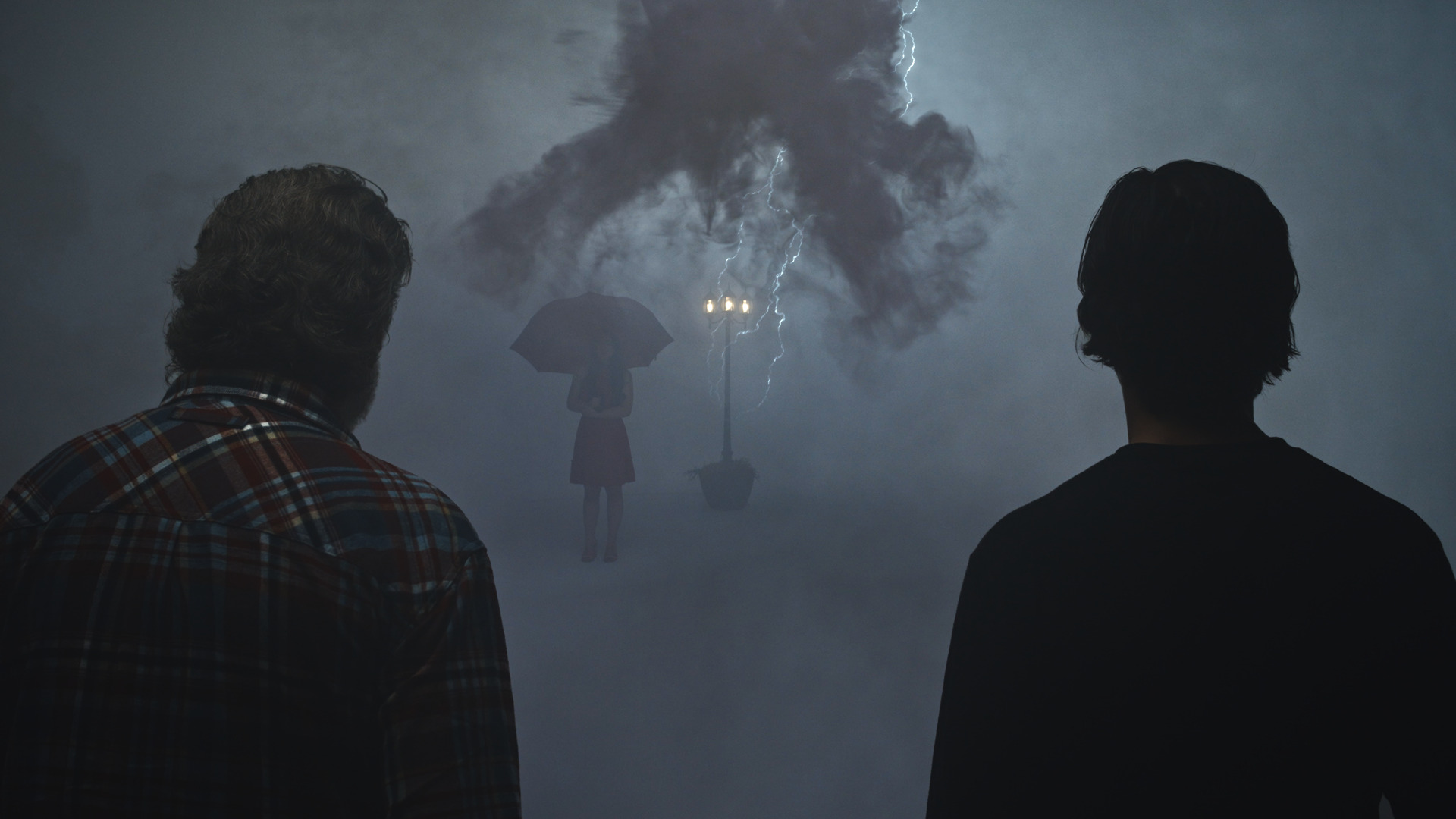
Cinematography of “Herman” by Jess Dunlap.
Kirill: One thing I keep on hearing about is great advances in lighting equipment – the quality of light, how much you can control, how portable they are. Is it becoming noticeably easier to make the setup that you want for less money?
Jess: Definitely, much easier. There are several factors to lighting equipment changing in a way that makes it easier for us to light scenes. It’s faster. It’s lighter weight. It’s cheaper. And it’s not as hot. Even 10 years ago, those older lights would warm up a small room to a pretty uncomfortable level.
You combine all those things, and you can light a movie such as “Herman” with a small crew in a small space, and you can hide these lower profile LED units in a nice way. On this movie we have a lot of lightning effects, some fire effects, and some power outage effects. A lot of those were pretty tricky to do just 10-15 years ago. They were possible, of course, but it would take a lot more money. And even if you had the money, it didn’t really look as good.
Kirill: Is there anything exciting for you on the horizon from these newsletters or forums?
Jess: I’m excited to see Aputure and other companies starting to release these 8×8 foot and 12×12 foot LED mats. So far I’ve only used them a couple of times, but they’re great for overhead sources and setups where you need bigger lights. The technology has advanced, but we’re still using these big lamps and then putting a big frame in front of it, so I’m excited about using a huge source that is simply the light itself.
Kirill: Switching to the artistic side of things, how difficult is it to define what art is?
Jess: It is as difficult as you want it to be [laughs]. In my mind, art is anything that is an expression of one’s own experience or one’s own connection with the world. By that definition, anything can be art.
To me it connects to how we define our purpose in life. It’s not about finding a purpose, but instead it is about creating a purpose. Art is similar. The goal is not to find what we should create based on what society is telling us. The goal is to find out what we should create based on what our own selves are telling us.
Kirill: Another thing that I’m struggling to find my own answer to is nature versus nurture. Do you feel that some people have this almost divine spark in them that makes them great artists, or can anybody be nurtured or trained to be – maybe not amazing – but great at art?
Jess: I do think anyone can be opened up to the creativity that lives inside of them. Everybody has that in them. For some people it comes easier than others, and there are different factors to why it comes harder to certain people. It could be their upbringing. It could be this sense that they don’t allow themselves to create something unless they know it will be accepted. That is a major notion that needs to be broken – or at least contended with – in any artist. What am I doing here that I’m doing simply because it’s expected of me by an audience? What am I doing here that I’m doing because it’s coming from within?
This is a constant battle for any artist, and some people for whom that battle is very difficult may end up not making art. But that creativity lives within all of us.
Kirill: I’m not sure if it’s biological or societal or a mix of the two. Do you feel that we are wired to need storytelling in our lives, most of us consuming stories and some of us elevating ourselves to tell stories?
Jess: That’s an interesting one. As an artist, with both music and filmmaking, I’ve always been drawn to stuff that’s a little bit more abstract, even stuff that has nothing to do with any kind of story. I like experimental visuals. I like experimental music without lyrics or vocals.
When I was younger, I used to think that maybe story is not that important to me. I liked the experience of seeing weird visuals or hearing crazy sounds. But over time I have noticed that story is a very rudimentary part of what it means to be human. If we only create art that is devoid of story, I do think there’s something missing there. Art that tells a story has more potential to influence others in a specific direction or a specific emotion – whether it’s for political purposes or simply artistic enjoyment. There’s something to be said for what a story brings to the table, and how much it can more efficiently impact an audience.
Kirill: Before we get to “Herman”, how was Covid for you?
Jess: After the first three months of lockdown, it started feeling like I needed to start adding up my finances to see how many months could I even survive at this. But I was fortunate to have clients that still needed content created during lockdown in 2020. They were often smaller projects with no crew, sometimes just YouTube and social media commercials that were getting shot around that time. There weren’t big movie shoots or bigger budget commercials happening, but I lucked out by being in a specific niche at that time.
Kirill: Is it back to normal how it was around 2019?
Jess: It’s back to normal from Covid, but there are other factors. We had the two strikes in the last few years, and that shook things up in a way it’s never fully recovered from. The tax incentive status in California is not as competitive as other states. There’s a lot of different factors where it does still feel slow for a lot of people out here. I’m still working somewhat consistently, but half of my work is not in Los Angeles. It’s a tumultuous time.
There’s potential for things to change. There’s a lot of people who are doing the work and trying to bring productions back to LA, and I hope they succeed.
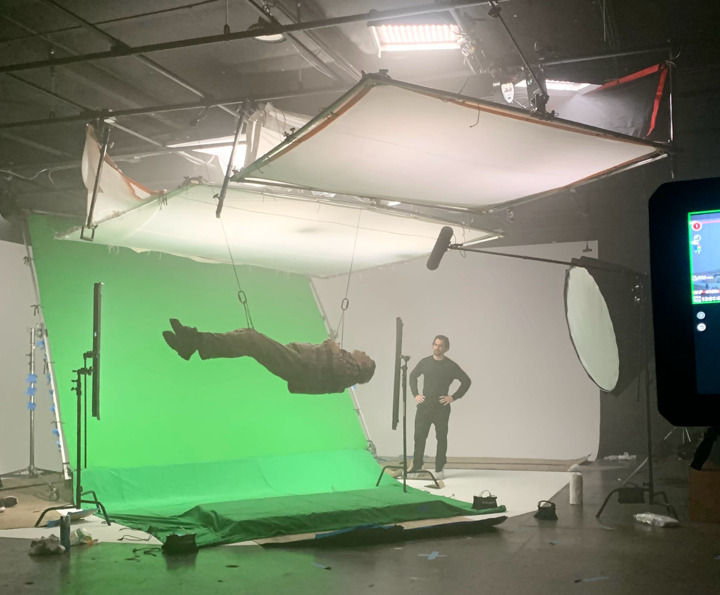
On the sets of “Herman”.
Kirill: Getting to “Herman”, what brought you to it?
Jess: The movie is written and directed by Andrew Vogel. Suzann Toni Petrongolo is one of the actors, and she’s also a producer on it. The three of us made a movie called “The Dirty South” two years ago, a thriller that we shot in Louisiana. That was my first time working with the two of them.
Back then I didn’t know that Andrew was also a writer and director. He came to me with this script about a year later, and said that they wanted to try and produce it for a low amount of money. I told him that if I’m free, I’m in. The positive thing about having so little money is that you also have only so few shoot days, and it’s much easier to commit to a couple of three-day weekends.
Kirill: What was your camera setup?
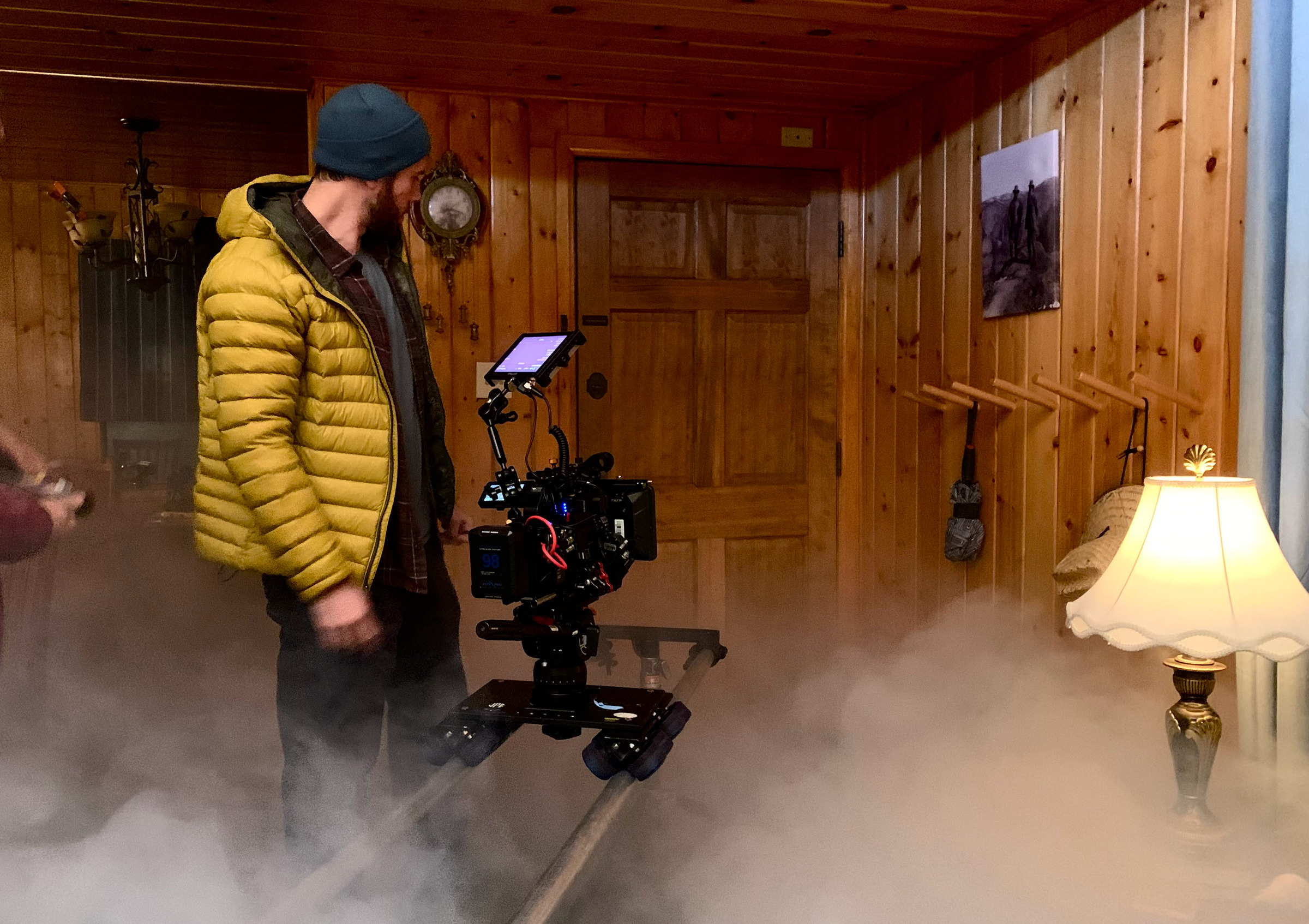
Jess: We had two Sony FX6 and one FX3 cameras, and we used the DZOFilm full-frame prime lenses. We had such a modest budget for equipment, so for me that was the way that we could affordably increase the image quality in shooting full frame. Luckily, there are affordable full frame options these days that were not there even 5 years ago.
Kirill: And the main cabin was there as a location?
Jess: That was a real cabin up in the mountains on the way to Big Bear here in California. There were a few other locations elsewhere used as flashbacks, and then the white void space that determined the psyche of the main character.
Kirill: Is it becoming easier with the more modern cameras to move around in these confined spaces?
Jess: Definitely. Simply having a lighter camera makes that all easier. It also makes it easier to fit three of these cameras in a fairly small space. I could not have done that 10-15 years ago.
Kirill: How do you tackle the challenge of spending so much time in one set, finding the angles and ways to not become too repetitive?
Jess: We spent three straight days in that one cabin. We have these aspirations to make every shot count, and make everything as interesting and creative as possible. But we’re also human beings, and as that 12-hour day goes on, we fall back into patterns. We get tired at hour 10. We resort to the shot list, and maybe we don’t feel as creative in certain moments. But then there are other moments where all cylinders are firing, and we are able to make fresh improvisational choices.
We all experienced a lot of that, and luckily we didn’t run into any hang-ups. Our entire crew was phenomenal. The crew really made our days happen. It was a small group, but I was able to rely on Tyler and Arthur, our camera operators, to come up with interesting angles. The director Andrew was also one of the lead actors, so he was at times leaning on me to help block the scenes, and in turn I would lean on the operators to watch the blocking with me and come up with fresh angles for each scene.
Kirill: Was there any particular color that you wanted to stay away from?
Jess: Nothing too non-standard. Most of our lighting is fireplace light or lamp light, which are both on the warmer orange-to-red side. Then we have lightning effects which are on the cooler white side, and this surreal inexplicable moonlight that is on the bluer side. So it’s mostly a warm-cool contrast that’s going on. We didn’t want anything more surreal than that. We were avoiding greens, pinks and purples. The cabin is a cozy, warm, and inviting space at the beginning that descends into something more chaotic – but it never strays too far from being lit by natural sources. Even when the power is out, you have light from the fireplace or that moonlight.
On the sets of “Herman”.
Kirill: Where did you do those out of body experiences where he sees his young wife and relives the trauma?
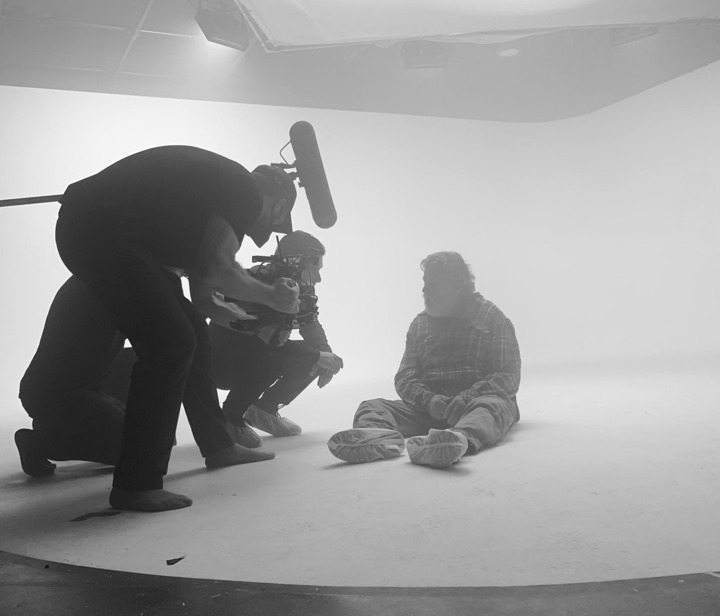
Jess: We called that space the white void. I love that Andrew wrote it as a white space and not a black space. It felt more of an opportunity to work with the space despite it being just a blank white canvas. I think black would have felt a little too much like a vacuum. We shot that stuff in a studio here in the valley in Los Angeles. It’s not too big of a space, and we tried to shoot it in a way that made it look bigger than it was.
Getting into the style of the camera movement that we use throughout the film, in the cabin we stuck to a more static, almost observational vibe at the beginning before things get weird. Then, when things go off the rails, the motion picks up – but it’s always smooth in there. It’s always floaty, even when stuff goes crazy. It doesn’t break out into handheld. It doesn’t get shaky.
I wanted to reserve the use of handheld for that white void space, because I thought it would be an interesting juxtaposition to have that pristine, surreal, almost clean white space to be seen with a shaky unstable camera. That felt like a big opportunity for me to go against the trend of what I would typically do. That space is also a stand-in for Herman’s own mind, so that sense of instability from handheld really works there.
Kirill: Is there such a thing as the most challenging sequence that you’ve tackled in this production?
Jess: I would have to say it’s multiple sequences that we shot at once on our second shoot day. We had to do 30 pages in one day – which is an enormous amount. Typically a big day of shooting is 10, maybe 15 pages – so shooting 30 in one day is astronomical.
The good thing about those pages that we had to shoot that day is that they were all mostly scenes that took place in the main living room of the cabin. So we started the day, we had our schedule, we reached the middle portion of maybe the four hours surrounding our lunch break, and our AD Heliya and I realized that we keep turning around multiple times in this room to try to complete a scene and then move on to the next one. I had lit the space to be able to turn around constantly. My crew had rigged multiple backlights to turn on and off, depending on which way we were facing. It was doable, but those minutes were adding up.
So we talked to the actors, and we decided to block shoot those 3 or 4 major scenes – shooting everything from one side for all those scenes, and then turning around and shooting everything from the other side for all the scenes going back to the first one. That’s a good way to save time, but it makes for a challenging brain teaser for the DP, for the actors, for the camera operators, for our production designer Kat – we all need to make sure that things are matching when we go back to return to a scene that we had just finished, but now we need to shoot the other side of it. That was tough, but in the end that saved time and made it possible for us to make our day. We cut some corners by returning to similar camera setups and not being as creative as we wanted to, but there really was no other way to do it.
Kirill: From the storytelling perspective, do you prefer working on stories that present everything to the viewer in clear and unambiguous terms, or stories that challenge the viewer to make up their own mind on what was real and what was not real, and what to make of the way the things ended?
Jess: I always appreciate it when filmmakers trust the audience to have some level of intelligence. Sometimes that gets taken a little too far, and that can leave an audience confused. It’s definitely a balance. There’s a sweet spot or a sweet range there.
For this film in particular, the moment I was sold on the script was after I finished it and I realized that this could be interpreted in the sense that all of these characters that show up at the cabin are not real. Maybe all of them are elements or family members within the mind of the main character Herman, but that’s not said to you explicitly. The story still works even if you don’t come to that realization, but to me it’s more profound when I did come to that realization. It works either way, and you’re not beat over the head with it.
You do get the sense that there’s something psychological happening. That’s the main element that we are given as an audience. This guy is potentially crazy, so you’re sent down the path of feeling like it could be something in his mind. Andrew’s writing is brilliant in the sense that we’re given the opportunity to come to that conclusion if we want to, but it still works if we don’t.
Kirill: What is your elevator pitch for watching this movie in a theatrical release – or watching any movie in a theatrical release – versus doing it on an iPhone on an iPad or any other smaller screen in people’s daily lives?
Jess: I’ve been returning to the movie theater more often lately. My biggest argument for watching this film in particular on a bigger screen is that it’s a ride. We are taken on a ride from a stable, observational view of this character into his chaotic psyche and this experience that he goes through. While watching it, you want to have the feeling of being strapped in and stuck on this ride with him. Watching it in a theater where you don’t have the ability to pause it or take a break is going to make it hit that much harder. That sense of being trapped the way Herman is and the gravity of the thriller aspect of this movie will come across so much more on the bigger screen.
Kirill: Now that you’ve been in the industry for a while, do you see yourself doing something different, or is this the place to be for you?
Jess: Definitely narrative storytelling – feature films and television – are my focus. Horror is fun. It gets to the heart of what a lot of us love as filmmakers. To be honest, it is the manipulation of the audience. We love to pull people in one direction and then the other, and flex our power as storytellers. But I love other genres as well. I love sci-fi, I love more standard drama-based thrillers, and genre-based movies. That’s the world that I want to live in. I’m still building my portfolio as a DP, and I’m not really turning down projects that are in certain genres at this point in my career.
Kirill: What do you know now that you wish you knew when you were starting?
Jess: There’s something I wish I knew when I was a lot younger and that I tell younger cinematographers or directors now. When you approach a new project, especially one where you find yourself putting a lot of pressure on yourself, and saying “this is my big chance, this is the big project, I need to not mess this up, I need to be perfect on this project” – it’s important to change that mindset. The mindset I recommend is to say that this next big project is not it – the one after this is it.
It opens up this mindset of seeing it always as an opportunity to experiment and break rules and take risks and do things wrong – because that’s the only way we learn. We learn by making mistakes, and you learn the most by making mistakes even on the biggest project you’ve ever had. Treating something with too much care and too much of a perfectionist mindset will simply hold you back from that, and it will also close off some of our more creative impulses. Adopt the mindset that this current big project is simply training for the next one.
Kirill: What would you consider to be your top choices for the golden standard of cinematography?
Jess: Rodrigo Prieto’s work on Martin Scorsese’s “Silence” from 2016 influenced me the most as a cinematographer. I love his use of natural lighting. The movie takes place several hundred years ago, so they had no electrical power, and the whole thing is lit by firelight or lanterns or moonlight. I love that look, but that look can be very easy to mess up.
Not only did he make it look natural, but he made it look phenomenal. There’s a lot of darkness that is done very tastefully. There’s a lot of daytime scenes that still maintain a mood. That came at a time in my career where I was struggling to feel confident in making those choices, to make darker imagery and to take more risks in that way.
Jess Dunlap on the sets of “Herman”.
And here I want to thank Jess Dunlap for taking the time to talk with me about the art and craft of cinematography. I also want to thank Suzann Toni Petrongolo for making this interview happen. “Herman” is out on video-on-demand channels tomorrow. Finally, if you want to know more about how films and TV shows are made, click here for additional in-depth interviews in this series.
