In the last 15 years his career has left an indelible mark on the silver screens. Through his collaborations with Steven Soderbergh, M. Night Shyamalan, Gary Ross and Francis Lawrence, production designer Philip Messina has worked, among the rest, on “Erin Brockovich”, “Traffic”, “Solaris”, all three “Ocean’s”, “8 Mile”, “The Last Airbender” and the upcoming “Free State of Jones”. And it has unquestionably been almost impossible to escape the juggernaut of “The Hunger Games” franchise, with Philip working on all four films in as many years.
In this interview he talks about the world of big-budget productions, returning to work with the same director on multiple projects, various aspects of physical sets and digital / CG environments, and designing movies that are watched on a variety of screens in our daily lives. In the second part of the interview Philip delves deeper into the intricately built worlds of “The Hunger Games”, talking about the schedule pressures of designing and shooting the two back-to-back parts of “Mockingjay”, approaching an existing universe from the book trilogy and translating it into on-screen visuals, defining the totalitarian spaces of the Capitol and finding parallels in the world of technology between the imaginary world of the franchise and the world that we all live in.
Kirill: Please tell us about yourself and your path so far.
Philip: My name is Philip Messina and I’m a production designer. I got into the industry in 1990 as a set designer, which was really a draughtsman, working with Stuart Wurtzel who was the production designer on the film “Mermaids”. I had never worked in the film industry before or even knew that these jobs existed.
They came to Boston to make this movie, and I worked on it for a few months and instantly fell in love with the film business and specifically the art department. I drew little bungalows and designed a lot of signs from the ’50s and the ’60s. That was back in the day where people didn’t really know what Hollywood did. There were no DVD extras or that kind of stuff, and I had no idea that there was a film business that took what I loved about architecture and design, and transformed it into films, which I also loved. It was a very transformative experience for me.
 I then was lucky enough to work on several films based in the Boston area after that. I was uncredited on “School Ties” which featured Matt Damon and Ben Affleck when they were local actors. I also worked on “House Sitter” where we ironically got to build a dream house for an architect. Then I saw very quickly that if I wanted to move up in the business, being in Boston was probably not the best place to be, that it would probably go faster if I moved to LA or NY. My wife and I got married and we both restarted our careers in Los Angeles, and I worked my way up from set designer to art director through the ’90s.
In 1999 I was fortunate enough to design “Erin Brockovich”, and then right after that “Traffic”. I had previously art-directed “Out of Sight” for Steven Soderbergh, and he gave me my break on “Erin”. It was crazy start to my career as a designer – both “Erin” and “Traffic” were Oscar nominated for best picture in 2000. That started an almost 10-year collaboration where Steven and I made all three “Ocean’s” movies, “Solaris” and “The Good German”. It was a very fun time. “The Good German” was in black-and-white set in post-war Berlin, “Solaris” was a ver heady science-fiction film, the “Ocean’s” movies were huge builds and we got to shoot all over Europe for “12”. It was quite an adventure, and my wife Kristen was the set decorator through all those films, and we got to travel and work together. Those were some of my favorite years in the film business.
Then I began to do films with other directors as well. I designed “8 Mile” for Curtis Hanson and “The Last Airbender” with M. Night Shyamalan with whom I worked as the art director on “Sixth Sense” years before. “8 Mile” was a gritty drama set in the rap world of Detroit and “Airbender” was a big fantasy movie where we got to do some great work on a very large scale. Then I ended up doing “The Hunger Games” with Gary Ross whom I had met through Steven Soderbergh. I’ve also just completed “Free State of Jones” with Gary – that’s coming out in the next couple of months. After the first “Hunger Games” I was asked by Francis Lawrence to complete the next three films in the series with him and ‘suddenly’ 4 years went by where I was almost exclusively designing that series
So that gets us up to the present day where I’m in Montreal working with Darren Aronofsky on his next film which stars Jennifer Lawrence and Javier Bardem – we start shooting in about 7 weeks.

Top: concept illustration for Katniss airlift sequence by Nathan Schroeder, courtesy of Philip Messina. Bottom – stills of the sequence from “Catching Fire”.
Kirill: As you collaborate with the same people, director or cinematographer, on multiple productions, does it become easier as you can anticipate what each side expects from the other?
Philip: Sure, it becomes easier. You know people’s strengths and weaknesses, and that goes both directions. He knows mine and I know his, and you are able to complement each other more easily. I worked with Francis Lawrence on three movies, with Gary Ross on two, with M. Night Shyamalan on two, with Steven Soderbergh on nine or ten. I tend to want to cultivate relationships with directors that I find interesting on projects that appeal to me. As I’ve worked through my career, I find that there are different things that appeal to me at different times in my life.
I’ve done period movies, I’ve done a couple of science-fiction movies, I’ve done fantasy, and this movie that I’m working on now is sort of undefinable. It’s unlike anything I’ve ever done, and if you know Darren Aronofsky, he has a very unique voice as a director. This is very exciting.
It’s really about working with creative people that I find exciting, whether it’s a cinematographer or a director – hopefully it’s all of the above. When it all comes together on one film it’s kind of magical. That’s what you’re always hoping for – a chemistry that all of us are able to put our best work forward and have it add up to something that is greater than the sum of its parts.
Kirill: It’s great when everything clicks together.
Philip: And at the beginning you don’t know but there’s always hope. It’s always a new start and you don’t know what it’s going to be – it’s just words on a page that are open to a myriad of interpretations. Sometimes it’s a great script that becomes better, and sometimes it’s a great script that doesn’t turn out as well, and sometimes it’s an OK script that turns out really well [laughs]. There’s no formula to it. It’s very interesting. We’re all making a piece of art together. We’re all artists creating, and if the creation sort of gels, it’s magical.
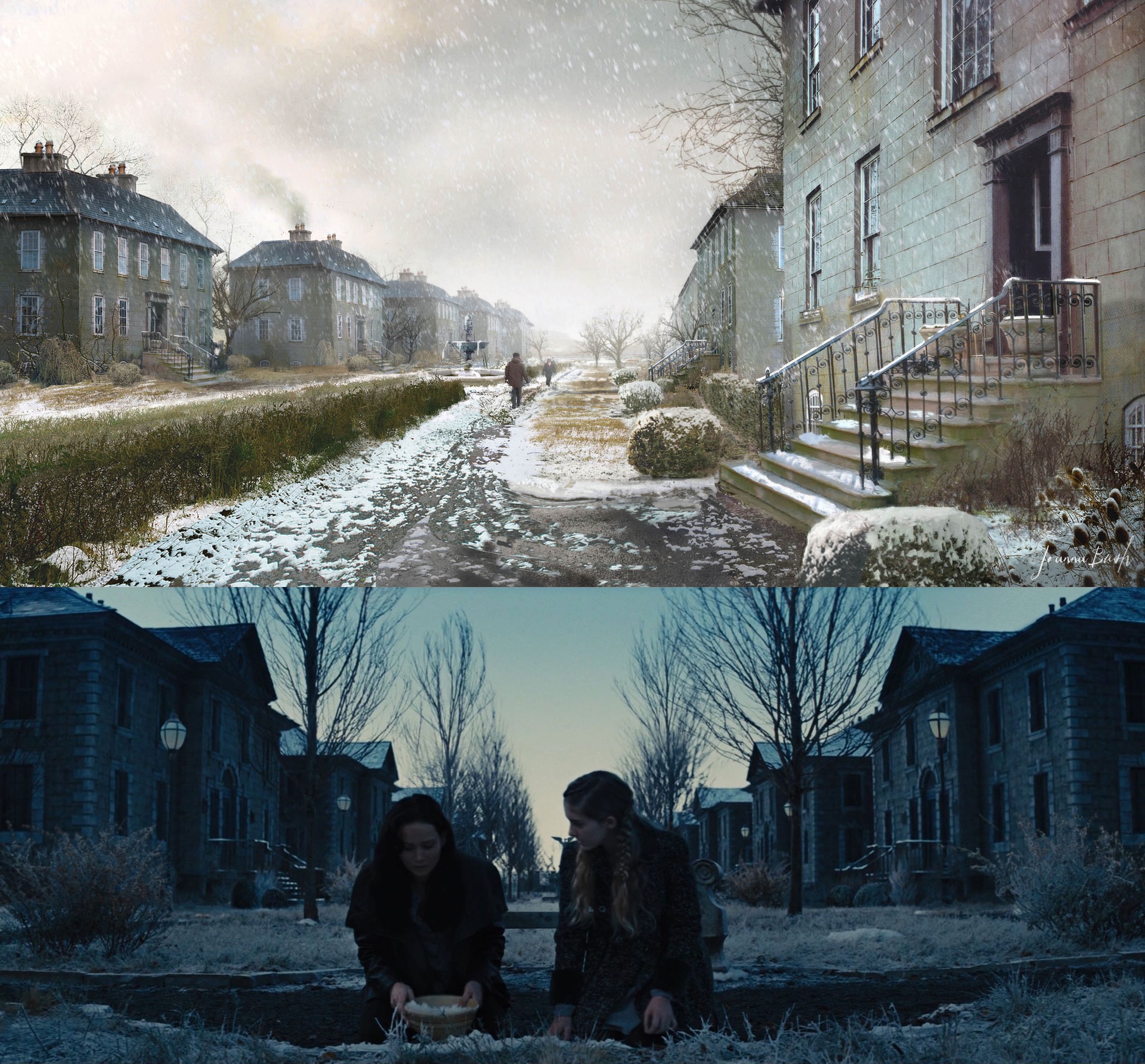
Top: concept illustration for Victory Village in District 12 by Joanna Bush, courtesy of Philip Messina. Bottom – still from “Catching Fire”.
Continue reading »
Continuing the ongoing series of interviews with creative artists working on various aspects of movie and TV productions, it is a great honour to welcome Alex DiGerlando. In this interview Alex talks about his experiences in the art department in the last 15 years, the changes that digital has brought with it and how it affects the world of feature and episodic productions, the evolution of cinematic storytelling in the world of episodic television, physicality of sets and digital set extensions, and the importance of defining and creating history for each and every set. Midway through the interview we talk about his work as the production designer on the “Beasts of the Southern Wild”, and then dig deep into the strikingly designed worlds of the first two seasons of “True Detective”.
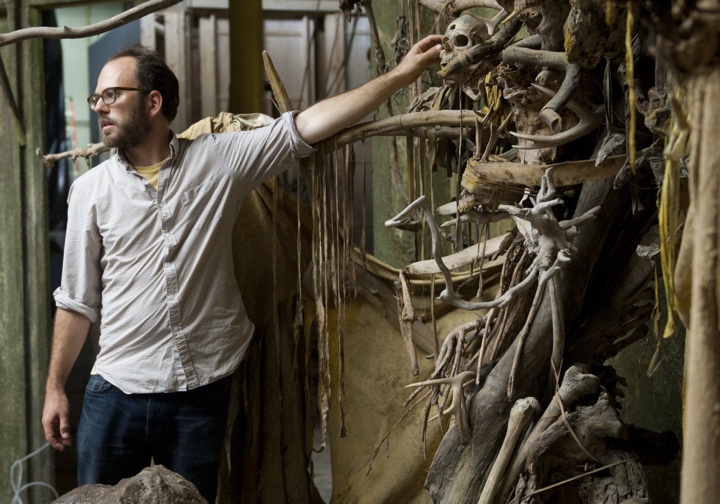
Alex DiGerlando on the set of “True Detective”. Photography by Lacey Terrell.
Kirill: Please tell us about yourself and how you started in the field.
Alex: I was always interested in the movies. My uncle is a film editor, and I grew up visiting him on sets and going to his office in New York and watching him cut together scenes. That always seemed exciting to me, especially since I liked movies so much.
I went to NYU to study film theory in the Cinema Studies department. I worked with a lot of my friends who were in the film production program, but my studies were purely theoretical so I didn’t have any technical training. At that time I was working as a development intern for Ted Demme’s production company, Spanky Pictures. I was learning about films from script and development side, and another intern who was working there was making a short film for class and asked me if I would help.
We went to her grandmother’s house to shoot this film, and I felt out of place because I didn’t have anything to offer in terms of using lights or loading the camera or anything like that. But what I did notice was that no one paid any attention to what the space would look like. They just thought that they’d just shoot at the house, but they didn’t think anything beyond that. I, not really knowing what to do with myself, started poking around.
I found these old cameras, thinking that they might be cool for the characters, so I put them out and dressed them onto a shelf. I kind of took it upon myself to make this room a little bit messy to go with the character, and the director really liked that. She empowered me to go for it, and that’s what I did. It sort of happened by accident. It was even before I ever thought about doing this for a living or before I was really all that conscious of production design as a job.
Kirill: So you discovered the field of production design by yourself.
Alex: I didn’t even know what it was. The room looked empty to me, so I thought I’d better make it look better. The bathroom was too clean, so I brushed my teeth and spit the toothpaste into the sink to make it look like a slob lived there. Doing these little things that I was not taught to do but were just instinctual.
From there I started becoming interested in the art department. At that time, at NYU there wasn’t much focus on the art department, so a lot of kids were just not thinking about it when they were making their films. Or, when they did think about it, they were spread too thin, leaving it by the wayside. So a lot of my friends started asking me to work on their films in that capacity.
And then, when I was in my senior year, Jon Kilik, a friend of the family who is a producer that works with Spike Lee a lot, told me that Spike’s art department was looking for a PA [production assistant] on “Bamboozled”. I was really excited about that idea, even considering taking a semester off. It would’ve been my last semester to go work on that, and Jon said that I should finish school, but maybe I could do an internship. That’s what I did. I ended up working a couple days a week in the art department of “Bamboozled”. And then, finally full-circle, I just designed Spike’s last movie “Chi-Raq”. So it began with Spike and it has come back to Spike.
Once I started PA’ing in the art department, I did that for a long time before I designed. I met up with Mark Friedberg, who really became a close friend and mentor. I worked for him for many years, and he started giving me more and more responsibility.
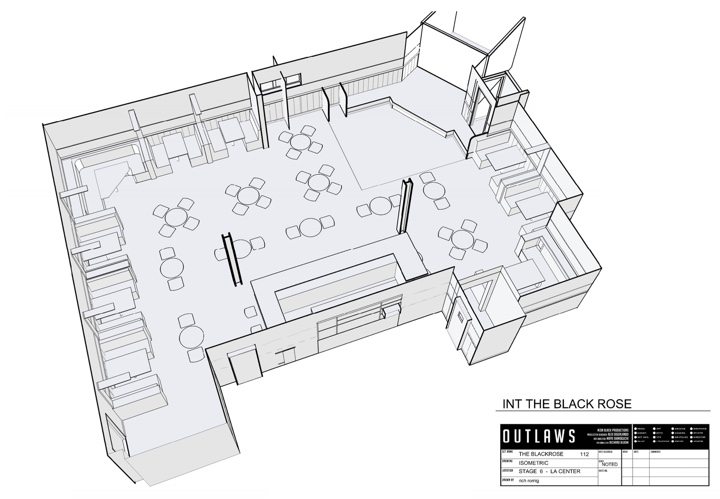
Isometric floor plan of “Black Rose” bar set in season 2 of “True Detective”. Courtesy of Alex DiGerlando.
Kirill: What kinds of changes have you seen in the last 15 years since you’ve started working on features and TV shows? Is there anything that affected you in the transition from film to digital? Is there any difference for you between the two?
Alex: Not really. There are little things. Working my way up through the art department, I learned the time-tested way things were done – what kind of colors are good on film, for example. When I was a PA, there was always the talk of avoiding white, and printing every prop piece of paperwork on off-white or cream or grey paper, because that would read as white, but it wouldn’t blow out the camera. And I see less of a necessity for that.
I don’t know if it’s the quality of video that is more forgiving, or if it’s just working with younger DPs [directors of photography] who are less put off by the effects of white. On both seasons of “True Detective” we did a lot of sets with white walls. Years ago, when I was learning about the art department, that was always described as a no-no, unless the scene specifically called for white walls for dramatic reasons, and even then you had to find the perfect shade of grey that would read as white.
That’s a change. I think there’s a little bit more freedom to embrace things as they are. It’s similar to how for years in the film industry, going way back, if you found a lens flare in your dailies, you would have to reshoot. That was considered a mistake. And somewhere in the 70s people started embracing the lens flare and looking at it as a benefit or an aesthetic choice. Now there are certain things that come along with video that are similar in that respect.
Video cameras are also a lot more sensitive in some ways than film, and a lot of DPs that I work with now are much more interested in using practical lighting – physical lights and fixtures that you see on-screen as opposed to movie lights that are behind the camera. A lot of my job has become working with the DP and the gaffer to light the scenes, because all the lighting is coming from within the set. Back in the day you would place lamps, but ultimately there would be a soft box on ceiling or movie lights strategically placed that were going to do the heavy lifting of the lighting.
Adam Arkapaw [cinematographer] on True Detective season 1 used lights when they needed to, but so many of the sets had the bulk of their lighting from practicals. And then sometimes he would hide LED strips under ledges or behind furniture to give definition.
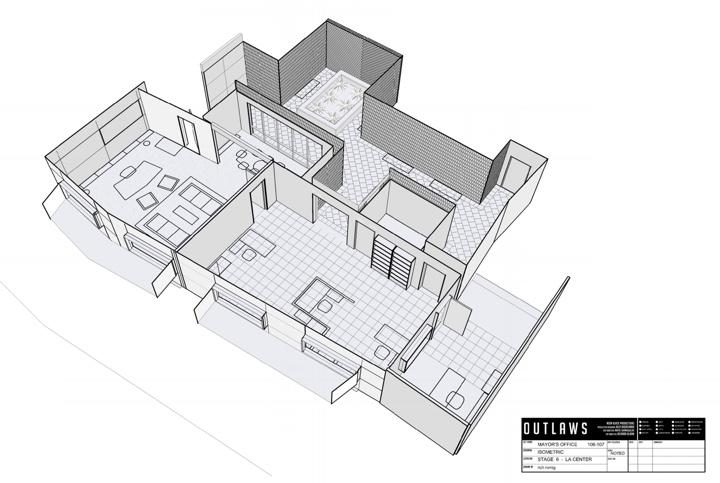
Isometric floor plan of mayor’s office set in season 2 of “True Detective”. Courtesy of Alex DiGerlando.
Continue reading »
