A move towards UI consistency in Windows 7

Once a subject of heated discussions, the native vs. cross-platform skinning has not been mentioned for quite some time in Swing blogosphere. While this post by no means aims to revive the dead ghosts, i saw something quite interesting in the PDC session on the Windows 7 Explorer. It looks like (at least in the current builds) Microsoft has decided to enforce better consistency across the UI layer of its flagship desktop products, including Office and Media Player. This specific issue has been brought as one of the major arguments against using a native look-and-feel (because the lack of consistency effectively meant that there is no native look-and-feel).

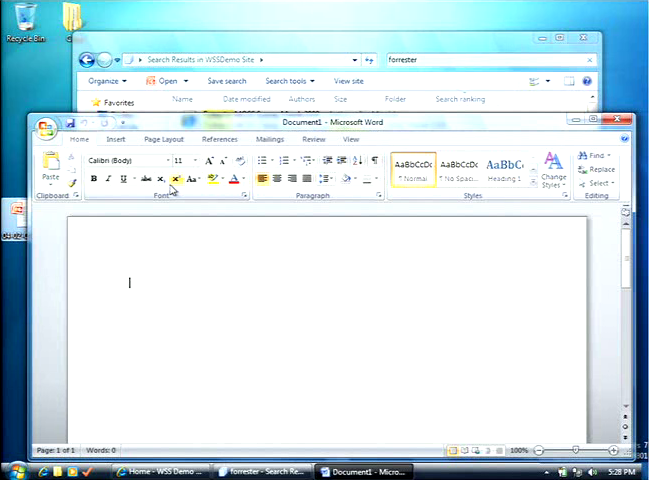
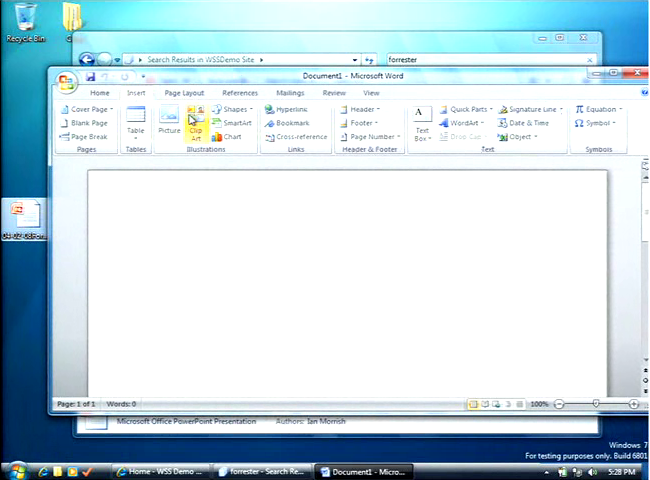
The following three screenshots show (what i presume to be) the next version of Office running on Windows 7. These were taken from the video stream and the quality is not the best, but the overall trend is still quite noticeable. The landmark Office ribbon that was skinnable as silver / blue / black in Office 2007 is now consistent with the platform look-and-feel (read more about the scenic ribbon in the PowerPoint slides of this PDC session). I’m not sure whether the presenter meant to show the new look of Office, or even if this is the final look. However, the screenshots clearly show that the ribbon UI is now much more consistent with the the rest of OS, including the colors, gradients, the glass chrome on the title pane and other UI bits (click to see full size view):
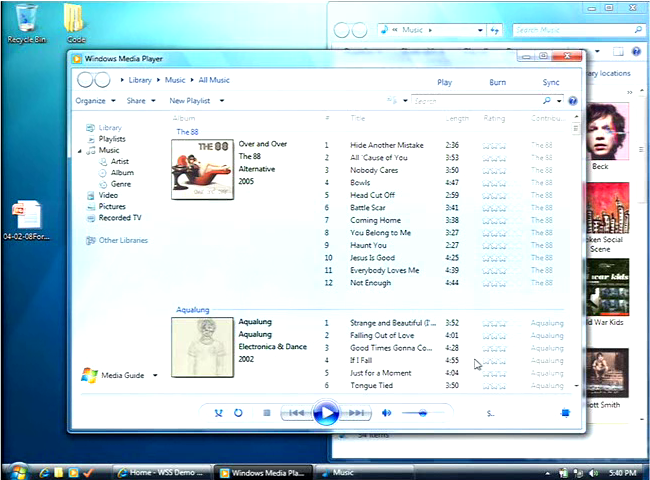
The same goes for the Windows Media Player. The screenshot below (click for full size view) shows a somewhat partial UI in the top bar (no icons on the twin round buttons), but the heavy glossy black / dark blue chrome found in the current Media Player UI is (at least for now) gone:
Standardizing the UI look of different bundled and add-on programs in Windows 7 is an interesting trend that is worth following in the months to come.


Related posts:

  1. Microsoft, Windows and High-DPI awareness High-DPI awareness has been the subject of the presentation that i held with Mike Swingler...
  2. More tricks with translucent Swing windows The java.net site has just published my article on translucent and shaped windows, and it...


2 Responses to “A move towards UI consistency in Windows 7”

  • bob Says:

    Wanna play Ketchup?

    Native widgetry on any platform is a joke. Yeah im sure the point of Windows 7 is to “play nice” with cross platform languages.

    Are you kidding me? Grow up dude.

  • Rick Jelliffe Says:

    One of the great favours that Microsoft has done for us with the Ribbon interface is that it really messes up the glib procurement requirements of the recent past: that software must be CUA compliant, or that an interface must be “Word-like” (very common that one.)

    If even such a conservative, “catch-up at version 3″ kind of company as Microsoft admits that WIMP/CUA/old-Word interfaces are under-performers, that should have *some* credibility.

    And if, now, both Microsoft and Apple (and HTML5?) have different sets of UI widgets than they did when Swing was first developed, it really makes attempts to make exact replicas of GUI skins seem a bit lame, doesn’t it. The ground has shifted.

    If the platforms have quite a bit of variability between applications, that works in favour of Swing applications: their fidelity to the native look and feel merely needs to be “within the range of variation” not absolute. And if there is less need for perfect emulation, there is more scope for support for a wider range of widgets.

    The current position with Java and Swing shows what Sun gave up by refusing to make Java part of a meaningful independent standardization process: by meeting Sun’s requirements, they have guaranteed that other’s requirements and constributions have been ignored.

    Without standardization through an independent organization, the big picture issue of whether WORA was workable for graphics without an aggressive project to track widgets from other platforms. Instead of seeing Microsoft’s J++ debacle as a sign of something other than bastardry, and instead of seeing IBM’s SWT as another example of the same legitimate requirement, Sun was able to bury the technical issues underneath marketing concerns. Participation in a real standards process could have allowed the technical issues to be aired independently of marketing concerns.